


Big tech’s lofty missions turn ordinary jobs into moral callings, leaving staff so invested that they struggle to walk away, according to two former insiders.
The pattern took hold in the 2000s, when joining a tech giant felt like joining a movement rather than taking a job. It is now resurfacing at fast-growing artificial intelligence (AI) labs, which tell recruits that their work is about saving humanity itself.
“I sometimes see people starting at companies like Anthropic and OpenAI, and it’s like a kid in the candy shop. There’s a lot of excitement and promise, and a sense of ‘I bear this duty and responsibility to humanity now that I work here,’” said Claire Stapleton, a former communications leader at Google and author of “Don’t Be Evil: Bad Bosses, Fake Promises and My Escape from Big Tech.” “That’s a kind of comical imbalance of power between employer and employee.”
“It doesn’t make it just a job; it makes it a sort of moral imperative,” she said. “It certainly is great for getting people to work hard and be committed to the mission of the company. But as it goes with these companies, that can become very complicated over time.”
Stapleton, who joined Google in 2007, said the company once promised to solve humanity’s problems. She said Anthropic’s rhetoric now pitches saving humanity instead, and both messages help explain why these companies should hold so much power.
“The companies are very savvy at using narrative to get operating room to do what they’re going to do. Cloaking things in quite moral and existential language is incredibly helpful to them,” she said.
Kristi Coulter, a former Amazon executive and author of “Exit Interview: The Life and Death of My Ambitious Career,” said lofty messaging is starting to hurt hiring.
She said she has met probably hundreds of people who refused even a first call with Amazon recruiters, because the gap between what the company says about itself and the stories people have heard has become too wide.
“Do I want to feed myself into something that’s been described as a meat grinder? Maybe not. So I do think it can be self-destructive in some ways to paint too lofty a picture,” she said.
“It’s a very human impulse to want to be part of something bigger than ourselves, and to do work that feels meaningful in the world. It’s just that tech has a difficult time delivering on that, and that can create these friction points,” Stapleton said.
She said companies should still try to stand for something, but the emotional bond that results with staff is complicated.
Island of misfit toys
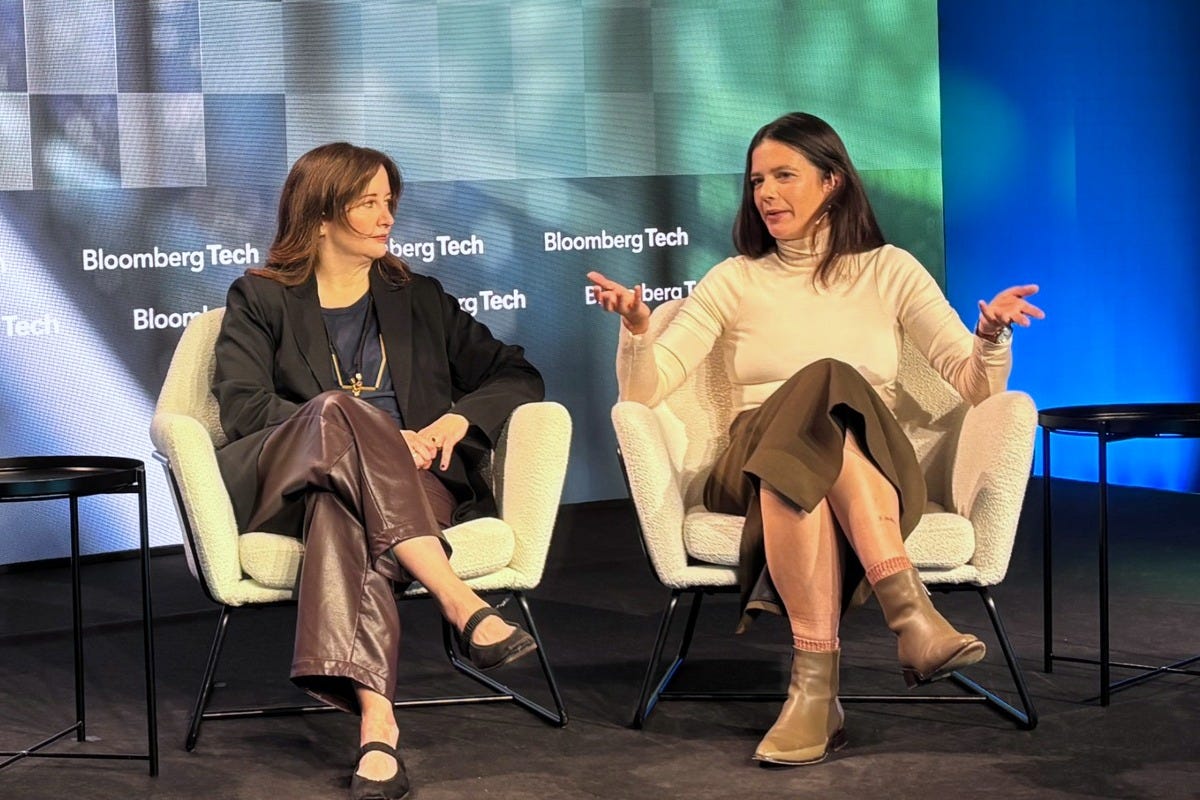
The comments came at a panel titled “The Human Cost of Big Tech” at Bloomberg Tech London on November 3. Amy Thomson, managing editor for Europe, the Middle East and Africa (EMEA) at Bloomberg, moderated the session.
Coulter, who worked at Amazon from 2006 to 2018, said it had about 5,000 Seattle staff when she joined. As headcount swelled toward 100,000 on a campus, many senior hires from conventional companies questioned its frugal habits.
“Amazon had been a place where quirky people were welcomed. We called it the island of misfit toys sometimes,” she said. “As it grew, that just inevitably started to fall away, and it got much more cookie-cutter.”
“Amazon struggled with the need, on the one hand, to cling to these leadership principles, which were good and thoughtful, and on the other hand, with not knowing how to scale them across this vast employee base,” she said.
Stapleton, who worked in Google’s internal communications, said the story it told staff diverged from reality as the company grew. She said its weekly TGIF (Thank Goodness It's Friday) staff meeting once welcomed dissent, but the company later curbed political talk on its intranet.
“It became a more conventional company, but they continued to insist on the moral language, the idealistic spirit. It fomented this natural sense of disillusionment, of falling short of the values,” she said.
“The trade-off that Google was willing to make was to shred some of these tenets of the open culture in service of having more control for the executives and a clearer line of power,” Stapleton said.
In 2018, she helped organize a walkout by about 20,000 Google employees over the company’s handling of sexual harassment claims. She left the following year.
“That was an accountability moment. And their response to it was basically to get rid of everybody,” she said.
Coulter said Amazon staff in the early days could not even speak on panels to promote the company, and she has seen a fair number of people fired for speaking out. They include former coworker Maren Costa, a 15-year Amazon veteran who helped lead staff climate activism and was fired in April 2020.
“What I see is more of a willingness of people to take that risk, and say, well, let’s see what happens, maybe they’ll fire me and maybe they won’t. Personally, that feels healthy to me,” she said.
“You are seeing a lot of people do it on the way out, which says to me that there’s less tolerance for disagreement internally,” Stapleton said. “Disagreement internally is important, whether or not it’s expensive.”
Executive brain rot
“Becoming a huge executive at one of these companies is akin to brain rot. It’s like phone addiction. It is something that you have to actively fight against to maintain your humanity,” Stapleton said.
She said Google long prided itself on a flat structure and on limiting manager power. As its business units grew, executives gained profit-and-loss responsibility, strategy staff and fleets of assistants who catered to their every need, and people found it harder to challenge them.
Coulter said Amazon founder Jeff Bezos changed outwardly over her years at the company but kept the same attention to detail.
“I argued with him about two or three words in a statement with the same granular detail that he would have argued with me a decade before that. So he was still the same guy,” she said.
Amazon officially said nothing about Coulter’s memoir, and Google did not comment on Stapleton’s book before publication.
Both authors said they had thought about Meta’s response to former executive Sarah Wynn-Williams, who was temporarily barred from promoting her memoir “Careless People: A Story of Where I Used to Work” by an emergency arbitration ruling in March 2025.
Coulter said men at Amazon wrote to say that, apart from the gender aspect, she had told their story too.
“There were so many women who I had thought of as just untouchable, these rare senior VPs (vice presidents) at Amazon, who wrote to me to say, ‘I felt like that every day,’” she said.
Asked what they would tell a 25-year-old woman considering a job in big tech, Coulter said to build skills that can take them beyond the industry if and when they are ready to move on, such as project management and emotional intelligence, rather than only learning to code.
“Being a little mercenary is not the worst thing if you’re a young person, especially a young woman who’s prone to give and give and give,” she said.
Stapleton said young recruits should get the most out of big tech, from skills and friendships to stints in cities such as London and Singapore, but should not mistake a career for a moral purpose.
“There’s so much to give and get in any job, but it can’t be your whole life,” she said.
Her final piece of advice for young women entering big tech was to have an exit plan ready for when the time comes.