


Quantum computing is beginning to find a concrete footing in financial services. Banks and technology providers are targeting specific problem areas, including risk modeling, portfolio optimization, and machine learning acceleration.
Rather than waiting for fault-tolerant machines, institutions are focusing on areas where incremental gains in computation and decision-making can deliver measurable value in complex, compute-intensive workflows. With hardware still under development, experts are prioritizing financial use cases that can be advanced today through quantum-inspired methods and preparatory work.
“We can do modeling of probabilistic systems, improved optimization, and quantum machine learning,” said Dr Ellen Devereux, quantum computing consultant at Fujitsu. “There’s a lot of hype because there’s a lot of promise, but the reality is we’re not yet ready to take advantage of those.”
“Where is operational and mathematical complexity? Where is it expensive to solve a problem, both mathematically and economically? Those are areas where you might want to focus your efforts,” said Franco Severini, CTO for financial services at Fujitsu.
The focus on use cases reflects a broader industry shift. Quantum computing is no longer framed as a distant research ambition but as a tool to address specific inefficiencies in existing systems.
In transactional environments, even marginal gains can translate into meaningful financial impact. Severini said improvements in throughput or decision-making can directly affect revenue, particularly in high-frequency or large-scale operations.
This is most evident in portfolio construction, derivatives pricing, and liquidity management, where complexity scales rapidly. Classical systems often rely on approximations, while quantum-inspired approaches are being tested to explore larger solution spaces more efficiently.
Practical value
Financial institutions are grounding quantum initiatives in business-led problem-solving rather than in theoretical exploration.
“Everything we do is partnering with the business unit that owns a strategic problem,” said Dr Phil Intallura, head of quantum at HSBC. “We look to beat what we’ve got by really building understanding and readiness for this technology.”
This approach reflects growing pressure on technology teams to deliver near-term value, even as hardware remains in development. It also aligns with the use of quantum-inspired algorithms on classical infrastructure, allowing firms to experiment without waiting for full-scale systems.

The shift is often compared with earlier waves of artificial intelligence (AI) adoption. While AI can be layered onto existing workflows, quantum computing requires a deeper transformation. Problems must be reformulated, data pipelines redesigned, and outputs interpreted within probabilistic frameworks. Early experimentation is therefore critical.
In practice, firms are adopting hybrid strategies. Classical systems handle most workloads, while quantum-inspired methods are applied selectively to high-impact components. This allows firms to validate improvements without disrupting core infrastructure, particularly in legacy environments.
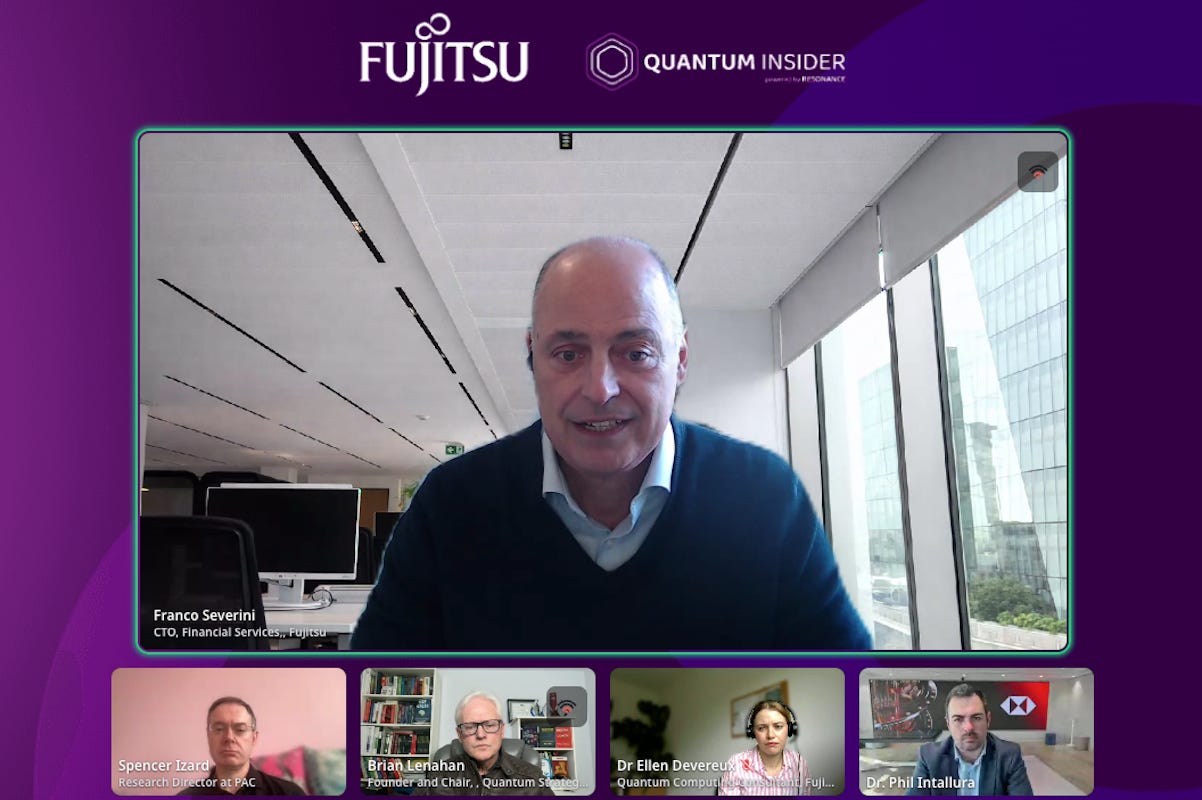
The discussion took place during a webinar hosted by Fujitsu on March 23, 2026, moderated by Brian Lenahan, founder and chair of the Quantum Strategy Institute. The session examined how quantum technologies are moving from experimental research to business-relevant applications in financial services.
Severini said expectations have become more grounded as the technology matures.
“The hard part isn’t proving something in a lab. The hard part is making a solution that survives in the production environment and gives value to a business,” Severini said.
He said industry perception has shifted. A few years ago, some clients questioned whether quantum computing was real. Today, the focus is on identifying where it can deliver tangible benefits.
This shift is influencing how organizations allocate resources. Companies are prioritizing use cases that integrate with existing systems and deliver incremental gains, rather than pursuing disruptive overhauls that may take years.
Readiness and risk
Despite clearer use cases, Devereux and Intallura said value will depend on preparation rather than immediate capability.

“We can start to develop algorithms and applications and use cases and research that help us understand where quantum computing will provide value,” Devereux said. “We can build that pipeline so that as soon as those quantum computers are available, we can take advantage of them.”
For large financial institutions, this requires rethinking how problems are structured, as quantum systems demand fundamentally different approaches than classical computing.
“The readiness curve is very steep,” Intallura said. “It’s about how you identify the use cases, deconstruct and reconstruct the problem, and build the data pipelines.”
He said organizations that want to move quickly must invest early in internal capabilities and align them with business priorities. This includes building cross-functional teams that combine domain expertise, quantitative modeling, and emerging quantum skills.
He added that adoption will not follow the same path as earlier technologies. Unlike AI, which can often be integrated with limited restructuring, quantum computing introduces a fundamentally different computational paradigm. Institutions must rethink workflows from the ground up and identify where quantum methods can complement classical systems.
Quantum computing is increasingly viewed as a risk management issue, particularly in cybersecurity and encryption.
“When you look at the impact quantum computing can have on our organization, it’s very large,” Intallura said. “It’s hundreds of billions of dollars over the next 10 years, but equally, the threats are very significant.”
The risk that quantum algorithms could break existing encryption standards is prompting governments and financial institutions to prepare for post-quantum cryptography.
“There’s a specific type of security concern related to Shor’s algorithm that is a threat to public key cryptography,” he said.
Shor’s algorithm, developed by mathematician Peter Shor in 1994, enables quantum computers to factor large numbers far more efficiently than classical methods, undermining widely used encryption systems such as Rivest-Shamir-Adleman (RSA).
Institutions are also assessing operational risks linked to premature adoption. Deploying immature solutions into critical systems could introduce instability, reinforcing the need for phased implementation and rigorous testing.
Talent and policy
Progress is constrained by a shortage of talent capable of bridging quantum computing and financial services.
“There’s still a talent bottleneck across the board,” said Spencer Izard, research director at Pierre Audoin Consultants (PAC). “There is a distinct scarcity of professionals who can bridge the gap between financial concepts and quantum capability.”

This gap is slowing the transition from proof of concept (POC) to production.
“A lot of proof of concepts are stalling at the implementation phase,” Izard said.
To address this, institutions are upskilling existing quantitative teams rather than relying solely on external hires.
“It’s operationally faster to teach a quant how to use a quantum capability than it is to teach a physicist the nuances of financial regulation,” Izard said.
Organizations are also creating roles focused on translating business problems into quantum-ready formulations.
The discussion comes as the UK government increases its focus on quantum technologies, shifting from research-led initiatives toward commercialization and adoption.
“What the UK manages to do on a consistent basis is build an ecosystem that works well together,” Devereux said. “There’s not a single big player winning, and that builds a more competitive environment.”
She said recent policy developments place greater emphasis on practical deployment and business integration.
“The commitment this time is a lot more commercially minded,” Devereux said. “It’s a bit less about research and more about adoption and building a business.”
For financial institutions, the timeline is becoming more tangible.
“Five years is actually quite a short timeline for some of these big businesses,” Devereux said. “Starting to prepare those use cases and the business more broadly needs to happen sooner rather than later.”
As quantum computing moves closer to viability, the industry focus is shifting from speculation to execution. The ability to translate theoretical potential into operational advantage will define competitive positioning.