


Quantum computing is approaching the moment when it stops promising an advantage and starts proving one.
The industry has spent years building noisy, error-prone machines while racing toward a fault-tolerant generation that can run far longer without losing accuracy to errors. That generation is arriving faster than many expected.
Mihir Bhaskar, senior vice president of global research and development at IonQ, said IonQ already sees advantages in hybrid workflows.
"We can program noisy devices to do things that are not directly simulatable on classical computers," he said. "We're starting to crossover into an interesting new regime of physics, but we're not yet in that regime for fault-tolerant quantum computers. We are just building the first fault-tolerant systems."
“We just published two results, one about our architecture, a compiler blueprint, and one on hardware testing showing that we are beyond the thresholds needed to start correcting these errors.”
“It’s not 10 years away. That is way too long of a timeline. The systems we are pushing and building in the lab now are really starting to cross this frontier,” he said.
Several other companies have recently reported progress in fault tolerance, but Bhaskar said the gains are now measured in orders of magnitude.
Krysta Svore, vice president of applied research in quantum computing at Nvidia, said proving an advantage mathematically does not guarantee a practical one. She cited Grover’s algorithm, a method for searching an unsorted database faster with a quantum computer, whose proven advantage does not yet reflect how fast real hardware runs.
“I don’t want a runtime that is 10,000 years,” she said. “I want a runtime that’s maybe a week or a day.”
“What really matters in practice is that it’s better than something we’re doing already,” she said. “That can come in different forms, but often it means something more accurate that takes less time. We just need to show that we can do this over and over for an interesting and practical problem.”
She pointed to the US Department of Energy’s target of a quantum system delivering scientific advantage by 2028, with 100 to 200 logical qubits and a logical error rate of 10-08.
Artificial intelligence (AI) must be integrated directly into the qubits to make them less noisy and more reliable, she said.
The ecosystem turns commercial
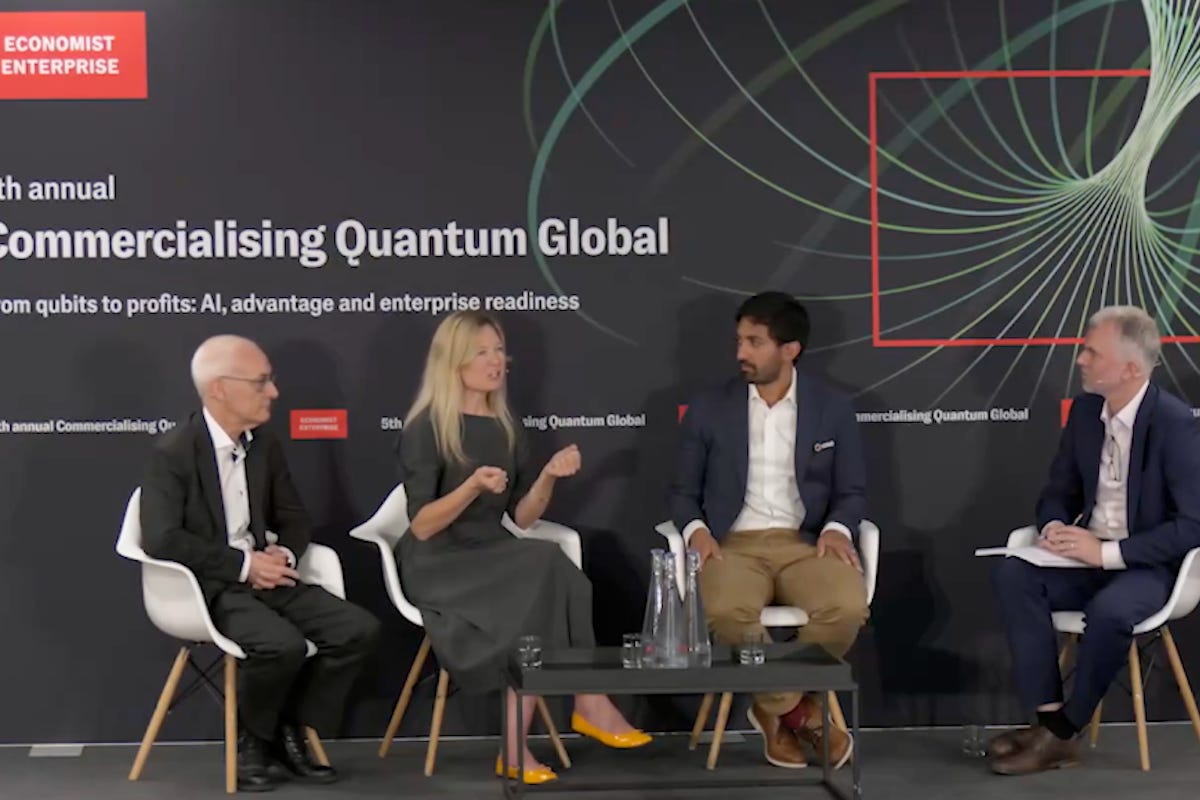
The panel was held at the fifth annual Commercialising Quantum Global conference, organized by Economist Enterprise, in London. Moderated by Andrew Palmer, executive editor of The Economist, the session examined what is real and what comes next in quantum computing.
Also on the panel was Leigh Lapworth, a fellow in computational science at Rolls-Royce who has spent decades applying computational fluid dynamics (CFD) to jet engine design.
Bhaskar said IonQ already sells quantum computers in multiple ways, from cloud access to dedicated on-site systems.
“IonQ commercializes quantum computers in multiple ways. We have quantum computers available on all three public clouds, so if you have an AWS account, you can log in and use that to access our quantum computers and run algorithms on them,” he said.
Its newest machines are typically deployed on-premises for dedicated enterprise and government use.
“There are a lot of enterprises now that want to be early in this, and they really want to be aggressive with their quantum strategy,” he said.
“As a scientist who was working in a lab on grants 10 to 12 years ago, the fact that we deployed over $300 million in quantum R&D last year is unthinkable,” he said. “But that’s what the economics justify, because we have to keep investing to relentlessly innovate.”
Svore said Nvidia is focused on building the software layer that enables developers to combine quantum processors with graphics processing units (GPUs) and central processing units (CPUs) in a single workflow.
“We need a platform that enables programming and developing across quantum, GPU and CPU systems as one system, and that’s what we’re doing with CUDA-Q,” she said. “It brings QPUs (quantum processing units) into that platform, so quantum kernels can be used alongside classical kernels.”
CUDA originally stood for Compute Unified Device Architecture, Nvidia’s platform for building accelerated GPU programs. CUDA-Q extends the same approach to quantum hardware, allowing developers to target both simulators and real machines from a single platform.
“Other examples are also in computer-aided design,” Svore said. “We work with Ansys, and we’re actively working with Ansys on these problems where the quantum mechanics actually matters. Ansys’s tools are used to design semiconductor devices that are now operating at a limit where the features are so small that quantum mechanics matters.”
“We need domain experts participating, whether in computational fluid dynamics such as at Rolls-Royce, or elsewhere,” she said. “What’s exciting right now is that we have agents that can help with that. Going forward, you won't sit down and write the program yourself. An agentic workflow can help domain experts become quantum experts.”
“Designing quantum error-correcting codes is an extremely complex branch of quantum science and engineering that we are inventing as we speak,” Bhaskar said. “Our ability to iterate through different error-correction codes at IonQ has been accelerated massively by using AI.”
The race to readiness
Lapworth said Rolls-Royce made its boldest quantum bet five years ago, well before any error-corrected machine existed.
“My background is in computational fluid dynamics, modeling the flow of air through a gas turbine,” he said.
“From the start we decided to go for the fault-tolerant era of logical qubits, and that has proven to be a benefit. When we took that decision about five years ago, the timescale for error-corrected machines was probably 10 years away.”
Lapworth joined Rolls-Royce in 1987 after a doctorate in CFD and has built the company’s own simulation codes ever since.
“The message was all about quality. It was the better answer. We were prepared to pay the extra computing costs because it gave better answers,” he said.
“If a code is 25 years old and you tell me you can run it twice as fast, I’m not going to be interested. If you say it’s 10 times as fast, I might be interested. If you say 100 times as fast, yes, I’m definitely interested. If you say you can give better answers, then yes, definitely interested.”
Lapworth said the team has relied heavily on external collaboration, including three Innovate UK-funded projects, one of which is with Xanadu in Canada.
“When we add up the number of people who have worked with us on those, at different points, we get to about 30,” he said. “That is a huge leverage of the four people that we have.”
Bhaskar raised a different kind of risk, one that touches every company, not just those actively experimenting with quantum hardware.
“One of the things that quantum computers can do is disrupt the conventional ways we have done public key encryption, and that’s something every enterprise needs to think about,” he said.
“As of 2024, we’ve had NIST-validated PQC (post-quantum cryptography) algorithms. It’s just a matter of time before quantum computers have the capacity to disrupt encryption, and that needs to be a conversation happening in boardrooms as well as governments.”
Asked what businesses should actually be doing to prepare, Bhaskar said the answer starts with a plan.
“We need a quantum readiness plan. Bringing your domain experts forward and empowering them to learn the opportunity within this technology stack is really important,” he said.
“We need real data sets and practical benchmarks to understand if quantum systems are even working, and we don’t want everyone to just wait for the ecosystem to figure it out.”
“This starts with scientists, research institutes and national labs,” he added. “That’s where the core of a lot of this work is right now. From there it expands out to companies like AstraZeneca and Rolls-Royce, whose R&D teams can start to engage as well.”
Looking a few years ahead, Svore said the pieces are already coming together.
“We will have integrated workflows where we see advantage for science,” she said. “You are taking data from a fault-tolerant quantum computer, feeding that into an AI model, and what you end up deploying is a classical model. The piece that’s needed is this hybrid workflow, and we hope to do this with CUDA-Q.”
With the US Department of Energy targeting 2028 for a scientifically useful fault-tolerant machine, the panel’s own expectation of integrated AI-quantum workflows within the next few years suggests the industry is converging on the same narrow window to prove its case.