


Falcon Finance, a digital asset infrastructure provider, is targeting the fast‑growing tokenized real‑world assets (RWA) market, betting that decentralized finance will converge on a single collateral layer that accepts crypto, Treasuries, gold, equities, and sovereign debt to unlock liquidity and improve capital efficiency across digital finance.
The tokenized real‑world assets (RWA) sector is expanding quickly but remains fragmented. Large volumes of tokenized collateral remain underutilized because yield products are scattered across platforms, asset classes, and jurisdictions, limiting institutional participation and scalability.
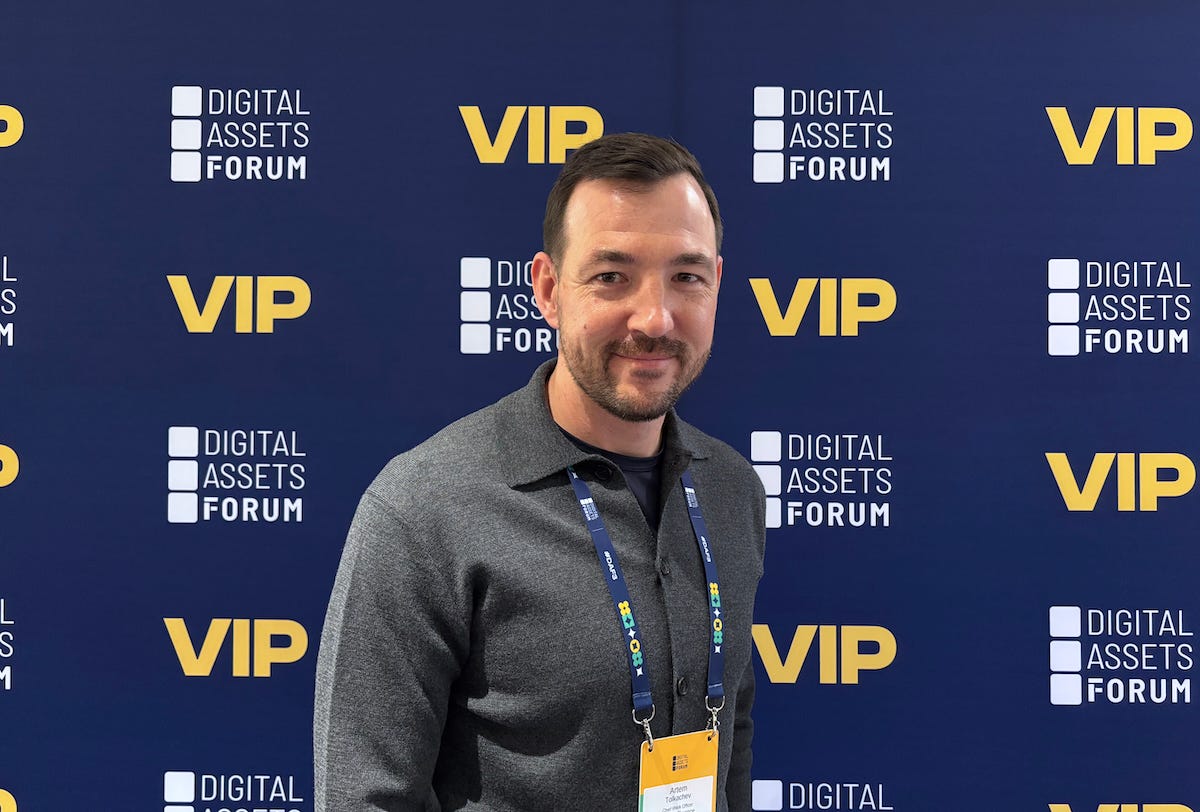
“Falcon’s platform connects collateral types including major digital assets and tokenized instruments—such as gold, equities, and sovereign bonds—into a unified collateral layer intended to support steadier, structured yield,” Artem Tolkachev, Chief RWA Officer at Falcon Finance, told TechJournal.uk in an interview during the Digital Assets Forum in London on February 4.
He said this approach is designed to improve the deployment of tokenized collateral across TradFi (traditional finance) and DeFi (decentralized finance).
“I don’t see any demand from TradFi users for real-world assets at the moment,” he said. “Most of what they’re doing is experiments and building infrastructure for future usage and pilot projects.”
The strategy centers on Falcon’s synthetic dollar, USDf, minted using crypto and tokenized real‑world assets as collateral. The model aims to provide cross‑asset liquidity while keeping users inside the digital asset ecosystem.
The company recently launched a $50 million ecosystem fund to accelerate infrastructure around structured yield products and tokenized collateral. The initiative supports teams building tools that increase demand, circulation, and composability across decentralized finance.
Market evolution
Tolkachev outlined the firm’s ambition during the Digital Assets Forum in London on February 4, describing a universal collateralization infrastructure that allows users to deposit tokenized assets and access liquidity without relying on traditional banking rails.
“Basically, we’re building universal collateralization infrastructure that allows users to use whatever assets they have, crypto or real-world assets, and mint a synthetic dollar, USDf, in exchange,” he said. “The idea is we’re providing liquidity to any type of collateral that you can bring if this collateral has decent price discovery and liquidity.”
Falcon began as a crypto‑collateralized stablecoin platform in early 2025 before expanding into tokenized real‑world assets, starting with U.S. Treasuries and later adding corporate debt, tokenized gold, and equities. Among the corporate credit products is a collateralized loan obligation fund managed by Centrifuge under the ticker JAAA, which Falcon accepts as part of its collateral framework.
Its collateral mix now includes tokenized Treasury products, corporate credit funds, gold, equities, and non‑U.S. sovereign debt such as Mexican treasury bills. The company aims to build a diversified collateral base similar to traditional finance portfolios.
The ecosystem fund combines capital and incentives to back teams building fixed‑income products, precious‑metal strategies, and risk infrastructure. It prioritizes projects with working products and clear paths to adoption.
Adoption gap
Despite rapid growth in tokenized Treasuries and private credit, Falcon believes institutional adoption remains limited because traditional financial institutions already have access to these assets through existing infrastructure.
“There is no reason for TradFi to use tokenized assets instead of regular assets,” he said. “They already can buy treasuries, corporate debt, or gold using their regular rails. Tokenized versions can be more expensive and require additional legal and compliance work.”
The main advantage of tokenized assets—instant liquidity through stablecoins—does not yet align with institutional operating models.
“This instant liquidity is in the form of stablecoins, and TradFi is not operating with stablecoins on a daily basis right now,” he said. “I see it’s going to change, but we’re not even close.”
Falcon expects regulation to be the main catalyst for adoption. Tolkachev said the surge in tokenized Treasury products in 2025 was partly driven by regulatory changes, including the Guiding and Establishing National Innovation for U.S. Stablecoins (GENIUS) Act, signed into law on July 18 last year, which created a comprehensive regulatory framework for stablecoins.
He added that yields rivaling those of decentralized finance also helped accelerate momentum.
“I think it hugely depends on regulation and institutional adoption,” he said. “Institutional adoption usually follows regulation because institutions are risk‑averse and want to be sure everything is compliant.”
The company is cautious about more exotic tokenization projects because pricing and liquidity remain major obstacles.
He said the biggest challenge for more experimental real‑world assets is price discovery, noting that decentralized finance requires continuous, real‑time pricing rather than periodic valuations.
He added that the firm evaluates how collateral could be redeemed in stressed scenarios, citing niche or experimental tokenization attempts—such as uranium, real estate, and collectibles—as examples of assets that remain difficult to price consistently and liquidate quickly.
Emerging markets
Falcon is expanding beyond U.S. dollar‑denominated assets to diversify collateral sources and reduce reliance on a single currency.
“We don’t want to be fully committed to U.S. dollar instruments,” Tolkachev said. “We are actively exploring emerging markets.”
The company has tested tokenized Mexican treasury bills and is exploring sovereign debt opportunities across Central Asia, including Kazakhstan, Kyrgyzstan, and Uzbekistan.
“We would like to work with tokenized versions of sovereign debt in Central Asia or Mexico,” he said. “All the assets backed by minerals or natural resources are also quite interesting for us.”
Falcon is evolving its product lineup to broaden access. Initially, users could interact with the platform only by minting USDf through a know‑your‑customer (KYC) process, with a minimum threshold of 10,000 USDf.
“A few months ago, we introduced vaults,” Tolkachev said. “You deposit your asset and start receiving yield.”
The platform now offers vaults for Bitcoin and tokenized gold, delivering modest yields while maintaining a conservative risk profile.
“We’re trying to be risk‑averse and balance our risk carefully,” he said. “It’s a modest yield, but you can have price appreciation and additional yield on top.”
Ecosystem fund
In a press release, Falcon said its $50 million ecosystem fund will accelerate infrastructure that makes tokenized collateral more usable across products and venues. It targets fixed‑income and Treasury products, tokenized RWA protocols, and precious metals, including gold, silver, and platinum.
The fund combines investment capital and token incentives and prioritizes teams with working products and clear paths to adoption, especially those building yield infrastructure and RWA integrations using USDf as a base layer.
Falcon said tokenized real‑world assets are growing rapidly, particularly in U.S. Treasuries and private credit, but remain underutilized because yield products are fragmented across asset types and venues.
The platform has scaled to more than $2.5 billion in total value locked and $2.1 billion in USDf supply, highlighting growing adoption of synthetic‑dollar infrastructure backed by tokenized collateral.
Portfolio teams will also receive go‑to‑market support, including strategic advisory and introductions across Falcon’s network of exchanges, custodians, and ecosystem partners.
By combining crypto assets, tokenized securities, and emerging‑market debt into a single collateral layer, Falcon is positioning universal collateral as a foundation for the next phase of tokenized finance.