


Soaring demand for critical minerals from artificial intelligence (AI), data centers and defense is pushing financiers to test whether new supply chains can last.
Yet new mines are slow to come on stream, and some materials need careful handling.
“The energy transition, the rapid adoption of AI and even the defense sector where it is today have created the spike in demand for critical minerals,” said Biro Condé, managing director for West and Central Africa at the US International Development Finance Corporation (DFC).
“When it comes to rare earths, you have to be very careful about not only processing capacity, but even the durability and the sustainability of the supply chain,” he said.
He said DFC is very selective on rare earth investments, which are highly important for the defense sector.
“We go as far as even creating chains, connecting processing plants where we’ve invested with mines that are potential suppliers for some of these plants. So we play a catalyzing role in the sector to unlock this value,” he said.
DFC keeps a public list of critical minerals and a separate list of strategic minerals.
Beyond copper, Condé said the agency is interested in manganese, lithium and zinc, and is closely watching iron ore projects and where it can diversify those value chains.
Some in the market worry that the AI story has been overplayed and that global copper supply is healthier than it looks. Inflation and central bank interest rate rises add to the uncertainty.
Phesto Musonda, board chairperson of ZCCM Investments Holdings (ZCCM-IH) in Zambia, said the projected copper demand is still there.
He said defense contractors and data center operators need to plan ahead, so they want supply security and look for market makers and traders that can hold stocks and balance supply.
Few proper new deposits have been found in recent years, and developing a copper asset takes 10 to 15 years from exploration to delivery. As grades fall from 1% to 0.5%, a mine producing 250,000 tons must excavate twice as much material for the same copper.
“We are not developing assets as fast as we should. That in itself will continue to make copper a sought-after commodity, a critical mineral,” he said.
Mining meets national security
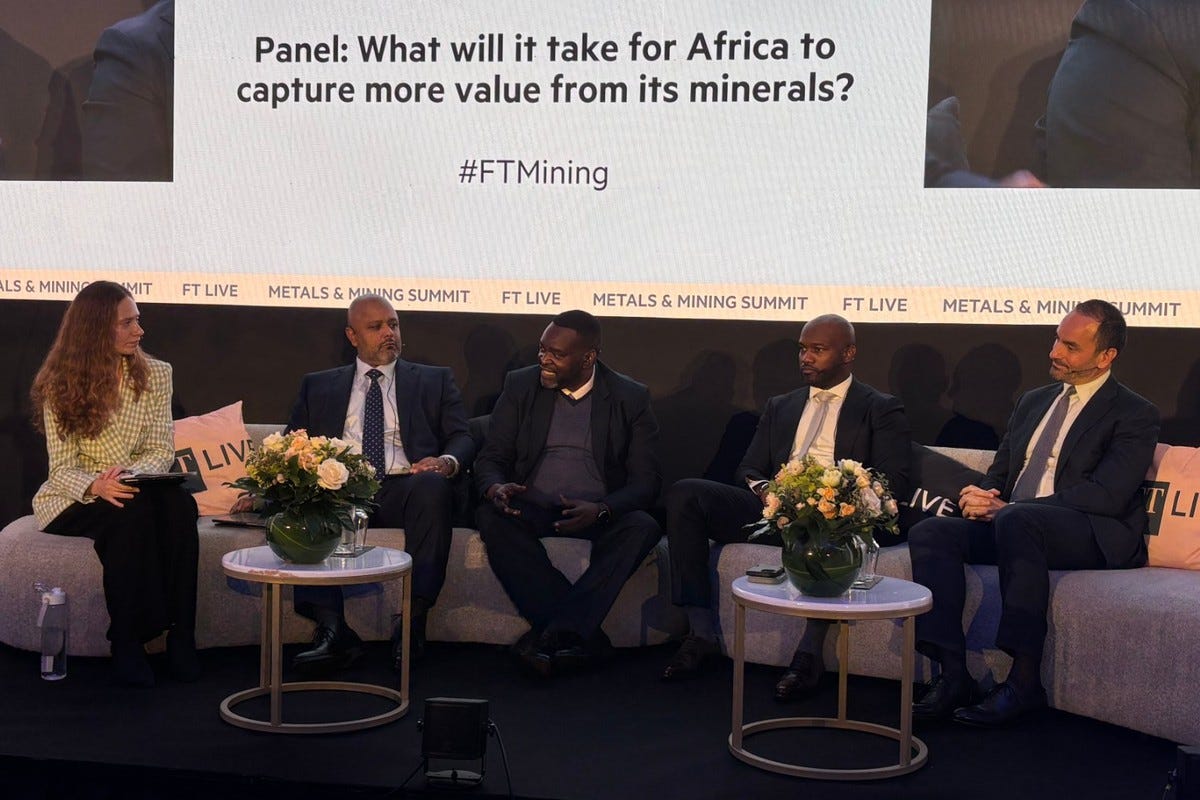
The FT Metals & Mining Summit 2026, organized by the Financial Times, took place in London on October 15. Camilla Hodgson, commodities correspondent at the Financial Times, moderated a panel on what it will take for Africa to capture more value from its minerals.
“Let’s not be naive. The elephant in the room on this subject is that mining is becoming an important part of not only national security, but also competitiveness,” Condé said.
“When we think about partner countries like the DRC (Democratic Republic of Congo) or any other countries in Southern and Central Africa, eventually as they move up the value chain, they will naturally start thinking more in that regard, especially from a national security standpoint,” he said.
Gécamines, the DRC’s state-owned miner, and Swiss commodity trader Mercuria set up a trading joint venture (JV) in December 2025 with DFC support. US buyers get first refusal on its copper, but only at fair market prices.
Condé said DFC’s financing for the JV is going through its normal underwriting process.
“We see an opportunity to not only meet US priorities as far as diversifying the mineral supply chain, but creating supply chains that are durable and sustainable,” he said.
Condé said DFC is also working on deals to secure metal for Project Vault, a US strategic minerals reserve.
Kostas Bintas, global head of metals and minerals at Mercuria Energy Trading, said the first 12,000 tons of DRC copper had gone into Project Vault that week. He said the DRC has committed to ship at least 100,000 tons of copper to the US through the JV.
Project Vault is a $12 billion stockpile launched in February and backed mainly by Export-Import Bank of the United States loans. Mercuria is one of its anchor investors.
Bintas said all JV sales are on market terms, and copper that US buyers turn down can go anywhere.
“Now this copper finds its way not only to the United States but to the strategic reserve initiative of the United States. A lot of policy initiatives have started to have real effects on the market and on the flows,” he said.
He said about 80% of the world’s copper stocks, roughly 1.8 million tons, now sit in the US because of the risk of a tariff on copper cathode. That is more than two years of US import needs.
“Policy that impacts price in critical minerals will continue in a broader way. We’re going to see the kind of tension we have seen on critical minerals in the last two to four years, and it will be stronger,” he said, adding that without a tariff, the market would send the metal back mainly to China.
Beyond the mine
Condé said DFC’s strategy goes beyond the mine, to whether partner countries can also build the energy, infrastructure and productive capabilities around it.
“Beyond the tax revenue, beyond the royalties, critical infrastructure has a tremendous impact in transforming these countries where we’re investing. That falls right in line with our development objectives for some of these countries, but also securing our value chain and making sure that they’re durable,” he said.
African state miners want a bigger share of that value.
“One of our priorities is to build our own production capacity, because Gécamines has evolved to become more like a passive investor, waiting for dividends,” said Baraka Kabemba, chief executive of Gécamines.
He said Gécamines will look to acquire existing assets in the Katanga region, pursue large greenfield exploration projects and build processing plants in the DRC to capture more value locally. The DRC, now the world’s second-largest copper producer, aims to become the largest by 2030 with 6 million tons.
Musonda said Zambian and Congolese copper long went to China as cathode and came back to Africa as finished goods.
“As Africa, we are saying things are changing. We need to add value to our copper. We are so close to it,” he said.
He said Africa’s young population will form a middle class buying electric vehicles, phones and laptops, though adding value locally will take time, technology and skills. Zambia has already deployed the first electric haul trucks of their kind to carry copper ore.
Bintas said staff from the African state partners sit in Mercuria’s Geneva offices, follow the transactions, and review the negotiations and documents so the knowledge can be transferred to their governments.
Kabemba said the JV is not meant to control all of the DRC’s copper.
“Everybody knows that China is our largest partner right now. But we have to make choices sometimes. For the time being, as far as copper is concerned, commercial agreements are with the United States,” he said.
Musonda said ZCCM-IH works with partners from Singapore, China, India and the US across its energy and copper assets, and a new trading platform does not override their rights, adding that even copper sent to China ends up in cables used in the US, Paris and the UK.
“The geopolitics is neither here nor there. Copper is a commodity for all of us here,” he said.
Kabemba said the DRC remains a multilateralist country and aims to bring in as many partners as possible to increase competition in the country.