


A growing number of enterprises are discovering that the biggest bottleneck in adopting agentic AI is no longer model capability, but execution speed. Building AI workflows often takes days of design, testing, and engineering coordination, slowing time‑to‑value at a moment when organizations are under pressure to deliver productivity gains quickly.
EverWorker, an early-stage agentic AI software firm, is positioning itself around that execution gap. Rather than asking companies to design and maintain complex workflows, the platform allows business users to create AI workers by describing the task and the desired outcome, compressing deployment timelines.
“It can take you 20 hours to create an AI workflow. With us, you can take an hour and a half to create it,” Cole Brooker, sales director at EverWorker, told TechJournal.uk in an interview. “All you do is tell it what you want to do, and it will run up and create the AI workflow by itself.”
He said the approach shifts the burden away from technical configuration and toward outcomes.
As enterprises move beyond pilot projects, that speed is becoming a competitive requirement rather than a convenience. Organizations want AI systems that can be deployed quickly, iterated easily, and adjusted by the people closest to the work.
EverWorker was founded in 2024 by entrepreneurs and former Veeam executives Ratmir Timashev and Anton Antich. Originally incorporated as Integrail, the company rebranded to EverWorker in June 2025 to reflect its focus on building an always‑on agentic AI workforce for enterprises. Headquartered in Connecticut, United States, with offices in the United Kingdom and Romania, the company employs about 60 people and is still in an early growth phase.
Deployment guardrails
One of the biggest constraints on enterprise AI adoption remains data control. Many organizations are reluctant to use agentic systems if documents, customer data, or internal records must leave their environment.
EverWorker has built its deployment model around that concern. The platform can be deployed across multiple architectures depending on customer requirements.
“We can deploy anywhere they want to,” Brooker said. “They can be deployed on SaaS, on our single tenant, on VPC (virtual private cloud), or on their servers in the basement.”
That flexibility allows companies to adopt agentic AI without compromising governance policies.
“Nothing would ever leave your environment,” Brooker said. “You can host it not just in the cloud, but on your own servers.”
The ability to deploy on‑premise or within private cloud environments is particularly relevant for regulated industries such as finance, healthcare, and legal services, where data residency and compliance requirements often slow AI rollouts.
From workflows to workers
Beyond deployment, EverWorker is making a broader argument about how automation should evolve. Traditional automation platforms rely on engineers to build and maintain workflows, with business teams waiting for changes to be implemented.
“We believe the future of agentic AI lies in AI employment, not just orchestration,” EverWorker said in its positioning document. “If you can describe a task, you can delegate it to an AI worker.”
By contrast, the traditional model assumes that engineers build flows, systems execute actions, and business teams wait.
The distinction is not merely semantic. Treating AI as a workforce rather than a set of workflows reframes how organizations think about responsibility, iteration, and scale. AI workers are expected to own outcomes, adapt to context, and improve over time, rather than follow static instructions.
Universal workers
At the center of EverWorker’s platform is “Universal Worker,” an agentic AI that can design and execute its own workflows within defined guardrails.
“We give people the ability to set the guardrails of where they want the AI to work,” Brooker said. “Then the agentic AI goes off and creates its own AI workflow depending on the task.”
Unlike structured workflow builders, which require explicit design and maintenance of complexity, the universal worker is intended to reason about how work should be done.
“It makes its own decisions. It evaluates. It will make it better as well,” he said.
Brooker contrasted that with more traditional agent builders.
“You can create AI agents that have a very complex structure, but you have to structure and manage that structure,” he said. “All you do here is tell it what you want to do.”
In practice, that autonomy allows AI workers to connect to relevant data sources, process documents, ask follow‑up questions when information is missing, and execute tasks across enterprise systems without predefined flows.
Enterprise reality
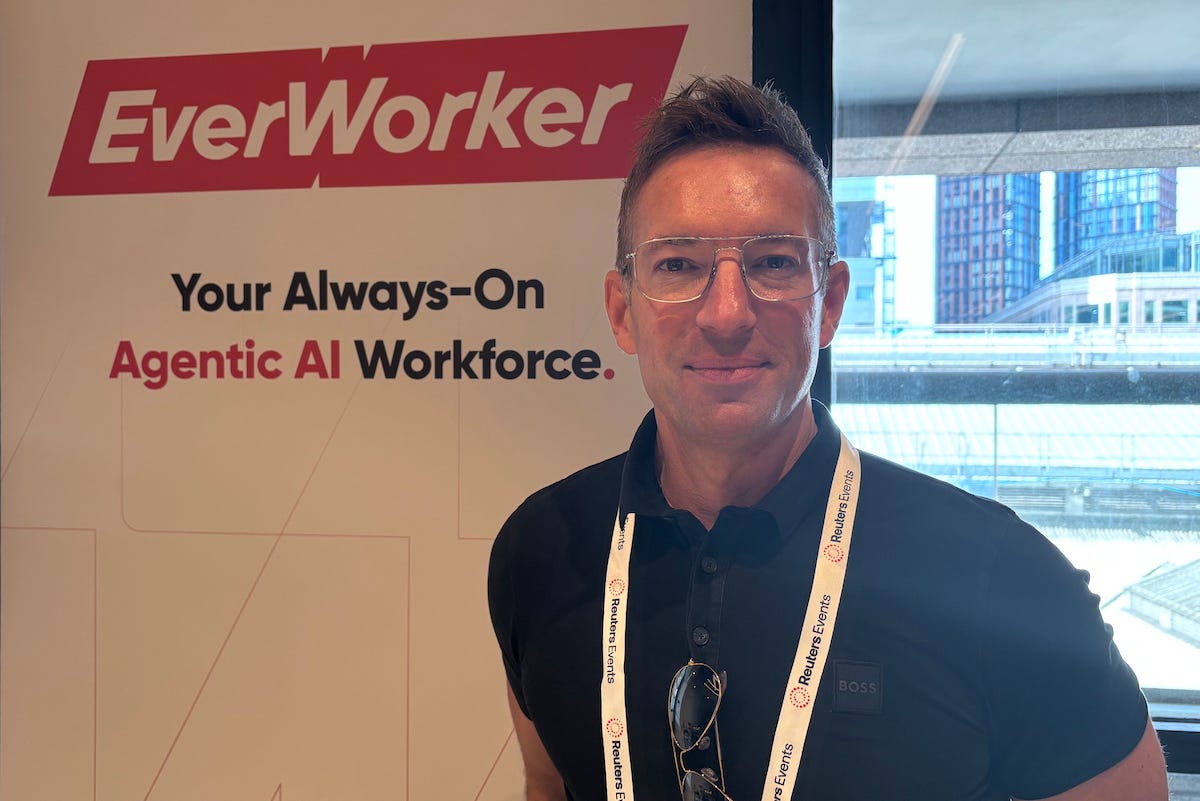
Brooker made the comments during an interview at Momentum AI 2025, an enterprise technology conference organized by Reuters Events in London. He discussed how companies are using agentic AI in document-intensive, operationally complex environments.
He cited customers who email scanned or photographed handwritten documents directly to an AI worker, which extracts the data, processes it through optical character recognition and large language models, and enters the information into customer relationship management systems.
That kind of use case highlights the difference between conversational AI tools and autonomous agents. The AI worker does not simply respond to prompts but completes an end‑to‑end task, checks for missing data, and executes actions across systems.
As enterprises roll out tools such as Microsoft Copilot and ChatGPT, Brooker said EverWorker deliberately avoids competing at the model or interface layer. Instead, the company focuses on using the latest large language models as interchangeable reasoning engines that sit behind autonomous AI workers.
He said the key difference lies in how work is carried out. While assistant-style tools are designed to respond to prompts and support individual users, EverWorker’s AI workers operate without continuous human input, taking responsibility for completing defined business processes from start to finish.
He added that platforms such as Microsoft Copilot still rely heavily on user interaction, even when built with no-code tools, whereas EverWorker’s universal workers are designed to initiate, evaluate, and improve their own workflows once goals and guardrails are set.
In that sense, he said enterprises face a strategic choice between deploying AI as a reactive assistant or treating it as a continuously operating digital worker embedded into business processes.