Eutelsat Network Solutions, a Paris-based global satellite operator, is advancing a multi-orbit strategy that integrates geostationary Earth orbit (GEO) and low Earth orbit (LEO) systems, as defense and government users shift toward more resilient, layered communications architectures in contested environments.
The move reflects a broader industry transition away from reliance on single-layer satellite networks toward integrated systems that combine multiple orbital and terrestrial assets to maintain connectivity under disruption.
For defense users, the shift is not only technical but operational. Modern missions increasingly depend on continuous data flows across dispersed assets, from command centers to forward-deployed units and autonomous systems. That requirement is forcing communications providers to deliver networks that can maintain performance even when individual nodes or links are degraded.
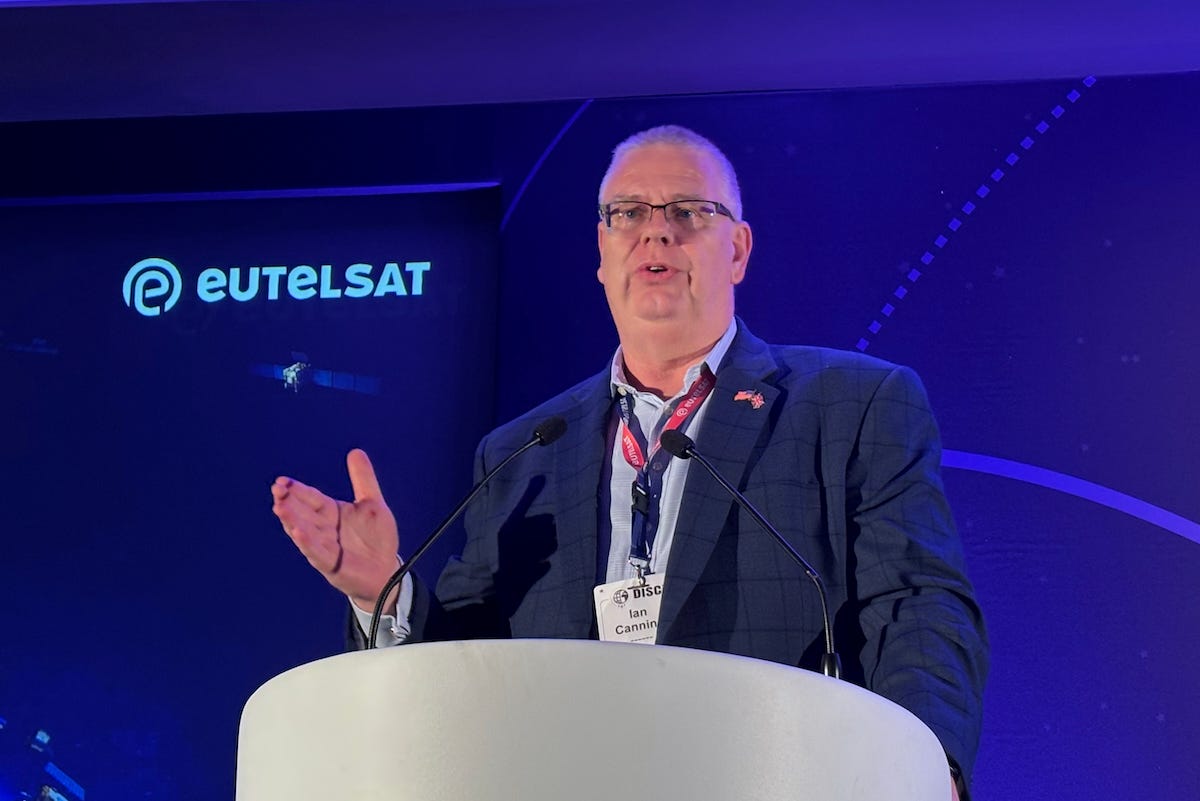
Ian Canning, president and chief executive officer of Eutelsat, said this evolution is changing how customers define reliability, moving beyond traditional uptime metrics toward mission assurance, where connectivity must be sustained under dynamic and contested conditions.
“Eutelsat is the only satellite operator in the world that is delivering both GEO and LEO services, and those networks can be fused together, not just with our networks but with competitor networks as well, to provide resilient communications,” Canning said.
The company’s approach combines GEO, LEO and terrestrial networks into a unified architecture that can dynamically route traffic across multiple pathways, reducing vulnerability to jamming, interference and infrastructure failure.
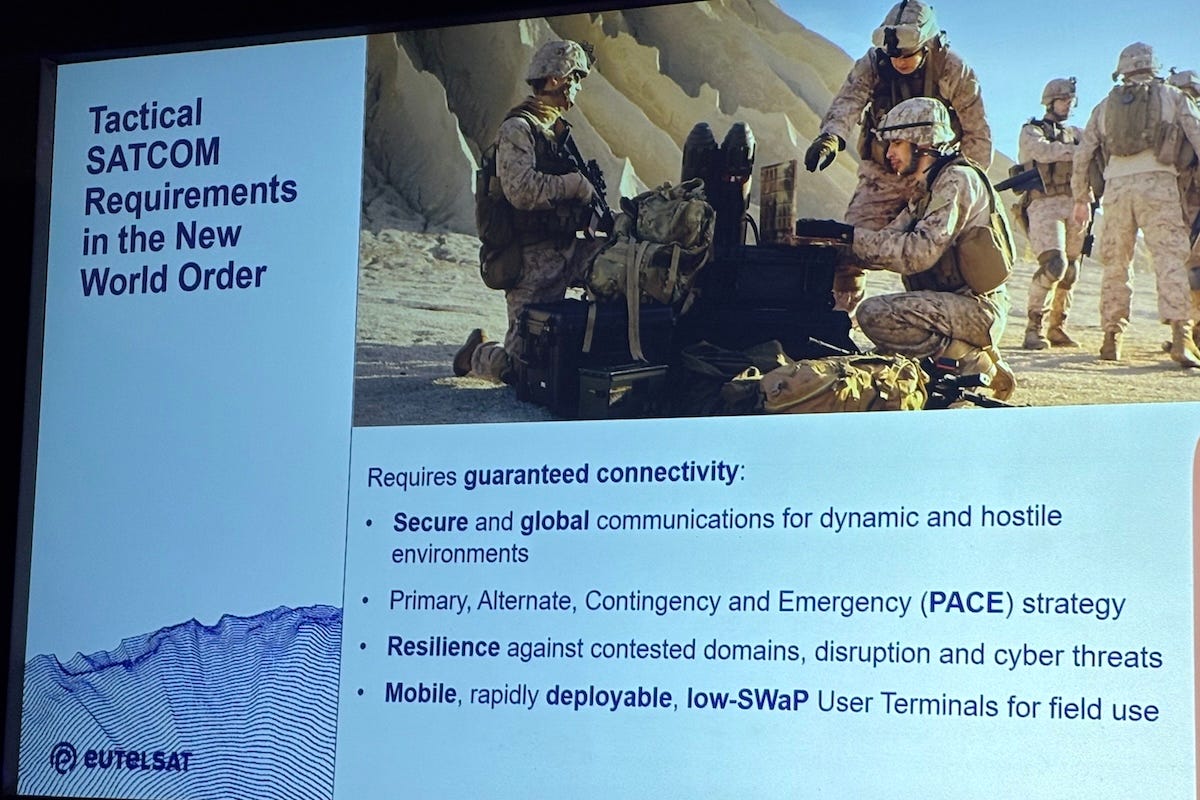
Multi-network resilience is increasingly structured around primary, alternative, contingency and emergency (PACE) frameworks, which require communications systems to operate seamlessly across different layers.
“Providing global, secure communications across multiple platforms that can support a real PACE plan is absolutely critical for customers operating in complex and contested environments,” Canning said.
He said no single network layer can meet future operational requirements, because modern missions demand redundancy, flexibility and the ability to adapt rapidly to changing conditions.
That has led to growing interest in orchestration platforms that can manage multiple networks simultaneously, automatically selecting the most appropriate pathway based on performance, availability and mission priority. Such capabilities are expected to become increasingly important as network environments grow more complex.
Scaling for unmanned operations
A key driver behind the shift is the rapid growth of unmanned and autonomous systems, which are significantly increasing demand for satellite connectivity.
“The man-to-unmanned ratio is shifting very quickly, and that is going to require scalable, resilient communications that can support a much larger number of endpoints than traditional systems were designed for,” Canning said.
He added that communications demand is no longer driven primarily by human users, but increasingly by distributed platforms such as drones and remote sensing systems that require persistent, high-capacity connectivity.
This evolution is placing new pressure on network design, with greater emphasis on scalability, bandwidth management and prioritisation of traffic across different mission types.
Canning said operators must also consider how to efficiently allocate limited spectrum and capacity as the number of connected devices increases, particularly in scenarios where large volumes of data must be transmitted in real time.
The ability to manage these demands while maintaining secure and reliable connectivity is becoming a key differentiator for satellite operators.
Timing, interference and signal integrity
Alongside scaling challenges, satellite operators are addressing growing technical demands around timing, interference and signal assurance in contested environments.
“We were asked to stabilize timing within the LEO network, because timing is critical for many applications, particularly in contested environments where interference and disruption are real risks,” Canning said.
He said this requirement has driven the development of additional capabilities that are now being extended across Eutelsat’s broader service portfolio, improving reliability under adverse conditions.
Operators are also increasingly expected to provide tools for monitoring and managing network performance in real time, enabling users to respond more effectively to disruptions.
This includes the ability to detect interference, reroute traffic and maintain synchronization across networks, all of which are critical for applications ranging from communications to navigation and data processing.
Electronic warfare impact
Recent conflicts have highlighted the vulnerability of communications systems to electronic warfare, reinforcing the need for multi-layer architectures.
“The tactical SATCOM environment has changed significantly over recent years, and the lessons from Ukraine have shown very clearly how electronic warfare can disrupt communications and force operators to rethink resilience,” Canning said.
He said operators have had to adapt quickly to ensure services continue to function despite jamming and interference, thereby accelerating demand for systems that can switch between networks and maintain continuity.
In practice, that means building systems that are not only resilient by design but also adaptable in real time, allowing users to shift between different communication paths without interrupting operations.
The experience has underscored the importance of integrating multiple layers of connectivity to provide redundancy and flexibility in contested scenarios.
Assured communications and control
Beyond resilience, customers are increasingly seeking greater control over how communications services are delivered and managed.
“We describe our services as secure, agile, resilient and assured, and that includes providing transparent service-level agreements that customers can rely on, alongside capabilities such as reserving capacity, prioritising access and applying geofencing,” Canning said.
He said users expect not only connectivity but also performance guarantees, as well as the ability to allocate resources according to mission priorities.
Canning spoke at the Defence In Space Conference (DISC) 2025 in London, where participants from the defence and space sectors discussed how satellite communications are evolving to meet changing operational requirements.
The session focused on the integration of space and terrestrial networks, the impact of electronic warfare and the growing role of autonomous systems in shaping communications demand.
Eutelsat is a satellite operator that became the world’s first fully integrated GEO-LEO provider following its 2023 merger with OneWeb. The combined company operates more than 35 geostationary satellites and a LEO constellation of over 600 satellites, enabling it to deliver both high-throughput broadcast services and low-latency broadband connectivity globally.
Historically, Eutelsat has been a major provider of video services, broadcasting nearly 7,000 television channels for more than 7,000 broadcasters and reaching around 274 million homes worldwide.
The group has expanded its focus in recent years to include connectivity services for maritime, aviation, remote regions and government users, alongside continued investment in new technologies such as Eutelsat Quantum, a fully reconfigurable software-defined satellite.
As demand for resilient, integrated communications continues to grow, multi-orbit strategies are expected to play an increasingly central role in both commercial and defense applications, positioning operators such as Eutelsat at the forefront of the evolving satellite communications landscape.
Looking ahead, the convergence of satellite and terrestrial networks is expected to accelerate further, driven by advances in software-defined infrastructure, network virtualization and automation.
These developments are likely to enable more flexible and responsive communications architectures capable of supporting a wide range of mission requirements.