


The definition of tech sovereignty in Europe is shifting away from owning every layer of the artificial intelligence (AI) stack.
Sovereignty, in this view, is not about building chips, models and software entirely within Europe. It is about operational resilience, staying in control without relying on a switch someone else can flip. The term “sovereign AI” only entered wide use as generative AI took off in 2023, and its meaning is still being worked out in practice.
“For those workloads you need jurisdictional immunity,” said Manuel Greisinger, general manager of Google Distributed Cloud EMEA. “You don’t want the Cloud Act to apply, and you need it to be cryptographically and post-quantum safe.”
“It would be delusional to think Europe could have the whole stack, from building chips that compete with the latest GPUs (graphics processing units) through to the software layer on top,” he said. “You cannot rely on infrastructure that has a kill switch built in, or that doesn’t provide full operational resilience.”
He said the distinction that matters is between workloads that are non-critical and elastic, and those that are highly mission-critical and cannot tolerate a break in the supply chain. He said running mission-critical workloads on an air-gapped system costs significantly more than putting non-critical ones on standard hyperscale infrastructure, a tradeoff every operator has to weigh.
That framing does not mean shutting out non-European tools, Greisinger said. Sovereign AI, in his view, means operating models in a resilient way that keeps innovation firmly in the operator’s own hands, regardless of where a given model was built.
“Sovereign AI doesn’t mean you don’t use other models,” he said. “As long as you can operate them in a resilient way and drive innovation from them, that’s key.”
Mark Pestridge, managing director of Telehouse, said the practical test for customers is less about geography than certainty.
“The physical infrastructure doesn’t need to be European, as long as you know where the data is held and where it’s flowing from and to,” he said.
The same principle works in reverse, Greisinger added.
“If something happens, can you push a button and evacuate the data to a globally distributed infrastructure?” he said. “That may be the only way to continue operating.”
He cited the war in Ukraine as the kind of crisis that makes an air-gapped, mission-critical setup risky without that fallback.
Power beats permits
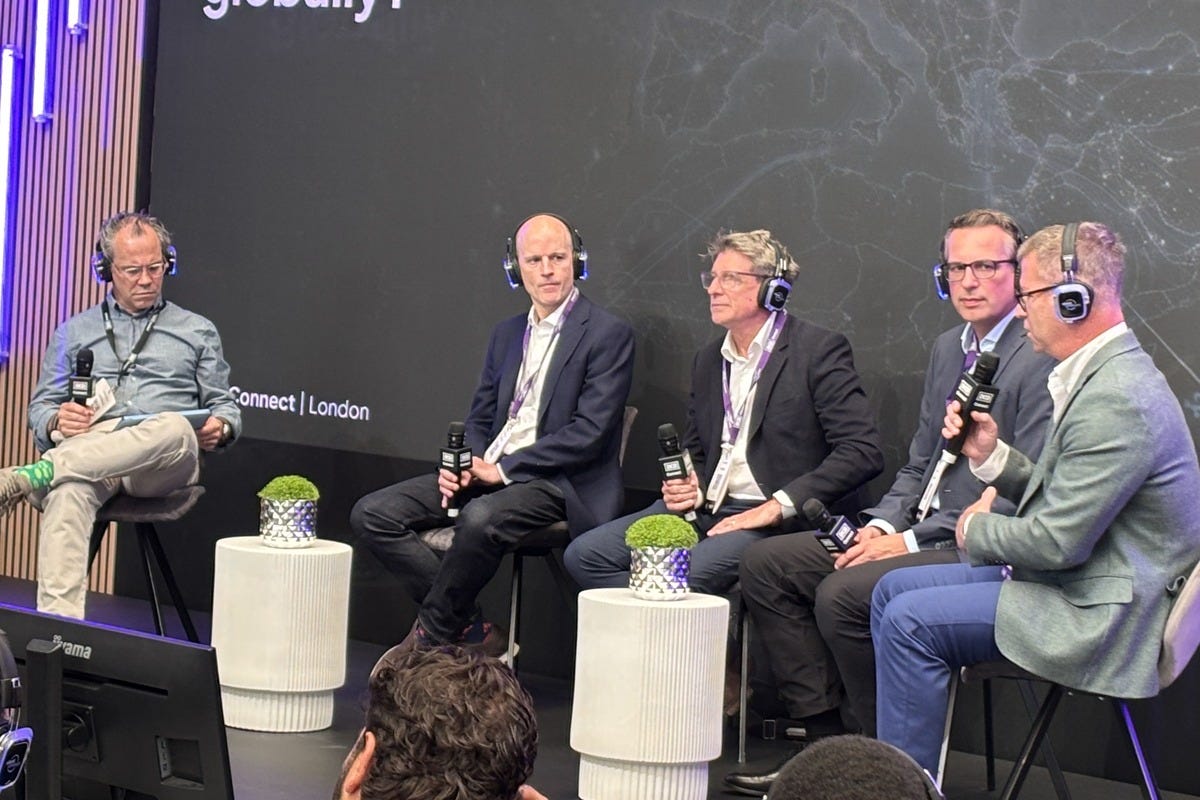
The discussion took place at DCD Connect London 2026 on September 16, during a panel titled “Europe’s Precision Strategy: Can a purpose-built digital continent still compete globally?” George Rockett, co-founder and board member of Yotta Events and DatacenterDynamics, moderated the session, which examined whether Europe’s data center industry can keep pace with the speed of artificial intelligence.
Also on the panel were Bruce Stephenson, chief development officer at HSCALE, a data center developer, and Greg Roberts, data center sector lead at Ramboll, the Danish engineering firm.
Stephenson said the industry's success comes down to three Ps: power, permits and people. Asked directly whether he ranks them, he confirmed power comes first, with people a close second.
“Without power, it’s clearly a massive understatement to say we don’t have a data center. It’s about power reform for the better,” he said. “Every developer in the room has had a power-on date slip by two, three, four, five years. To call that a business case killer is an understatement.”
“Just look at the backlogs of the hyperscalers,” Greisinger said. “Every single one has a triple-digit billion figure in backlog that needs to be built out into capacity to be turned into revenue.”
Greisinger said the primary constraint he hears from customers is power availability in existing data centers. His own prescription for closing that gap has little to do with engineering.
“In order to be successful moving forward, Europe needs to be way less fragmented,” he said. “It’s more or less a political issue, with individual countries competing with each other.”
He named Mistral, ElevenLabs and Lovable as the kind of homegrown AI companies he wants Europe to produce more of.
“We cannot act as independent countries. It needs to all come together at the end of the day,” he said. “If that happens, by 2030 you will see enough sovereign AI infrastructure here.”
Building without stopping
Pestridge said the constraint is not only power. It is the physical difficulty of upgrading a data center that never stops running.
“Retrofitting an interconnected data center is really difficult,” he said. “If you say to a customer, we’re going to take that down and retrofit it to provide, say, 45 to 100 kilowatts of rack, they’re going to say no.”
He said the difficulty is one of scale. A single interconnected facility can carry thousands of cross-connects, so customers won't accept taking it fully offline to raise power density.
“What we’re looking at is how you can do it in pockets of those buildings, floor by floor, rather than the whole building,” he said. “We already have the planning permission and access to the power. It’s about making sure customers are comfortable with what you’re going to do to them.”
He said the most difficult example was Telehouse’s old Thomson Reuters building, now known as Telehouse South.
“It’s the most difficult project we’ve ever done,” he said. “You have to constantly balance keeping the lights on and keeping the interconnection going.”
He said many of the connections in older buildings were never fully documented, so identifying one sometimes means physically removing it, a process that can trigger serious outages if it goes wrong.
Greisinger said Google takes a similar approach on the software side.
“We take the approach of containerizing the solution, a fully certified container for specific applications, at least to get customers started while they retrofit or build new locations,” he said. “It’s all about the time to value.”
Roberts offered a different picture of where the industry is heading, literally closer to home.
“There’s a rise in inference, and we’re going to start to see that integrated within our cities,” he said. “These are opportunities to use stranded power, and the waste heat these sites produce for community heating schemes.”
“Data centers seem remote, stuck out somewhere. Going forward, I think communities are going to start to see these smaller data centers within cities supporting our economies, research, manufacturing, healthcare and social benefits.”
“We need to start choosing the locations where we want data center development to happen,” he said. “That means making sure there is power, water, connectivity and skills available in that location.”
He said this kind of planning, which European Union (EU) legislation already allows member states to pursue, would also help attract companies that share Europe’s own values around data sovereignty and sustainability.
The panel agreed that this vision of embedded infrastructure only works if local communities are on board.
“The third thing to look at is enhanced public perception,” said Pestridge. “We need to be more proactive about engaging with the public, and understanding the good our industry enables, rather than just the energy or water it uses.”
He said knocking down a building and starting again causes disruption, traffic, construction work, dust and pollution that a data center operator cannot inflict on the community it operates in.
Panelists said that trust will decide how much of Europe’s AI capacity gets built at home, rather than imported.