A European push to build secure military satellite communications (satcom) is accelerating, with a new standards-led waveform program designed to work across allied networks rather than fragment them.
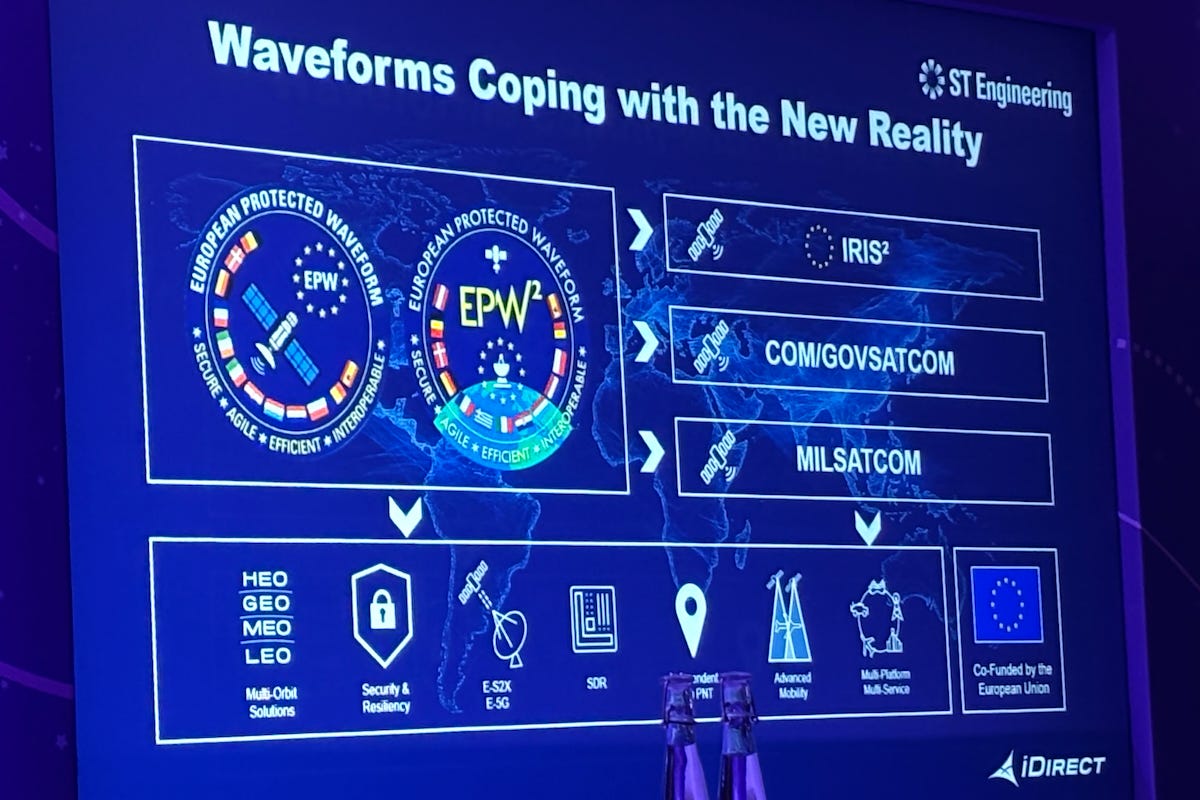
The European Protected Waveform (EPW) program, launched in 2023, is moving into a new phase, marking a key step in Europe’s push for secure, interoperable military satellite communications.
Developed under the European Defence Fund with an estimated cost of €29.9 million, the program focuses on creating waveform standards that can operate across geostationary Earth orbit (GEO) and non-geostationary orbit (NGSO) systems while supporting both sovereign European missions and coalition operations with NATO partners.
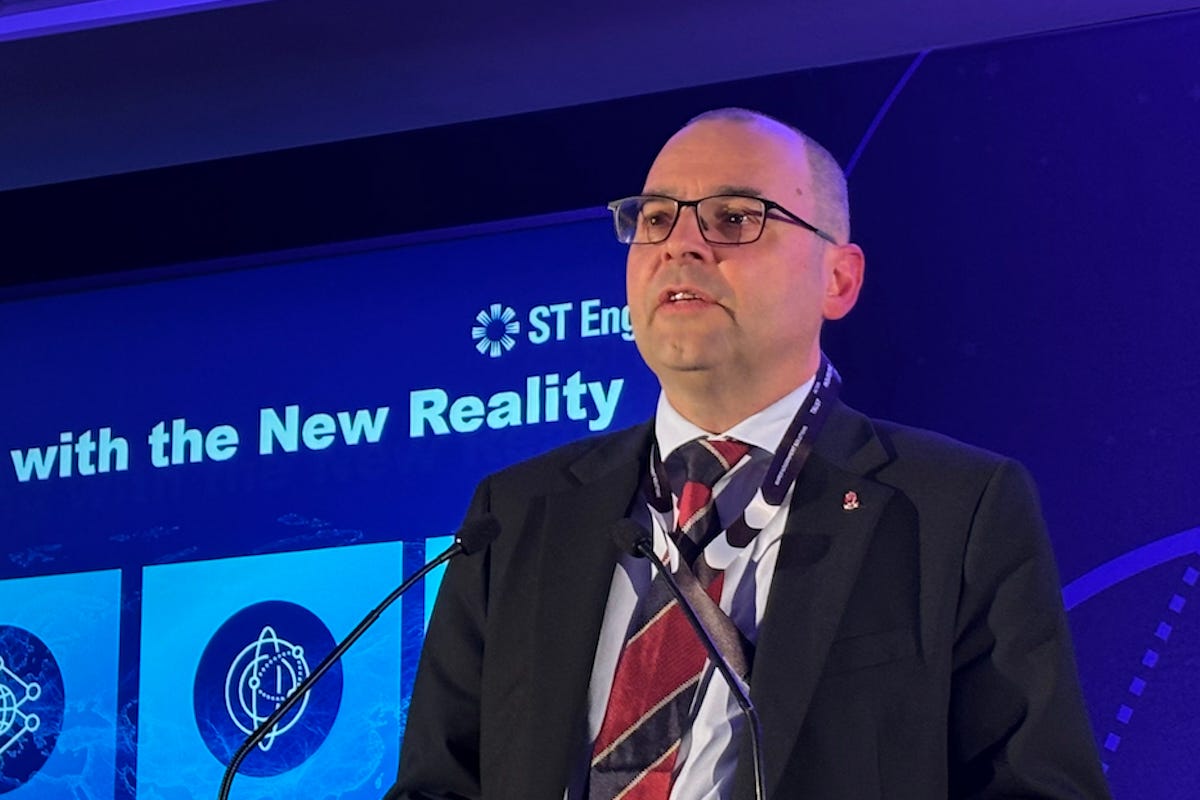
“One of the examples that we are thinking about is the European Protected Waveform. It’s a prime example of when you think about open architectures, new waveforms and new capabilities, combining all of these elements into one end-to-end system,” said Koen Willems, Vice President, EU Programs & Government Relations at ST Engineering iDirect Europe.
“The key element is open architecture. That is where you define the standards, and then you can put sovereign capabilities on that architecture—whether it’s UK, European, or NATO,” Willems said.
Last November, the EPW initiative completed over-the-air testing in Germany, validating its ability to operate across both geostationary and low Earth orbit (LEO) satellite systems while maintaining resilience against jamming, cyber threats, and unauthorized access.
Toward 2030 capability
The EPW program is aligned with Europe’s broader satellite communications roadmap, including the Infrastructure for Resilience, Interconnectivity and Security by Satellite (IRIS²) constellation, with initial capability targeted around 2028 and full capability by 2030.
IRIS² is the European Union’s multi-orbit satellite constellation designed to provide secure communications for governments and defense while also delivering commercial connectivity services.
Willems said the initiative involves a consortium of companies and nations working to deliver a fully operational capability by the end of the decade.
The program is designed to support both sovereign European operations and coalition missions, reflecting the dual priorities of strategic autonomy and interoperability.
He said the primary driver behind this shift is the reality of joint operations.
“The driver in Europe was joint communications; it’s rare that one country goes into operation. You have joint training, joint operations, so you need interoperability, and that is something you get through standards,” he said.
Rather than forcing countries to adopt identical systems, open architectures allow national capabilities to coexist within a shared framework. This approach enables sovereign control while maintaining compatibility across alliances.
He said the overlap between European Union and NATO membership creates a natural pathway for alignment, even as funding and governance structures remain distinct.
“We know that the majority of our nations in Europe are also NATO nations; that is where the conversation can happen,” Willems said.
Software-defined shift
At the Defence In Space Conference (DISC) 2025 in London, Willems outlined how European defense communications are shifting away from platform-specific systems toward standards-based architectures.
He said technical transformation is equally critical to enabling interoperability at scale.
“You needed to deploy several modem systems from different vendors, one was connecting to GEO capability, another to partner systems, and another to multi-orbit, and that is a logistical nightmare,” he said.
Historically, military satellite communications relied on multiple hardware systems to connect to different networks, creating operational complexity in deployed environments.
That model is now being replaced by software-defined systems that support multiple waveforms and satellite constellations on a single platform. Software-defined capabilities also enable multi-purpose deployment across aerial, naval and land platforms, reducing the logistical burden while improving flexibility.
“That logistical nightmare is something that we can overcome today. The magic word here is software-defined,” Willems said.
These systems allow operators to adapt communications dynamically, switching between networks and configurations without requiring additional hardware deployments.
Multi-orbit resilience
A central feature of the emerging architecture is multi-orbit connectivity, which integrates GEO, medium Earth orbit (MEO) and LEO satellites into a unified network.
This capability is increasingly important in contested environments where communications infrastructure may be disrupted or targeted.
“Multi-orbit is there to expand your operations. It makes sure that you are resilient, so you can switch between satellites when you are jammed or when there is interference,” Willems said.
Multi-orbit systems enable seamless switching between orbital layers and provide redundancy and continuity, ensuring that critical communications can be maintained even under electronic warfare conditions.
He said this approach also supports broader operational agility, allowing networks to scale and adapt to different mission requirements.
Cloud and automation
ST Engineering iDirect Europe, based in Sint-Niklaas, Belgium, serves as the company’s EU Satcom Centre of Excellence, focusing on ground-segment technologies tailored to European defense requirements. The unit operates under EU and Belgian regulatory frameworks and has more than three decades of experience in satellite communications systems, supporting both commercial and government programs.
Willems pointed to virtualization and automation as key enablers of next-generation defense communications. Traditional systems rely on dedicated hardware for processing and network management, limiting flexibility and scalability.
“Virtualization means putting processing not on a one-to-one device, but on servers or in a private cloud,” he said.
This shift allows capabilities such as network management, signal processing, and modulation to be centralized or distributed as needed, improving efficiency and responsiveness. Automation further enhances these systems by enabling orchestration across multiple assets and networks.
“Automation is about orchestrating capabilities across different satellite assets and networks, and planning globally,” Willems said.
Together, these technologies form the backbone of a more agile, software-driven communications architecture that can evolve alongside operational requirements.
Transition and integration
The transition toward future architectures requires careful planning of legacy systems, particularly as defense operators migrate from existing platforms to next-generation capabilities.
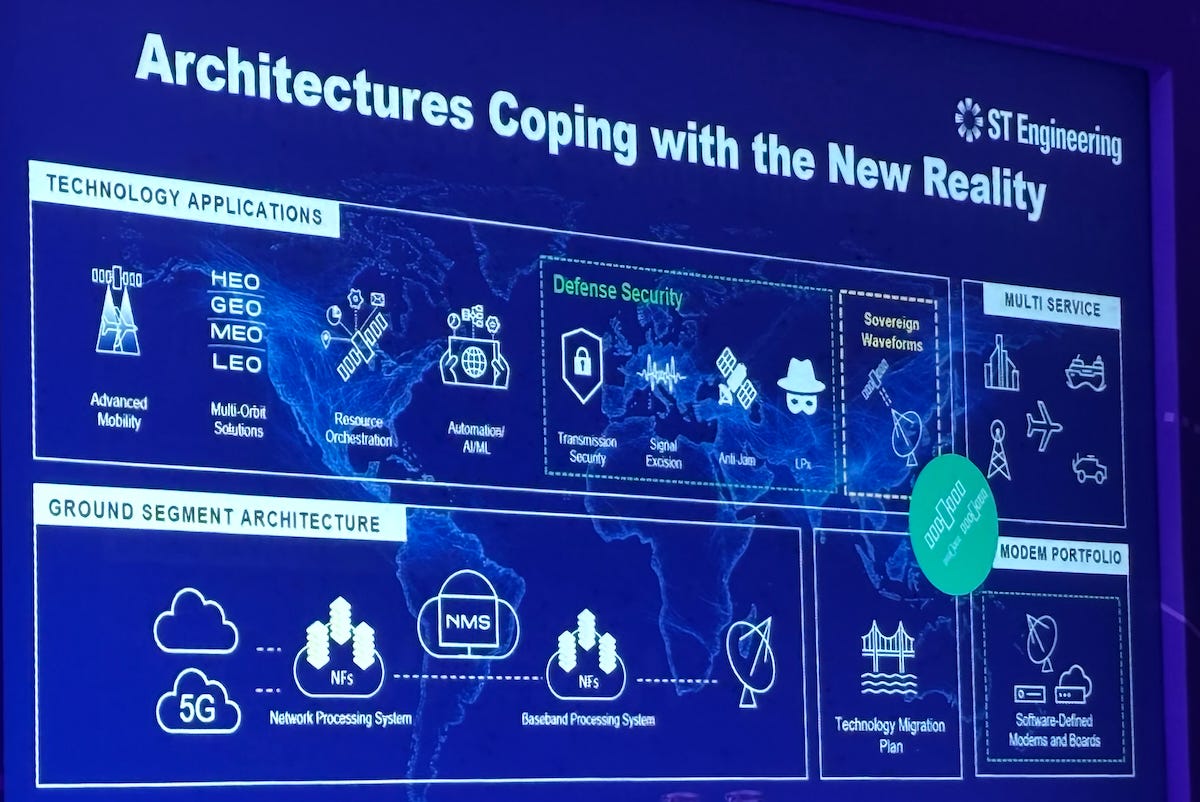
“You also need to think about the transition towards the newer platform. You need to make sure that technology can migrate together with your entire network toward future capabilities,” Willems said.
This migration challenge is particularly relevant for military users who rely on long-lifecycle systems, in which incremental upgrades must be integrated without disrupting ongoing operations.
Open architecture provides a pathway for this evolution by allowing new capabilities to be introduced alongside existing infrastructure.
“We’re not only thinking about modulation standards, but also about integration. We need to make sure that you can piece all these elements together into one architecture,” he said.
This broader approach enables defense organizations to combine mobility, automation, and network management into a unified system, reducing operational complexity while improving user experience.
These developments are aligned with Europe’s long-term satellite strategy and future 5G-based architectures.
“We’re discussing not only DVB (Digital Video Broadcasting), but also 5G and next-generation 5G. We need to make sure that these future releases are fully secure not only for commercial operations, but also for military operations,” Willems said.
The combination of open architecture, software-defined systems, and multi-orbit connectivity will define how military communications networks are designed and deployed. The ability to integrate sovereign and allied capabilities within a single framework will be critical as defense operations become more interconnected and technologically complex.