


Dollar stablecoins are becoming more than a fast way to move money. For Europe, its growing use in enterprise payments raises questions about monetary sovereignty.
If dollar-backed stablecoins become default settlement tools for global commerce, European banks and companies may gain speed and liquidity while relying more heavily on US-linked financial infrastructure.
“Stablecoins are also used by the US as an asset to finance the US Treasury. It is also a new instrument for monetary policy,” said Nadia Filali, Chief Innovation Officer at Caisse des Dépôts. “For us, it is important to look at what is the place of the euro and Europe in this area.”
Filali said the choice between regulated stablecoins and bank-issued tokens is not only about technology. Bank-issued tokens are more likely to serve capital markets and wholesale markets, while regulated stablecoins may be used more broadly in transactions between companies, banks and wider markets.
That distinction matters because stablecoins are already heavily linked to the US dollar. Caisse des Dépôts has strategic priorities linked to financial, digital and industrial sovereignty in France and Europe.
Europe is developing a digital euro for both wholesale and retail uses, but central banks now understand that digital money will not be limited to a digital euro.
Commercial bank money, stablecoins and other forms of digital money are also expected to play a role. Europe’s challenge is to support innovation without allowing its future digital-money infrastructure to be shaped entirely by dollar liquidity.
“I am not sure that fragmentation in this area will be positive,” she said. “We need to collaborate more between banks, and not only at the national level.”
Xavier Gomez, Group Chief Operating Officer of Vancelian, also said regulation would be key, pointing to competition between Europe’s Markets in Crypto-Assets Regulation (MiCA) and the US GENIUS Act.
Banks need authorization and accounting clarity before moving more deeply into this business. The broader challenge is how traditional finance can converge with decentralized finance while keeping regulated cash at the center of enterprise adoption.
Faster rules
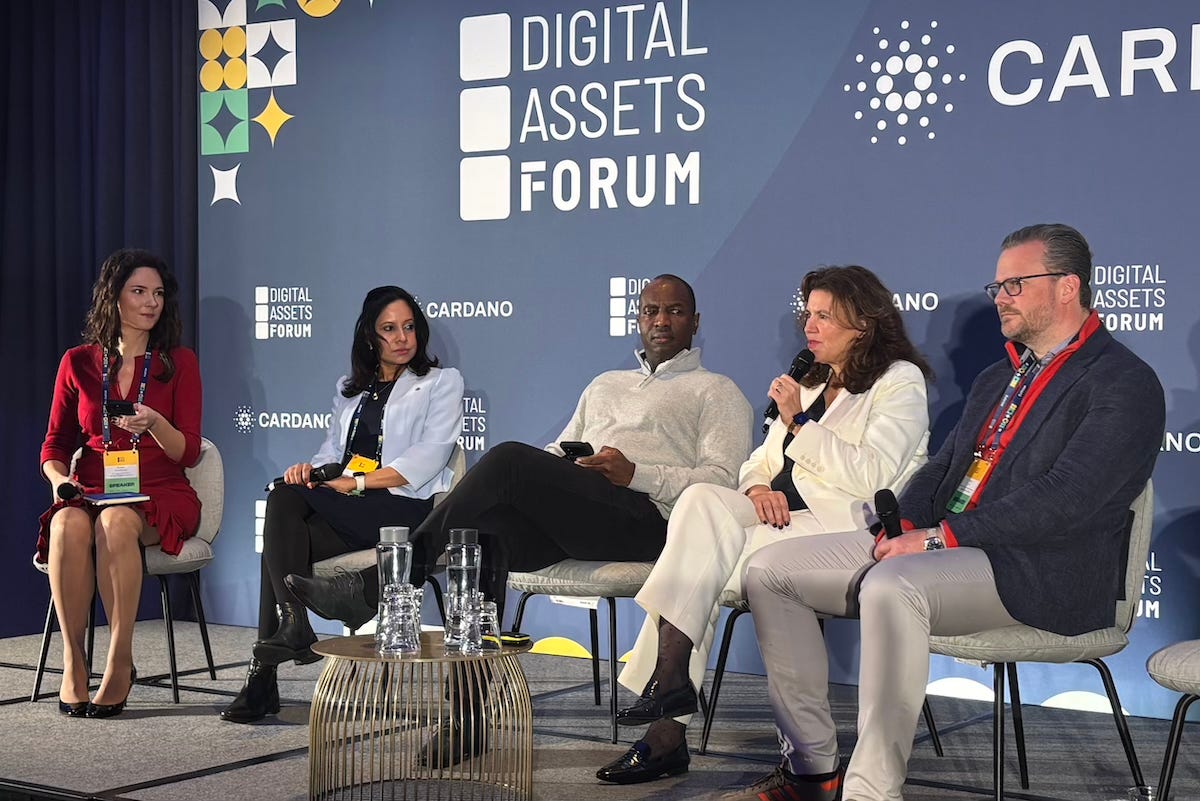
Digital Assets Forum 2026, organized by European Blockchain Convention, brought the discussion to London. The panel, titled “Regulated Stablecoins vs Bank-Issued Tokens: What Will Enterprises Use?”, was moderated by Polina Evstifeeva, Executive in Residence at Global Digital Finance (GDF).
Shreyosee Dutta-Roy, Director of Digital Assets at UBS, said regulators should avoid treating all crypto-related activities as a single category. The risks in payment, settlement, custody and trading are different, so rules should be designed around specific use cases.
“This term crypto has become a monolith,” she said. “The risk appetites of payment, settlement, custody and trading are very different.”
She said clearer and faster regulatory timelines would help enterprises adopt digital money. If rules remain unclear for too long after consultations, companies may find it difficult to plan product development, compliance processes and treasury operations.
“Having a faster timeline between consultation and making it live would be good,” she said.
Unclear rules make it difficult for enterprises to plan the adoption of digital-money tools.
Peter Left, Head of Digital & Markets Innovation at Lloyds Banking Group, said interoperability is one of the two key problems that digital-money systems need to solve. Today’s interoperability between deposits and account-based money is achieved through on-demand transfers of central bank reserves.
“Interoperability is key,” he said. “It is a great design that the Bank of England came up with to have central bank reserves as part of the backing asset portfolio.”
A similar model could be applied to stablecoins if part of their backing assets consisted of central bank reserves. That could allow stablecoins to be converted into tokenized deposits when a payment journey required it.
Dutta-Roy cited the Bank for International Settlements (BIS)’s Project Agorá as another example of interoperability work. The project brings together seven central banks and 41 financial institutions to examine how commercial bank tokens and digital central bank reserves can support 24/7 programmable cross-border payments.
Tokenized deposits have benefits from an accounting perspective, but they are also closed-loop. That makes interoperability with other banks and global consortia important.
Both stablecoin and tokenized-deposit systems would need a digital Know Your Client (KYC) or payee confirmation process, so banks could track the movement of funds and meet sanctions compliance requirements.
For banks, the point is not only whether money can move faster. It is whether faster money can still meet the controls expected in regulated financial markets.
Use-case split
The panelists repeatedly pushed back against the idea that enterprises must choose one form of digital money over the other. The likely outcome is a mixed model in which stablecoins and tokenized deposits serve different functions.
Dutta-Roy said banks have customer segments that want stablecoins, while institutions and corporate clients also want the benefits of bank tokens.
“It is not versus,” Left said. “It is the right product for the right use case.”
He said deposits are backed by assets such as private-sector loans, including mortgages and business lending. Stablecoins, by contrast, are generally backed by short-dated government bonds and more liquid assets. That difference affects how each instrument should be used.
He added that tokenized deposits can be moved between wallets and network nodes, but Lloyds still needs to know the wallet owner. For example, in its work with Archax, Lloyds needed to know the business, where it was registered and what kind of business it carried out.
“I can’t have it travel like a stablecoin can,” he said. “When it needs to go places I don’t know, that’s when we use stablecoins.”
Dutta-Roy said stablecoins can help with cross-border payments and decentralized finance (DeFi) transactions. DeFi refers to blockchain-based financial services that use code, smart contracts and digital wallets rather than conventional intermediaries.
“Stablecoin helps where you need cross-border payments or DeFi transactions,” she said. “It is a very good bridge between TradFi and DeFi.”
TradFi (Traditional finance) refers to banks, asset managers and other established financial institutions. Stablecoins could be useful where distribution matters most, such as cases where a bank may not need to know which investor is purchasing a money market fund.
Tokenized deposits are also moving into real use cases. Lloyds was running a node on the Canton Network, a blockchain designed for regulated financial markets, and had carried out pilot transactions with market counterparties. One example involved using tokenized deposits in a delivery-versus-payment workflow to buy tokenized UK government bonds or gilts.
UBS launched a US dollar cash pilot in 2024, with corporate treasury management as the main use case. Multinational companies often have multiple business entities across markets, leading to fragmented liquidity.
Tokenized deposits could help such companies see inflows and outflows more clearly, reduce the need for extra liquidity buffers and lower capital costs. They could also help facilitate high-quality capital market transactions involving central bank connectivity or tokenized securities.
Gomez said Vancelian’s enterprise clients preferred stablecoins for payments, investment solutions, on-chain cash management and atomic settlement. He said cash was sensitive for small and medium-sized enterprises (SMEs), making cost reduction and faster settlement important.
The next phase of enterprise digital money will depend on whether regulators, banks and fintech firms can make these systems interoperable, compliant and commercially useful. Stablecoins may provide reach, while tokenized deposits may provide bank-grade control.