


Boards are no longer satisfied with anecdotes about hours saved or experimental pilots when it comes to artificial intelligence. As agentic AI moves deeper into enterprise operations, executives are under pressure to demonstrate measurable returns, translate productivity into revenue or cost reduction, and show how AI-driven workflows change how businesses actually operate.
That pressure is reshaping how companies deploy agentic AI. Rather than treating it as another layer on top of generative AI or machine learning, many organizations are redesigning processes around autonomous agents that can act on predictive insights, trigger decisions, and operate at a scale humans cannot match.
“For every dollar spent on AI, we’re seeing about $3.7 come back. But the best organizations are getting about 10 times return,” said Rob Smithson, UK AI business processes applications lead, Microsoft. “At the moment, it’s really money well spent.”
Smithson said the internal conversation is shifting as boards push leaders to move beyond experimentation.
“We are seeing much less tolerance for soft efficiency arguments,” he said. “The expectation now is that AI initiatives translate into clear financial impact.”
Industry experts said the path to outsized returns is not wider deployment of chat-style tools, but tighter integration of agents into repeatable, high-volume workflows with clear financial baselines.
Finance, fraud detection, procurement, and operations were repeatedly cited as early candidates because outcomes can be measured directly against cost leakage, cycle times, or loss prevention.
When agents are given authority to act within defined guardrails—rather than simply recommend actions—the gains compound across thousands or millions of transactions.
That shift is forcing companies to rethink not only how they measure AI, but how they design it in the first place.
Coupling the AI stack
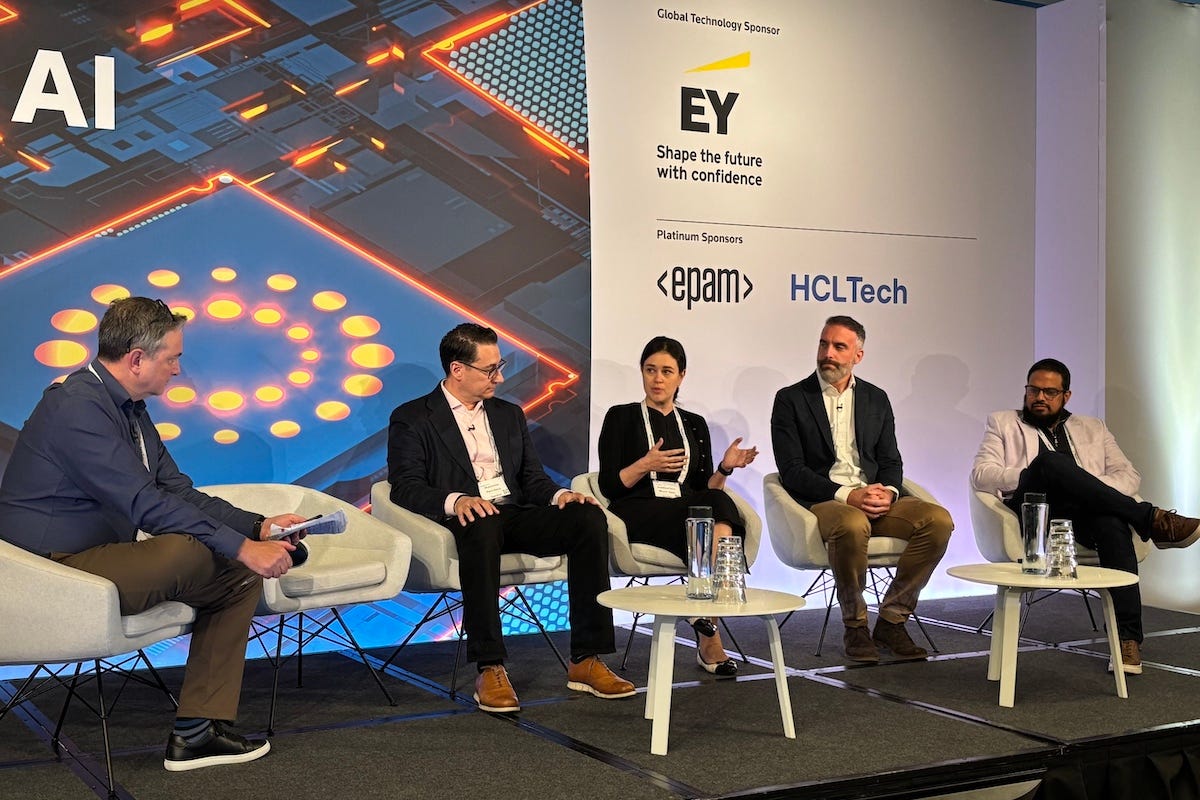
The remarks were made during a panel discussion titled “The Agentic Leap: How to Unlock Business Value with Agentic AI?” at Momentum AI 2025, a two-day enterprise technology conference in London organized by Reuters Events. The session was moderated by Simon Jury, group data director at Kingfisher.
Panelists from Microsoft, Skyscanner, Vodafone, and CBRE discussed how agentic AI is reshaping enterprise operations, governance models, and investment decisions as organizations move from pilots to production.
“The most value comes when we couple predictive AI, generative AI, and agentic AI,” said Khadir Fayaz, senior vice president of digital technology at CBRE. “Predictive insights translate into actions through agentic workflows, and generative AI helps explain and operationalize those outcomes.”
At CBRE, which manages large-scale facilities and commercial properties worldwide, Fayaz said this coupling allows insights to move directly into execution. Predictive models can forecast energy consumption or maintenance needs, while agents initiate workflows that adjust operations or flag issues without waiting for human intervention.
The emphasis on coupling reflects frustration with standalone AI tools that generate insights but stop short of action. Executives increasingly see agentic AI as the missing layer that converts analysis into operational change.
“It’s a continuum from analytics to machine learning to generative AI and now agentic AI,” said Piero Sierra, chief product officer at Skyscanner. “What ultimately matters is whether users are getting real help and good answers, not the labels we put on the technology.”
Sierra said that distinction has become less relevant internally as teams focus on outcomes rather than architectures. At Skyscanner, the goal is to improve how travelers plan and experience trips, rather than showcase advanced AI systems.
Jury said many companies are reassessing earlier structural choices.
“We invested early in a centralized AI center of excellence, but it wasn’t always close enough to the business,” he said. “If we had our time again, we would probably build it more decentralized.”
Measuring what matters
As AI tools become embedded across functions, executives are rethinking how value is measured. Fayaz warned against focusing on surface-level metrics.
“We get caught in measuring how many hours are saved or how many lines of code were generated,” he said. “The real business impact is how fast feature velocity improves and how that translates into value for customers.”
Several panelists said this shift reflects a broader change in boardroom expectations.
Rather than treating AI as a discretionary technology spend, boards increasingly expect it to behave like any other capital investment, with clear payback periods, risk profiles, and accountability.
That has pushed executive teams to link agentic AI initiatives directly to profit-and-loss lines, such as cost-to-serve, fraud losses, procurement efficiency, and revenue conversion.
In software development and digital operations, leaders are increasingly measuring how quickly new features reach customers and how reliably processes run at scale.
Executives said outcome-based indicators, such as reduced manual rework, are easier to defend at the board level than abstract productivity gains.
Sierra said Skyscanner tracks adoption and retention of AI tools among engineers, as well as the acceptance of AI-generated code into production. Those signals are then distilled into productivity measures for leadership review.
At the same time, panelists acknowledged growing pressure to translate those gains into hard financial outcomes.
“We are starting to shift from soft efficiency to hard questions around cost reduction,” Fayaz said. “Boards are asking those questions far more aggressively than they did a year ago.”
That pressure is also shaping build-versus-buy decisions.
Several speakers said speed to market increasingly outweighs ownership, as many AI capabilities become commoditized and differentiation shifts toward proprietary data and customer experience.
“The decision often comes down to what gets us to market fastest while retaining competitive advantage,” Fayaz said.
Skyscanner has favored flexibility over standardization. Sierra said the company has prioritized architectural flexibility to avoid locking into a single AI stack too early.
Data still sets the ceiling
Despite the focus on agents and autonomy, executives stressed that data quality remains the primary constraint on scaling agentic AI.
“If the data itself is not good, whatever models you put on top of it will not be very valuable,” Sierra said.
He noted that Skyscanner spent years cleaning and restructuring data to support machine learning before generative or agentic AI became mainstream.
Vodafone has taken a similar approach, linking data investments directly to business outcomes.
Miryem Salah, chief data officer and head of digital and transformation at Vodafone, said executives rarely approve data programs in isolation.
“Never talk about the data movement itself,” she said. “Talk about the outcome—how it helps employees and customers—and educate leaders on why those data foundations matter.”
Speakers also highlighted the growing importance of unstructured data, which often sits outside traditional analytics pipelines but is critical for agentic workflows that rely on context and decision-making.
From tools to teammates
Looking ahead, panelists said agentic AI will increasingly be treated less like software and more like a digital workforce.
“What we’re moving toward is humans becoming agent bosses,” Smithson said. “Agents handle repetitive processes, while people focus on relationships, judgment, and decision-making.”
He said some organizations are beginning to onboard agents in ways that mirror human employees, defining roles, responsibilities, and performance expectations. Over time, that shift could redefine how work is structured across enterprises.
“One employee with an agent will outperform a team without AI,” he said. “But the highest productivity comes from teams where humans and AI work together.”
As boards demand clearer returns and regulators sharpen oversight, agentic AI is moving out of the experimental phase, forcing enterprises to prove that autonomy, backed by solid data and disciplined measurement, can deliver sustained business value.