


Enterprise AI investments are increasingly being judged not by experimentation volume, but by whether they deliver measurable value at scale. As boards demand clearer evidence of returns, executives across insurance, media, retail, and real estate are narrowing their focus from dozens of pilots to a smaller set of AI deployments that can be embedded into core business processes.
That shift reflects a growing recognition that artificial intelligence has moved beyond novelty. While enthusiasm for generative models remains high, senior leaders now face pressure to justify rising compute costs, licensing fees, and organizational disruption. The challenge is no longer whether AI can work, but whether it can be operationalized in ways that materially improve productivity, margins, or customer outcomes.
“Limit the use cases to begin with, but be laser-focused on the ones that are going to make a core, fundamental difference within your day-to-day processes,” said Pravina Ladva, Group Chief Digital and Technology Officer at Swiss Re.
Her comments capture a broader recalibration underway in large enterprises, where AI strategies are being rewritten to emphasize focus, discipline, and integration rather than breadth. Instead of chasing hundreds of ideas, organizations are prioritizing fewer initiatives that can withstand scrutiny from finance teams and boards.
For many executives, the tension lies in balancing innovation with accountability. AI programs often promise transformational gains, but those benefits can be difficult to quantify, especially in early stages.
“It’s easy to have hundreds of use cases. The real challenge comes at scale, when costs start piling up and people say, ‘I’m not seeing the returns,’” Ladva said.
As a result, leaders are being forced to rethink how success is defined and measured.
Christopher Blatchford, chief technology officer at Kingfisher, the FTSE 100 home improvement group behind brands such as B&Q and Screwfix, said the company is increasingly tying AI initiatives directly to financial reporting, with AI-driven gains required to be reflected in business unit profit-and-loss statements.
He said the group insists that any AI-related benefits are explicitly included in business cases.
“For any benefits associated with AI, we insist that those businesses include those benefits in their P&L (profit and loss statements). If they don’t, it would be silly to sign up for those savings or revenue-generating benefits,” Blatchford said.
Where outcomes can be measured through controlled experiments, such as digital recommendation systems, the results are closely scrutinized.
In one case, he said an A/B test (split test) of a recommended system showed around £140 million in profit before tax, providing a clear line of sight between technology investment and commercial impact.
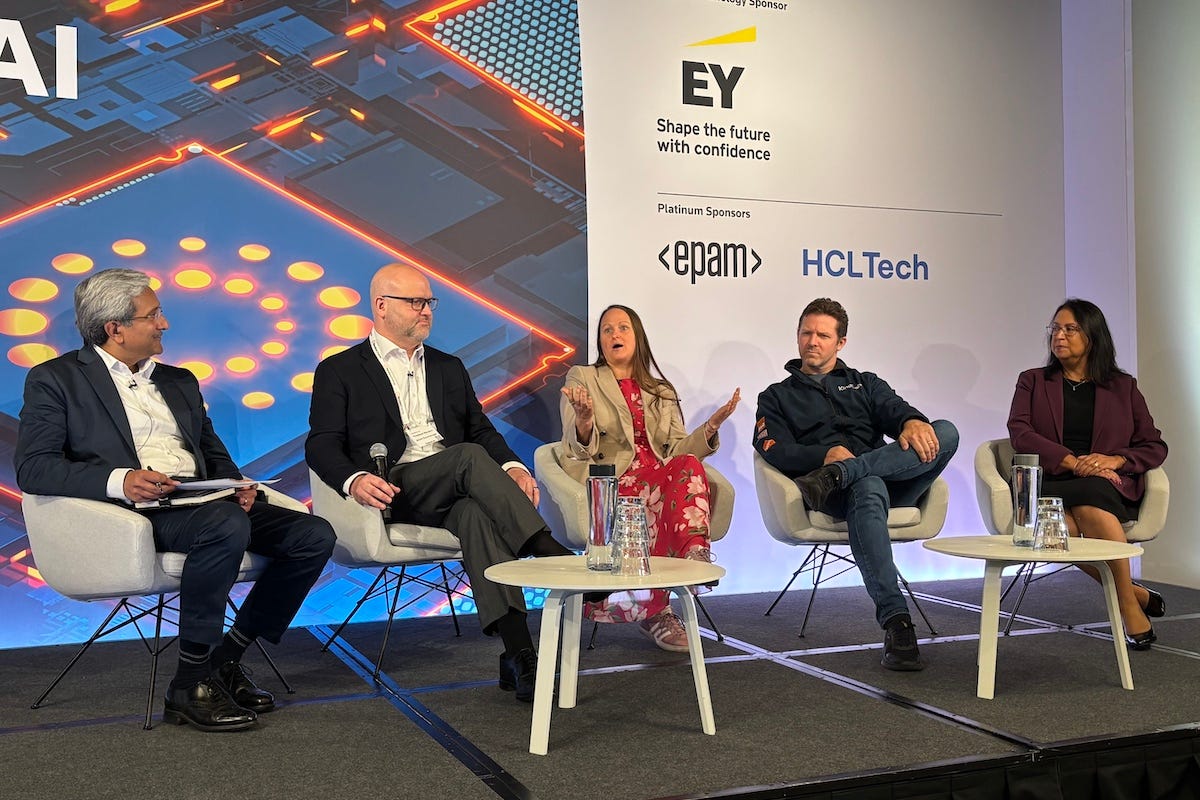
The comments were made at Momentum AI 2025, a two-day enterprise technology conference organized by Reuters Events. The panel discussion, titled “Benchmarking Enterprise AI Transformation: Where are we on our AI transformation journey?”, was moderated by Ashley Braganza, Dean of Brunel Business School and host of The AI Adoption Podcast.
From pilots to operations
Beyond return-on-investment (ROI) debates, panelists repeatedly stressed that AI is no longer being treated as a side project. Instead, it is increasingly woven into day-to-day operations.
Ladva said Swiss Re’s AI strategy is business-led and technology-enabled, reversing the traditional model where new capabilities emerge from IT teams before finding commercial relevance. She said the focus is on embedding AI into core workflows rather than layering it on top of existing processes.
In claims management, for example, tens of thousands of cases now pass through AI-supported systems, while underwriting tools are being offered directly to clients to speed up decision-making. The goal, she said, is to make AI part of how work is done, not an optional enhancement.
Jason Escaravage, chief information officer at Thomson Reuters, said the company’s AI adoption now spans both internal productivity and customer-facing products, with generative AI tools made available to all employees to move beyond basic question-and-answer use cases.
He said staff are increasingly building multi-step workflows and retrieval-augmented generation systems, while AI agents are being deployed in specific teams such as sales, legal, and development.
“We wanted to provide that horizontal productivity capability to all of our users,” he added. “Beyond that general horizontal layer, we’re very focused on putting agents into specific teams and workflows to get benefits.”
Within the legal function, he said, tasks that once took hours or days, including contract review and eDiscovery, can now be completed in minutes or hours.
Electronic discovery, or eDiscovery, refers to the process of identifying, collecting, and producing electronically stored information (ESI) in response to requests made during litigation or investigations.
Culture before code
Despite technological progress, executives agreed that culture remains a major barrier to enterprise AI adoption. Moving from pilot projects to scaled deployment requires changes in behavior, skills, and trust that cannot be achieved solely through software.
Hilary Reynolds, head of digital and technology for CBRE’s UK and Ireland business, said early engagement has been critical. The real estate group launched an internal AI champions community to encourage experimentation and knowledge sharing across business units.
What began as a small initiative has expanded rapidly, she said, bringing together employees with varying levels of technical expertise.
She said engaging employees early should not be seen as a sign that an AI initiative is failing.
“When people actually work through real scenarios themselves, it stops being frightening,” she said, adding that practical exposure has been more effective than top-down mandates.
Escaravage said the cultural shift required by generative AI is often underestimated. Unlike traditional enterprise software, AI tools require users to interact conversationally, delegate tasks, and critically review outputs. He said that change has forced technology leaders to spend more time on learning, skill development, and change management than on infrastructure rollout.
Architecture choices harden
As AI becomes more central to enterprise operations, architectural decisions are evolving as well. Rather than framing choices as a binary decision between building or buying, executives increasingly describe a hybrid approach.
“If you make one big bet and something changes commercially, that becomes very challenging,” Ladva said. “Our approach is hybrid, combining internal capability with strategic partners and newer entrants.”
Blatchford said modular architecture is a guiding principle at Kingfisher.
“The North Star architecture is modular, because that lets you swap technologies in and out,” he said. “It limits vendor lock-in and reduces risk when things change.”
Escaravage described a similar best-of-breed strategy at Thomson Reuters.
“This is going to be an ecosystem play over the short term,” he said, referring to partnerships that connect critical data, workflows, and large language models rather than relying on standalone platforms.
Ladva said that today AI primarily augments decision-making rather than replacing it. Concerns about hallucinations, data quality, and accountability mean humans must remain in the loop, especially where outcomes carry legal or financial consequences.
Reynolds echoed that view, warning that overreliance on AI-generated outputs without sufficient scrutiny could create new risks. In advisory and expertise-driven businesses, she said, the value lies not just in speed, but in judgment and critical thinking.
The discussion also touched on longer-term questions about how far automation could go. While some panelists argued that no category of work is theoretically off limits, others stressed the importance of societal trust, ethics, and customer expectations in shaping adoption.
Fail fast, not forever
As organizations experiment with AI, leaders acknowledged that not every initiative will succeed. The challenge, they said, is avoiding so-called zombie projects that linger without delivering value.
Ladva said Swiss Re does not track a formal failure rate but applies a stage-gated approach designed to quickly stop unsuccessful initiatives. She said transparency is essential to prevent resources from being consumed by projects that no longer make sense.
Escaravage added that the real metric is learning velocity rather than success or failure in isolation. Given the rapid pace of model and tooling improvements, he said experiments that fell short a year ago may be worth revisiting as capabilities mature.
Looking ahead, panelists agreed that enterprise AI strategies will continue to converge around a few core principles: focus on embedded use cases, rigorous measurement, cultural readiness, and architectural flexibility. As boards sharpen their scrutiny, the organizations that succeed will be those that treat AI not as a side experiment, but as an integral part of how the business operates.