


Artificial intelligence is spreading through large companies faster than executives can govern it, creating a widening gap between official policy and what employees are actually doing at their desks.
Unofficial or “shadow AI” use is now widespread as staff experiment with ChatGPT, Perplexity and other tools before compliance, legal and security teams can approve them. That is turning AI adoption into a bottom-up reality rather than a centrally managed program.
“If you walk around the offices, you will see on the second screen people have ChatGPT or Perplexity or whatever it is. When the manager comes in, they click it away. This is happening all the time, everywhere,” said Rickard Damm, senior vice-president of consumer AI at Deutsche Telekom.
“I think all of us have a gigantic shadow AI that we are not talking about and acknowledging if we don’t let people actually experiment,” he said.
Damm said Deutsche Telekom has about 40,000 frontline staff in Germany and has given them broad AI capabilities to test ideas, build agents and improve daily work. He said usage has been growing exponentially week after week, showing how quickly adoption spreads when employees see immediate value.
In practice, that includes employees drafting customer responses, summarizing meetings, building small workflow agents and testing productivity tools without waiting for formal approval.
Executives said these micro-uses accumulate into meaningful efficiency gains, but they also create fragmented processes that are hard to audit.
That pace is creating a management problem as much as a technology opportunity. Tools are moving faster than enterprise approval systems, and workers are not waiting for every committee to catch up.
Conny Ploth, vice-president of global AI transformation at Santander, said this was one reason shadow AI had become so widespread.
“The shadow AI is happening because we are not fast enough onboarding new technology and solutions,” she said.
“We are too slow in our governance processes,” Ploth said. “We need to bring legal, risk, compliance and CISOs (Chief Information Security Officers) on our way and make them speed up decision-making.”
She said companies often spend so long approving a tool that a newer one has already emerged.
That lag leaves approved systems behind the market and pushes employees to work around them.
Executives said this mismatch is structural. Large organizations are designed to minimize risk, while AI innovation is moving at consumer-internet speed. That creates a persistent gap between what is officially allowed and what is practically used.
The problem is especially acute in regulated sectors. Banks and insurers cannot adopt every new tool instantly, but they also cannot ignore rising demand for faster and more personalized digital services. Executives said this tension is forcing firms to balance control with unmanaged experimentation.
AI transformation
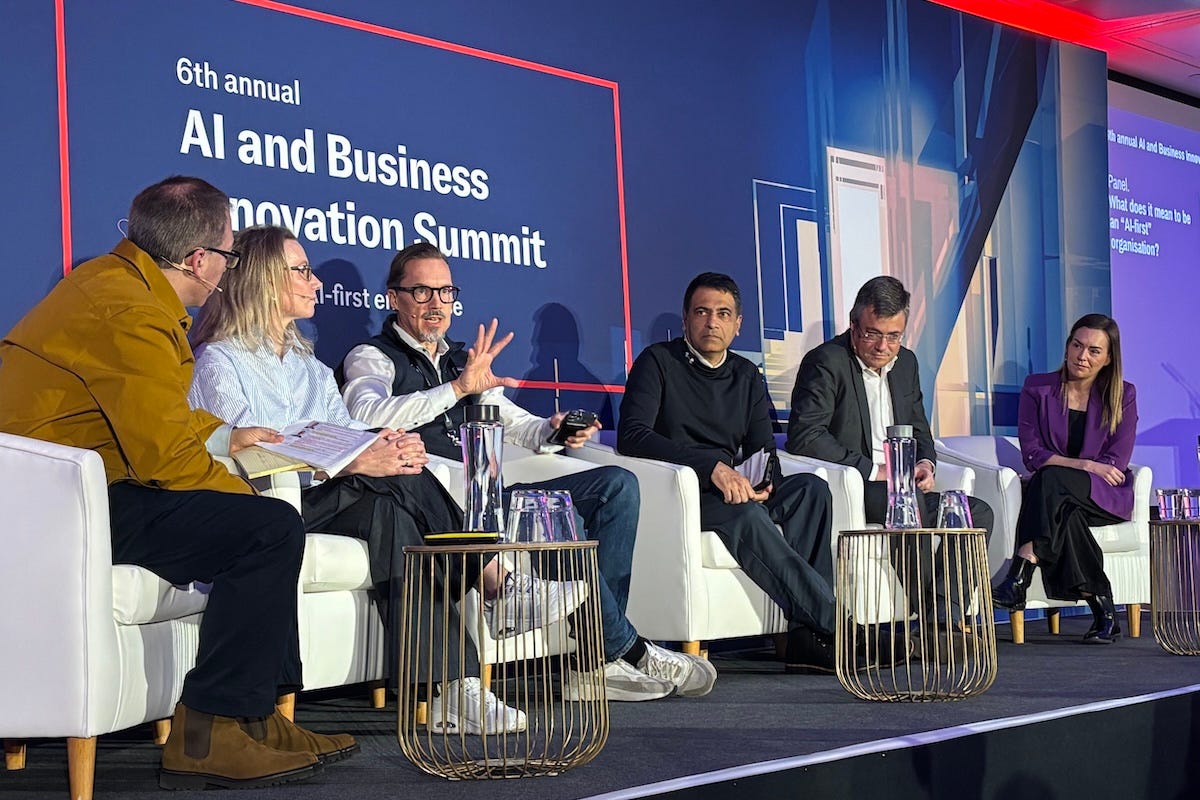
These issues were debated at the AI and Business Innovation Summit, organized by Economist Impact in London on March 25.
The panel was moderated by Kenneth Cukier, deputy executive editor of The Economist. It brought together executives from Santander, Deutsche Telekom, Schneider Electric, and AXA Germany, as well as an academic from Spain.
Speakers said using AI tools across an organization is not the same as becoming an AI-first company. Many firms are still mistaking experimentation for transformation.
“If we really want to be AI-first, how do we really transform the company? If only 5% of people are using AI tools, we haven’t transformed the company,” said Philippe Rambach, senior vice-president and chief artificial intelligence officer at Schneider Electric.
“The key point is to think about what value we want to bring to customers and what we need to change in the way we work, not start from a new agent or a new LLM,” he said.
Rambach said companies should begin with business problems, define what they want to change, and then decide how AI can enable that shift.
Isolated use cases and productivity tools, while useful, do not change an operating model on their own.
He said many organizations are still layering AI onto legacy workflows rather than redesigning processes from the ground up. That approach may deliver incremental gains but rarely produces the step change needed to justify large-scale investment.
“What I’m most proud of is not what we do for internal efficiency, but how we embed AI in what we offer to our customers,” Rambach said. “Our AI helps them save energy and makes our tools easier to use.”
That distinction highlights a broader shift. Internal copilots may show early traction, but true transformation starts when companies change products, customer value and core processes rather than adding another layer on legacy systems.
Stephanie Peterson, chief customer officer at AXA Germany, said this requires structural change, not incremental adjustments.
“We changed the entire structure of our organization,” she said. “What was historically our HR department is now called people, data and experience.”
“We need to fundamentally change the structures and KPI sets to deliver differently, faster and better,” Peterson said.
She said the redesign was developed at the board level and implemented with regulatory approval, marking a formal shift in how the company approaches workforce planning, data and AI.
At AXA Germany, the new structure integrates people, data and technology into a single framework for decision-making. Peterson said that allows the company to align hiring, skills development and digital transformation under one strategy rather than treating them as separate functions.
Peterson added that culture must evolve alongside structure, with organizations working across gray zones where collaboration creates value beyond rigid departmental boundaries.
Workforce shift
Executives also pointed to a broader shift in the value of human work.
“All of a sudden, intelligence became abundant and cheap, and the entire way you invest has to be recalculated,” said Ikhlaq Sidhu, dean of the IE School of Science and Technology in Madrid.
“There is a new bar of what it means to add value,” he said. “Some people rise above the AI, and others fall below it.”
Sidhu said that repetitive cognitive work is becoming vulnerable, much like manual work during earlier waves of automation. Workers who combine judgment and critical thinking with AI will gain, while others risk losing relevance.
He added that organizations must rethink how they allocate capital and talent, as the cost of certain types of knowledge work declines.
That could shift investment toward roles that amplify AI rather than compete with it.
The panel’s advice for hiring reflected that shift. Damm said candidates should build and ship projects using no-code or low-code tools rather than rely on CVs. Sidhu said skills and mindset matter more than pedigree, while Rambach stressed the enduring value of core disciplines such as mathematics and critical thinking.
The discussion also highlighted a tension between inclusion and elite performance. Damm said companies should “supercharge the super people,” while Peterson said insurance firms are more focused on filling repetitive roles that AI can help automate.
Executives said both approaches can coexist.
Companies can raise baseline productivity through automation while also enabling top performers to scale their impact using AI tools.
Sector differences were clear. Telecom groups can move faster, while banks and insurers must balance innovation with trust and regulation. Ploth said Santander must preserve customer trust but also meet demand for faster, more personalized services.
The panel closed on failure. Peterson said companies must accept unsuccessful experiments as part of the transformation.
“You’re never going to hit home runs if you’re not willing to strike out,” she said.
“I want seven out of every 10 ideas to be a failure, because if that’s not happening, we’re not trying the right things,” Peterson said.
Cukier noted that not every company can afford that failure rate. Peterson said the alternative is worse: fail early in controlled experiments or risk falling behind later.
Firms that can govern AI effectively, redesign their operations and adapt their workforce are likely to be better positioned as adoption accelerates.