Companies are flooding their organizations with generative artificial intelligence (AI) pilots, but most are struggling to show meaningful returns. The real gains are emerging not from more use cases, but from fewer, higher-impact bets tied directly to business performance.
As pressure mounts from boards and investors, executives are being pushed to prove results, not activity. That is forcing a shift from experimentation to hard prioritization, with leaders deciding which AI initiatives deserve capital and which should be cut.
“Forget these white rabbits. Focus on a few clear objectives, because this is what is most likely to be driving EBITDA and turn this from a proof-of-concept exercise to something that can unlock results,” said Michael Jacobides, Sir Donald Gordon Professor of Entrepreneurship and Innovation at London Business School.
“The localized use cases are limited. They don’t tell you what the value really is. You need to start focusing on the real value add that can motivate the leadership,” he said.
Jacobides said too many companies are rewarding isolated use cases that look inventive but do little to change performance. Leadership should be ruthless in defining what they want to change, how they will measure it, and when they expect results.
He said discipline matters because the strategic gains from AI do not come from dropping a tool into an existing process. They come from changes in how work is done across the organization, much as earlier industrial technologies only delivered when companies redesigned the systems around them.
That shift, he suggested, is what separates experiments that generate internal buzz from investments that can move earnings, sharpen competitive position and justify sustained executive attention. In his framing, the issue is not whether companies can find another use case, but whether they can identify a business problem large enough to warrant structural change.
Bubble economics
Jacobides was speaking at the AI and Business Innovation Summit in London on March 25, an event organized by Economist Impact. His session examined whether companies should back broad-based experimentation or concentrate on a small number of projects that can materially improve performance.
Jacobides, whose work focuses on strategy, innovation and industry transformation, said the choice is becoming more urgent as capital markets demand evidence of real returns.
He framed that decision against a distorted market backdrop. Generative AI is highly relatable and widely used, but its economics remain weak and its business logic is still unsettled.
“We are all living in the biggest premium party that humanity has seen, because the prices don’t even reflect the marginal cost, let alone the training,” he said. “The economics of the sector are entirely unworkable.”
Jacobides said the companies making real money so far are largely those selling compute, chips and related capacity, while many model and application providers are still burning cash. He warned that today’s pricing cannot last and said enterprises should be careful about building long-term plans on temporary economics.
That disconnect has intensified pressure on chief executives, who are being asked by boards for an AI strategy before the value proposition is fully understood. The result is a rush to produce visible activity, even when that activity is not tied to measurable business outcomes.
His research points to a clearer pattern. Companies that use generative AI regularly in functions central to the firm, such as operations, information technology (IT), engineering, risk, and legal, tend to be more satisfied with the results than those that use it only occasionally or for peripheral tasks.
“The more you use AI for things that are central to the firm, like operations and IT and engineering, even risk and legal, the happier you are,” he said.
By contrast, the most common corporate uses, such as writing emails and generic cross-functional assistance, do not change performance enough to justify the excitement.
“The things that are the places where most people use it, writing email, cross-functional stuff, don’t really move the needle,” he said.
He also said that an obsession with cost-cutting and productivity, on its own, often fails to create meaningful gains. More promising are systematic uses tied to stronger customer engagement, hyper-personalization and the creation of new business models.
Where value lies
To explain why, Jacobides turned to history. When factories first moved from steam to electricity, the biggest gains did not come from replacing one power source with another. They came later, when manufacturers redesigned the whole production layout to reflect what electric motors made possible.
“The real benefit was not changing one engine with the other,” he said. “The real benefit was that you would entirely reconfigure the production.”
That is how executives should think about AI. Layering a tool on top of an inherited workflow may offer incremental convenience, but it is unlikely to deliver the deeper gains that warrant board-level attention and capital allocation. The real opportunity lies in redesigning processes so that AI changes the pace, sequence and economics of work.
Jacobides did not dismiss smaller experiments entirely. He said these “white rabbits” can still help companies get staff comfortable with the technology, encourage adoption and surface useful ideas that leaders might not discover on their own.
“They help motivate adoption and integration of technology,” he said. “There is a space to experiment with technology that is seen as threatening, which is super important.”
He pointed to examples such as custom generative AI tools and hackathon-style initiatives that can engage employees and create momentum. But he said those initiatives should serve a broader strategy, not substitute for one. Used well, they can prepare the organization for bigger changes rather than becoming a portfolio of disconnected pilots.
He also challenged the assumption that AI simply destroys jobs. Using radiology as an example, he said stronger AI can increase the strategic value of certain professions by expanding demand, sharpening specialization and changing how their expertise is used.
“AI is good, but we have a massive shortage of radiologists because the salaries are going up, demand is going up because the strategic context for them has become more advantageous,” he said.
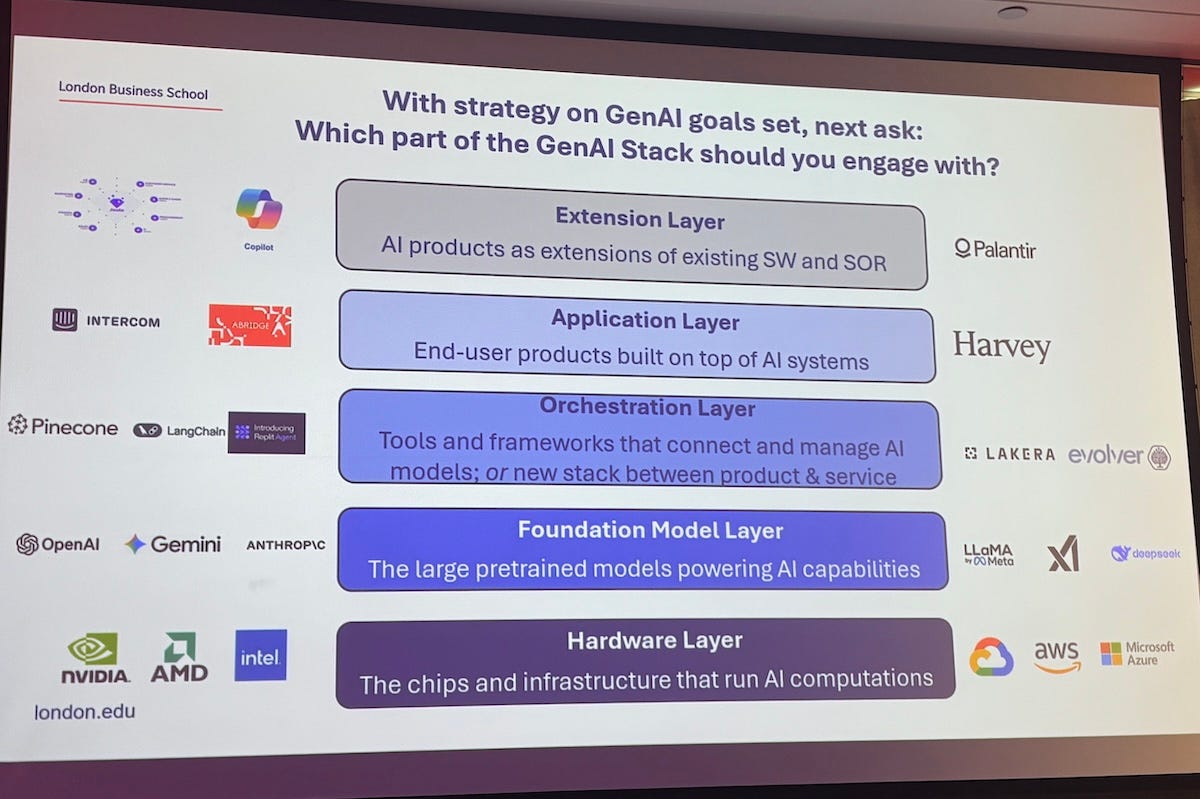
Companies must decide where in the AI stack they want to play, whether at the hardware, foundation model, application or orchestration layer. The biggest opportunities may lie in combining generative AI with traditional machine learning and enterprise data to produce a clearer value proposition.
For Jacobides, the practical message is straightforward: ambition matters, but discipline matters more. Companies that use AI to rethink systems, focus investment and articulate a clear destination are more likely to turn experimentation into durable business results.