


Within five years, callers will need to prove they are human as artificial intelligence (AI) agents become the default voice, said a leading European startup.
Devices would verify humans, while people’s own AI agents would be confirmed as genuine, it said.
“Now we’re in the transition phase. In three to five years’ time, it will be an expectation that you interact with AI,” said Mati Staniszewski, co-founder and chief executive of ElevenLabs. “Today you assume you are interacting with a human unless it’s proven to be AI. It will be the opposite.”
“It’s not only the agents working on behalf of our businesses. It’s also the increasing threat of personal agents,” he said.
He said many people already have a personal agent, and more will deal with businesses over the coming year. ElevenLabs is building ways to detect them in text and voice, working with others on common protocols and releasing detection models publicly so any business or government can use them.
The transition will unfold differently depending on how mature each country’s public and commercial sectors are, he said.
He pointed to Britain as a likely leader in applied AI. ElevenLabs signed a memorandum of understanding (MoU) with the Department for Science, Innovation and Technology (DSIT) in June, covering voice access to public services, AI security research and skills.
Under the agreement, ElevenLabs is giving the UK government access to its voice models for a three-year research program. One strand will test whether people can tell when they are speaking to an AI agent, and how that changes their behavior.
Clear signals about when to expect an AI conversation would help curb misuse of open-source models that lack such safeguards, he said. He worries about the longer tail of less advanced countries and wants to work with them.
ElevenLabs, which Staniszewski co-founded with Piotr Dabkowski in 2022, builds voice models and conversational agents for businesses and creators.
Enterprise clients now generate most of its $600 million in annual recurring revenue (ARR). Headquartered in London, where about 200 of its staff are based, the company has grown from 300 to more than 1,000 employees worldwide this year.
Passing the Turing test
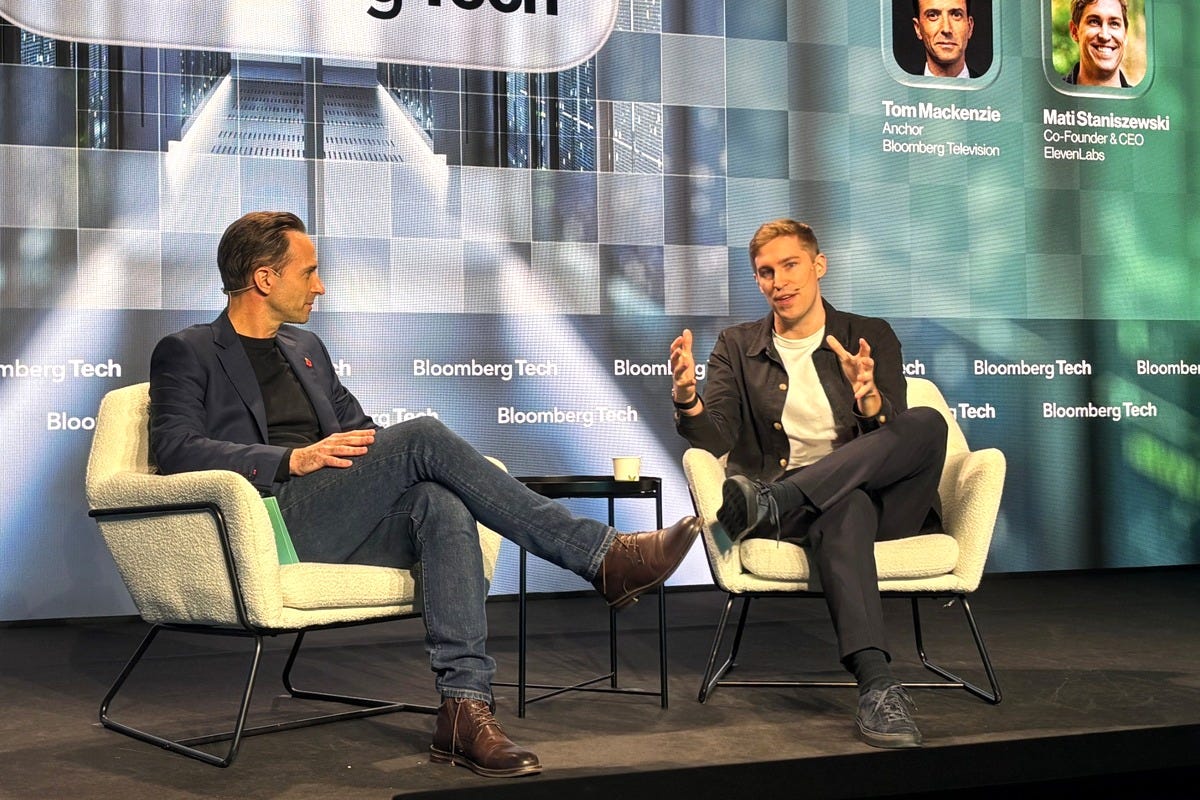
The comments came during a fireside chat titled “When AI Finds Its Voice” at Bloomberg Tech London, organized by Bloomberg, in London on November 3. Tom Mackenzie, an anchor at Bloomberg Television, moderated it. The session opened the event’s main stage.
Staniszewski said the conversational Turing test, in which a person cannot tell an AI agent from a human, has already been passed in customer support. There, agents have the right knowledge and resolve queries correctly.
“In that setting, which is very controlled, you know roughly what the expected conversational patterns are,” he said. “As you shift to a sales conversation or a dynamic conversation, then it gets a little bit harder.”
An agent must know when to interrupt and when to pause, which users already expect, he said.
If a listener simply nods or makes a noise, the agent should carry on speaking. Learning those patterns in open-ended uses such as sales is a large part of ElevenLabs’ research work.
“In the next six to 12 months, we will see the conversational AI Turing test be passed across all types of different use cases,” he said. “It’s not only intelligence; it’s also the emotional intelligence and how you react in those conversations.”
He listed sales, marketing, fan engagement and creative projects with artists among the next targets.
ElevenLabs released its Eleven v4 and v4 Turbo speech models in September, adding more expressive control, support for more than 90 languages and lower latency for live voice agents. He said independent benchmarks rank them as the leading text-to-speech and transcription models.
Staniszewski said people must always know when they are dealing with AI. ElevenLabs watermarks all AI content in its conversations, so it can trace how, when and by whom it was created. Separate systems moderate text and voice.
“Voice is such a core part of identity. As we build the ecosystem, it’s not only the safety part of how you deploy it; it’s also safety and guardrails of how the voice agents interact,” he said.
The same technology can also be turned on fraudsters, he said. Spam calls can often be spotted, though not reliably, from the internet protocol (IP) address they come from.
A UK charity built a voice agent with ElevenLabs that picked up calls from IP addresses already flagged for spam. Its only job was to keep scammers talking. The charity published the recordings, and the longest call ran for more than 50 minutes.
Picking the right model
Staniszewski said ElevenLabs is building the interaction layer of AI, since how people interact with AI is key to getting value from it.
Voice AI now spans several types of models, from component systems that chain speech recognition, language and speech generation to speech-to-speech and duplex models that can listen and talk at once. Behind its agents, ElevenLabs runs an “interaction engine” that decides which model handles each stage of a conversation.
“You don’t need a Ferrari for every task,” he said.
A basic question about a product can go to a simpler, faster model, while authenticating a caller and processing a refund calls for a more reliable one. The system also has to know when to hand the conversation to a human.
“It’s going to be a lot of AI agents, but knowing when to bring the human into the picture and how to continue the contextual layer is as important,” he said.
He said Trainline now resolves ticket rebookings and cancellations more than five times faster with agents, while Revolut is looking beyond in-app support to proactively offering customers product information.
He said three forces are driving demand:
Conversational agents that combine intelligence with emotional intelligence
AI and humans working together to contain and resolve customer queries
A connected customer journey, from support to proactive offers
Asked whether cheap open-weight voice models, such as those from Palo Alto-based Fish Audio, could commoditize the market, he said models are only one part of the business. Deploying them needs a knowledge base, connections to customer relationship management (CRM) and telephony systems, and tools for testing and monitoring.
Fish Audio, which grew out of the open-source Fish Speech project, raised a $52 million seed round in July.
“Moving from building a model to deploying that in production is a different beast,” he said. “As models get closer in capabilities, we still know that those two other layers, product and ecosystem, remain essential.”
He said customers can draw on thousands of ready-made simulation tests, guardrails and voices, while forward-deployed engineers work alongside them. He was once one himself at Palantir.
Enterprise adoption of AI has barely begun, he said, citing Anthropic’s filing for an initial public offering (IPO). It showed that Fortune 500 customers spending $100,000 or more a year spent less than 0.1% of their total expenses with Anthropic in the third quarter. Even its top 10 Fortune 500 customers spent less than 1%.
“If we use that as a proxy for adoption, it is just being started, and we see exactly the same,” he said.
Clients such as Admiral, Stripe, Deliveroo and DoorDash are only at the start, he said. US political friction concerns him less, as those clients keep finding more value in their deployments. The company is still hiring to keep up.
ElevenLabs aims to run itself like a public company ahead of a possible 2028 listing, he said.