


The European Central Bank (ECB) is doubling down on a digital euro to counter the creeping dominance of US dollar stablecoins. The UK risks falling behind, leaving consumers no clear right to redeem the foreign-issued stablecoins they hold.
Policymakers are only beginning to grasp that the stablecoin debate is not merely a financial markets question. It is a contest over monetary sovereignty.
“We’re not thinking about it enough. It’s very vital that we realize this isn’t just about financial markets; it’s also about geopolitics, and I don’t think that has really resonated as yet,” said Dr. Lisa Cameron, founder of the UKUS Crypto Alliance and former member of parliament.
“Many of the parliamentarians think, ‘Oh, this is about cryptocurrency, and I don’t need to get involved in that.’ Actually, it’s very important, because it’s also about the sovereignty of currency,” she added.
Bryan Pascoe, chief executive of the International Capital Markets Association (ICMA), said the ECB’s posture is deliberately defensive.
“The European priorities have been to take a more defensive approach and look at things more related to central bank-run processes than we’ve seen in the US,” he said. “That doesn’t always provide the full-scale accessibility you would see from a private sector stablecoin.”
Europe lacks a single safe asset deep and liquid enough to back a euro-denominated stablecoin at scale. Even Germany, France and Italy have relatively illiquid bond markets compared to the US. That is why the ECB is focused on delivering a central bank digital currency (CBDC) as its digital solution.
Jannah Patchay, executive-in-residence and board member at Global Digital Finance (GDF), said the UK’s current legislation leaves stablecoin holders exposed.
“There is a black hole around the rights that coin holders have,” she said. “There are no provisions as to how, if I’m holding a US dollar-denominated stablecoin, I am actually meaningfully able to redeem them.”
The Financial Conduct Authority (FCA) is now building a competitive framework for locally issued stablecoins. Cameron founded the first All-Party Parliamentary Group (APPG) on digital assets in 2020, when there had been no debates on the subject in the House of Commons. She said parliamentary engagement has since “tapered off” and must urgently be revived.
Synthetic CBDC emerges
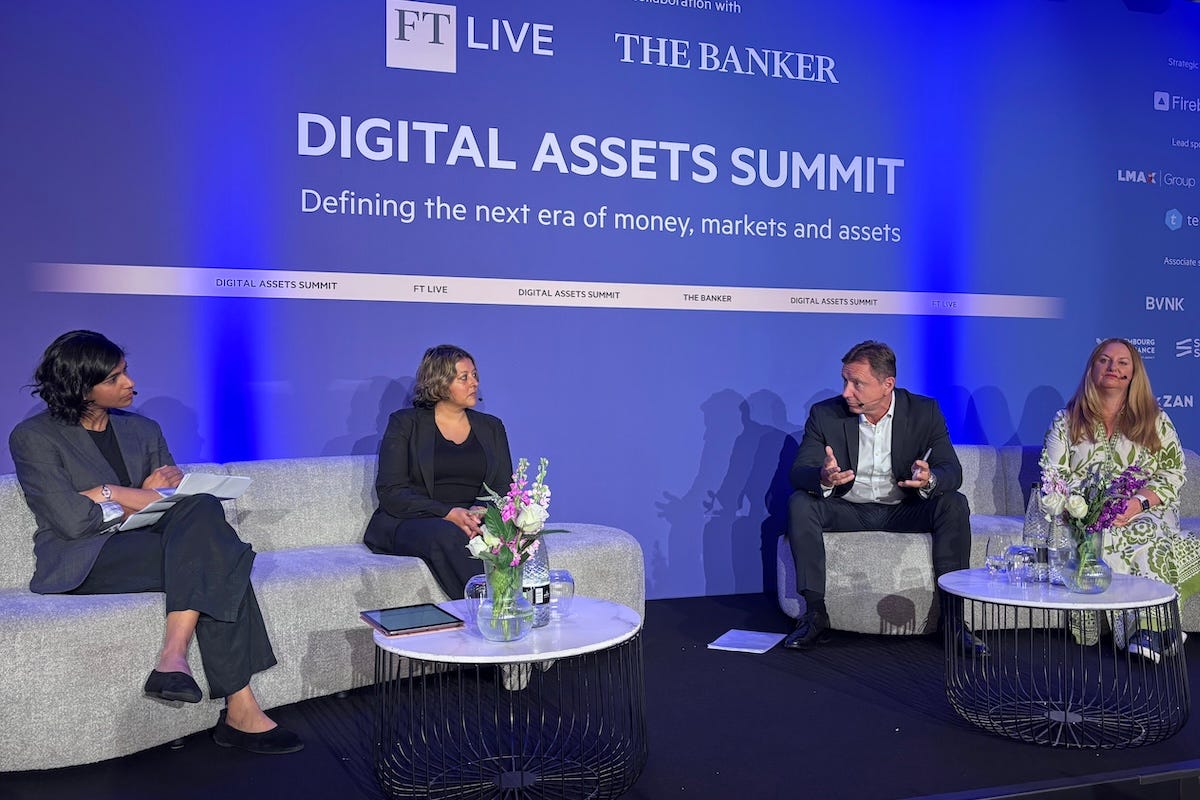
The panel took place at the Financial Times Digital Assets Summit in London on May 13. It was moderated by Jill Shah, US trading and crypto correspondent at the Financial Times. The discussion examined whether stablecoins promote financial inclusion or risk entrenching dollar dominance globally.
One idea that drew notable interest was a CBDC-stablecoin hybrid, raised by an audience member from a US bank stablecoin issuer. He proposed that the Federal Reserve allow banks to earmark a sub-account of a Fed master account for stablecoin reserves, removing capital requirements and shifting them to the Treasury’s balance sheet.
Patchay said the structure would entirely eliminate the US Treasury as an intermediary in US Treasury issuance.
“It’s almost like a synthetic CBDC type structure,” she said. “But ultimately, it’s the coin holder who is lending to the government via you as an intermediary, just without the issuance of any debt at any point. From a regulatory perspective, it’s super interesting.”
Cameron said a CBDC-stablecoin hybrid had been widely discussed at the Consensus Miami 2026 conference in early May as a likely direction for the longer-term future.
On wholesale markets, Pascoe was candid about how far the industry has to go. Digital securities have undergone extensive pilots but have yet to achieve scale, largely because cash settlement has failed to keep pace with the digitalization of securities.
“We still see stablecoins principally as an access tool for crypto asset trading,” he said. “They haven’t necessarily manifested themselves on a consistent basis in terms of payments, savings or remittances, which is the next obvious use case.”
Only the US dollar market has the depth to support stablecoins as collateral at scale. Tether is already the 17th largest buyer of US Treasuries, arriving faster than most expected, yet its presence has already moved yields.
Pascoe also cautioned that the label misleads retail investors, who may assume a stablecoin guarantees a one-to-one dollar peg, which it does not. He said the inherent risk needs to be communicated more clearly.
He said short-dated government bonds remain the most important collateral for stablecoins because they are safe, provide a reasonable yield to issuers, and can be liquidated quickly to meet redemption demands.
The Bank of England’s ongoing stablecoin consultation and the UK Debt Management Office’s work on expanding Treasury bill issuance are likely connected for precisely this reason.
Africa’s payment detour
Last year’s GENIUS Act enshrined an explicit US policy intent to entrench the dollar's global use through stablecoins.
Patchay said this poses a direct challenge to monetary sovereignty wherever the dollar is not the native currency.
“The combination of the explicit policy intent from the US government that stablecoins should be another means of entrenching dollar use in the financial system, along with the ready availability of dollar-denominated stablecoins, poses challenges to monetary and economic sovereignty,” she said.
“If you clamp down entirely on dollar stablecoins, people will just use them in ways that are not transparent to the regulator. Regulators and central banks will lose sight of those flows and lose all control,” she added.
Nigeria and China have both attempted restrictions, pushing usage underground rather than eliminating it. Nigeria’s e-Naira CBDC also illustrates a key lesson: tokenizing a currency does not work if the underlying economic fundamentals are weak.
The challenge is sharpest in Africa. Colonial-era correspondent banking routes payments between African countries through European and American financial hubs.
“If you are in Senegal in West Africa and you want to make a payment to a supplier in Kenya in East Africa, your payment will be routed from Dakar to Paris to New York for the dollar leg, back over to London and then down to Nairobi,” Patchay said.
“There will be multiple correspondent banks involved at each leg of the journey, and therefore multiple layers of cost and inefficiency. Some of these payments can take up to a week or more,” she added.
African central banks are now looking to leapfrog this system with stablecoins and digital money, just as the continent once leapfrogged traditional banking with mobile money. This year, GDF launched an Africa-specific chapter on stablecoin regulation at the 3i Africa Summit.
Cameron added a psychological dimension that policymakers have largely overlooked.
She said that as money becomes digital, citizens’ emotional connection to their national currency weakens. She said governments must urgently build frameworks to protect monetary sovereignty before that attachment fades entirely.