


The most valuable new hire in technology is increasingly not the trained coder. It is the professional who spent years mastering a different field entirely, and who can see how human systems fit together in ways that artificial intelligence (AI) cannot replicate.
Generative AI can analyze those systems. What it cannot hold is the judgment built from working inside them: running wards, navigating supply chains, managing public services. That is what employers are now seeking.
“I talk about being jigsaw puzzle experts. If you’re really good at jigsaw puzzles, it means you can see the picture you’re trying to get to. Whether it’s putting pieces of code together or putting platforms together, having that experience becomes really valuable,” said Susan Bowen, chief executive of Digital Catapult.
Bowen, who began her career as a coder before containerization existed, said the analogy applies equally to anyone entering from healthcare, social care or engineering.
She said the shift is also creating room for skill sets that the industry has long struggled to classify.
“There’s an opportunity now more than ever for new and divergent skill sets, because we’ve kind of hidden those before. As people come through without experience, management thinking and putting skills together is going to be really important,” she said.
Anna Brailsford, chief executive of CodeFirstGirls, one of the world’s largest communities of women in technology, said former NHS workers are now among the fastest-growing cohort in its programs.
“A domain edge, for me, would be taking a GP, teaching them data science and AI, and placing them in a professional services consultancy’s data insights team in the health sector,” she said. “That domain edge is going to bring you something that AI can never bring you. The way they think about putting systems together is entirely different.”
She said the shift is already visible in how companies are approaching entry-level hiring.
“What we’re seeing in entry-level talent is the complete rise of the career switcher. At mid-talent level, what you’re looking for is agility and adaptability, with all of those years of industry experience, to become a systems thinker,” she said.
Fear stalls AI adoption
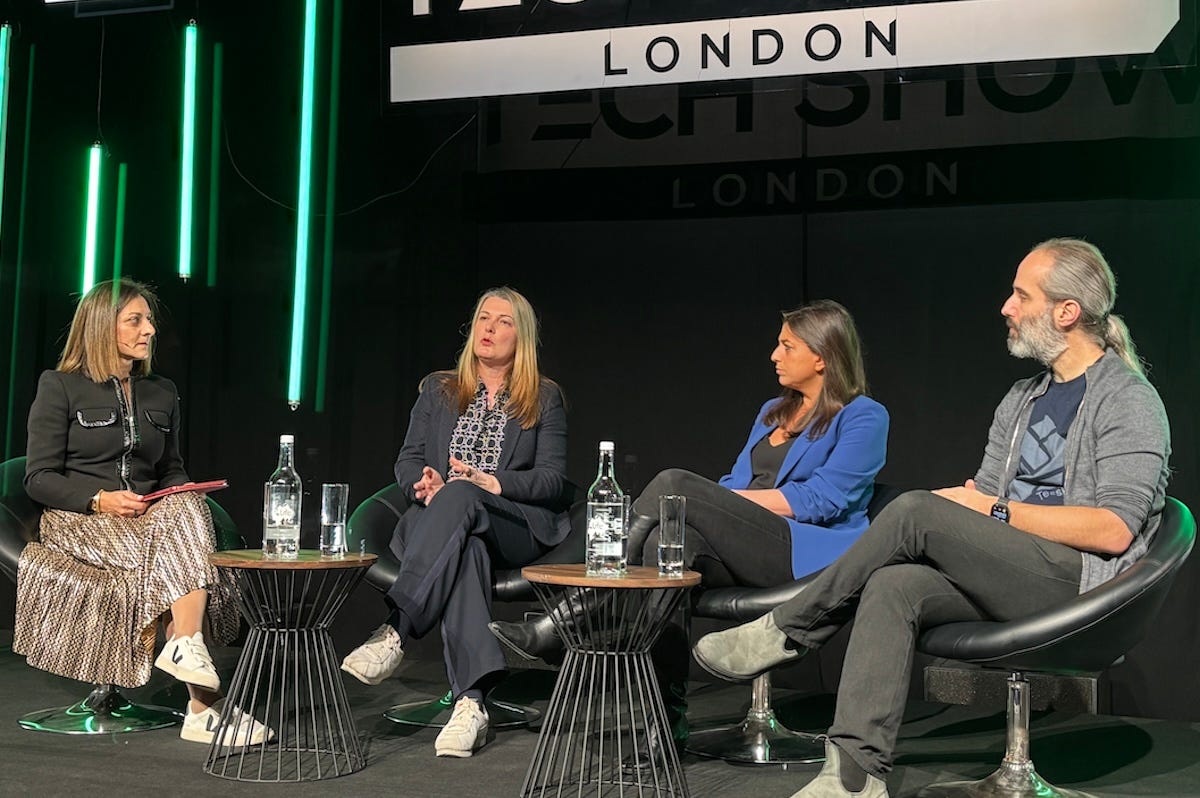
The panel spoke at Tech Show London 2026, organized by CloserStill Media.
Guy Podjarny, founder and chief executive of Tessl and former chief executive of Snyk, said speed is the most misunderstood variable in AI adoption.
“No matter if you are an enterprise or a small business, act with urgency. Using AI tools should not be predicated on having your data in order. It is a mistake to wait until you organize your state before you get stuck in,” he said.
Podjarny said the root of the delay is rarely operational but psychological.
“Fear is probably the most paralyzing piece. It’s easier to pick the opinion you like and find enough substantiation for it. Fear is probably the biggest slowdown factor. It’s not about head start,” he said.
The problem is compounded by the pace of change itself, he argued: even well-considered decisions made months ago can be obsolete before they are acted upon.
“What is deemed fast to a typical company, even midsize, let alone an enterprise, is just nowhere near fast enough. By the time you finish your analysis and book the meeting to review it, it will no longer be relevant because the capabilities have evolved,” he said.
The debate over entry-level talent drew a sharper divide. Press coverage suggesting junior developers are no longer needed prompted Brailsford to challenge the premise directly.
“I want to put to bed the myth that entry-level technology talent is not required. If we can focus on bringing in systems thinkers, it is an absolute no-brainer: that talent is going to be just as relevant today as it will be by 2030,” she said.
Podjarny said he did not fully disagree but drew a distinction between job security and near-term productivity.
“Mid-level talent right now is the one that shines. These people are sufficiently adaptable and not set in their ways. At Tessl, we hire mid-level more than senior talent, because adaptability matters more than craft in this world,” he said.
He said hiring decisions now turn less on experience and more on attitude toward AI.
“I’m much more worried about hiring a person who is reticent to embrace AI tools than one who is too junior and doesn’t yet have good taste. They will learn that,” he said.
Learning to manage AI
Bowen and Brailsford said adaptability has become the primary currency of the technology workforce, overriding traditional notions of seniority and accumulated craft.
Podjarny said at Tessl, adaptability is something they observe rather than recruit for.
“We’ve deleted more code at Tessl than ever. You create a thing, learn from it, the world changes. You take the learning along, delete what you built, then create something new. Creating is now easier,” he said.
He said the ability to manage AI tools, not just use them, has become a distinct competency that most organizations are failing to build deliberately.
“There is a competency in learning to use AI well and in using agents: think of it as a management capacity. I know how to manage people; I know how to manage AI. Carve out dedicated time and invest in those skills,” Podjarny said.
The panel then turned to government and the partnership models best placed to close the wider skills gap.
“The way we stimulate growth in the UK economy is through the startup community and scaleups. Lord Timpson came to the Ministry of Justice and said: I have these problems in the prison system. Who has solutions? By inviting in startups and partners, you bring in technology thinking and the skills,” Bowen said.
Lord Timpson OBE served as Minister of State for Prisons, Probation and Reducing Reoffending from July 2024 to July 2026. Before entering government, he spent more than two decades as chief executive of the Timpson Group, a retail services chain known for actively recruiting former prisoners.
Brailsford said effective partnership means industry and government working together on the talent pipeline, citing the Women in Tech Taskforce launched in December as a model of what coordinated effort can produce.
She said CodeFirstGirls draws data from 130 organizations and finds that inclusive talent pools consistently deliver better time-to-value.
Podjarny praised specific policy tools while calling for a deeper cultural shift in how the UK celebrates innovation.
“The government knows how to do tax-based incentives: the Enterprise Management Incentive has improved and work visas are relatively good. But the challenge is on the cultural side: celebrating the successes of innovation. The UK is a conservative society and does not encourage enough of that,” he said.
Bowen closed on a longer horizon, arguing that the next workforce is already building relevant skills in ways the industry has not learned to recognize or measure.
“As we look at the next workforce, we have to think about gamification: what skills are being learned through those applications and how they can be redeployed. These are skill sets that we don’t talk about very much,” she said.
She said organizations have been slow to recognize the skills being built on gaming platforms, and that this represents an opportunity enterprises cannot afford to ignore.