


A quantum computer taking shape in Denmark is designed to do something today’s machines cannot, reliably simulating the chemistry behind new drugs, better batteries and cleaner fuels.
Work on the machine began in autumn 2025 and is due to finish by spring 2027, when it is expected to run on 1,225 physical qubits producing 50 logical qubits, a Level 2 machine in Microsoft’s three-tier system, where qubits are stabilized through error correction instead of left noisy and unreliable.
“A quantum machine is not a standalone entity,” said Zulfi Alam, corporate vice president of Microsoft Quantum. “These are hybrid systems that have to work closely with classical computing and AI.”
Atom Computing, a quantum hardware company based in Colorado, is building Magne’s physical qubits, while Microsoft provides the software that runs on top of them. He said the two companies believe together they are building the most powerful quantum machine of its kind.
“The signature application for a quantum machine today is chemistry, and by extension pharma,” Alam said. “That’s where the collaboration with Denmark makes so much sense. It’s a match made in heaven.”
QuNorth, the Danish body created to own and run the machine, was set up jointly by Denmark’s Export and Investment Fund (EIFO) and the Novo Nordisk Foundation, which announced the 80-million-euro deal on July 17, 2025, with construction beginning later that same autumn.
Magne will sit in Copenhagen’s Innovation District, built for Nordic researchers, startups and enterprises.
“We have worked cohesively for six years on a Nordic quantum initiative, where we have modeled and explored the problems,” said Ebba Carbonnier, chief executive of QuNorth. “Now that we will physically have a Level 2 quantum computer, that is of great benefit.”
Magne is named after Thor’s son in Norse mythology. After Ragnarok, the cataclysmic end of the world, Magne is one of the few survivors, and inherits Thor’s hammer, Mjolnir.
“We love the name for a more humble reason,” Alam said.
Who do you trust
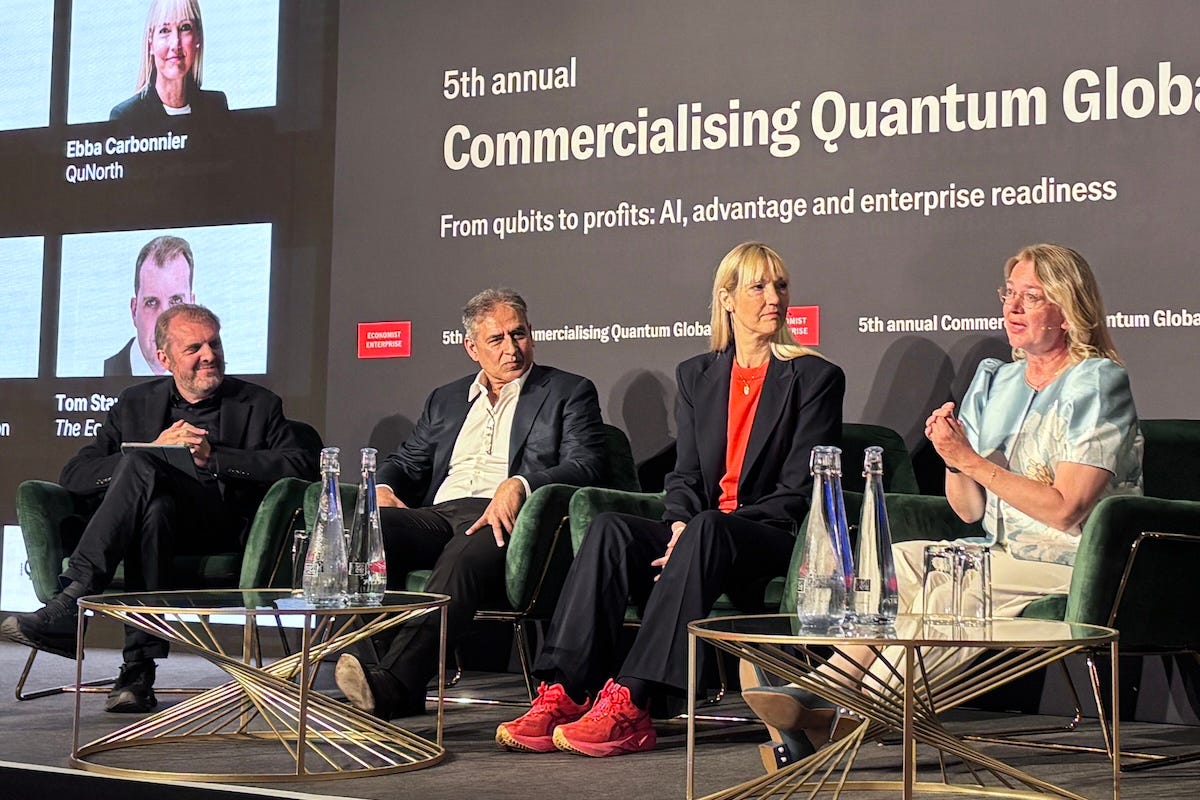
The panel took place at Commercialising Quantum Global 2026, an event organized by Economist Enterprise in London. It was moderated by Tom Standage, deputy editor of The Economist, and examined how quantum computing ecosystems form and who ultimately benefits from them.
Carbonnier joined Alam and Lene Oddershede, Chief Scientific Officer of Planetary Science & Technology at the Novo Nordisk Foundation, on the panel to discuss who should be trusted to build it.
“The question about hardware sovereignty on its own is a little premature,” said Alam. “For us to collectively build a quantum machine successfully, we have to work together.”
He said confining hardware or algorithms to a single geography would only cause such efforts to fail.
An audience member asked how far Magne’s supply chain stretches outside Scandinavia, at an event where sovereignty over technology was already on people’s minds after an AI chatbot called Fable was taken offline the previous week.
Alam said Atom has relocated staff to Denmark, and that the supply chain for this class of hardware can be built entirely within Europe or the United States, without depending on shipping routes through geopolitically unstable regions such as the Middle East.
Oddershede said geography was only part of the picture. Trust mattered just as much.
“It’s important to work with trusted partners,” she said. “A large part of Microsoft’s research and development is actually in Copenhagen, like the Majorana lab, so you could say Microsoft trusts Denmark with an important part of its activities.”
She said the processes and data on the machine belong solely to the customer, with a firewall separating them from the machine’s operators, an arrangement she described as extremely secure.
Standage pressed further, asking whether Microsoft was brought in only to integrate a system after the foundation had already chosen its vendor. Oddershede said it was more complicated than that, and that the decision on a supplier was made jointly with the EIFO.
“We based the decision on a combination of factors, but mostly on technical due diligence,” she said.
She said the foundation, working in partnership with the Danish government, has invested heavily in accelerating the wider Nordic quantum ecosystem beyond the Magne deal itself.
That funding covers hardware, materials development for the qubits themselves and a chip fabrication facility under construction.
“Novo Holdings is a cornerstone investor in 55 North, which to my knowledge is the world’s largest quantum investment fund,” Oddershede said. “We are also cornerstone investors in a European scale-up fund with a target of five billion euros. We are really quite serious about our ambition on investments in quantum.”
She said Denmark’s existing strength in quantum research makes it easier to recruit top talent to Copenhagen.
Getting companies quantum ready
Carbonnier said many of QuNorth’s startup and enterprise partners have already tested an experimental Level 1 machine and are keen to move onto something more capable.
Oddershede said Carbonnier’s team already has a list of about 80 companies, split into three groups: those ready to go straight onto the machine, those in the process of being onboarded and those still curious about what quantum could do for them.
Carbonnier said training and skills programs for these companies are already underway, well before the machine is due online in spring 2027.
Microsoft has already onboarded its last batch of partner companies onto an early development kit and simulator, Alam said, adding that formal customer onboarding with real users is due to begin as early as January, ahead of the machine’s full launch in spring 2027.
Beyond Denmark, Oddershede said the goal is a European-wide system for accessing different types of quantum hardware.
That is similar to a shared test bed already used in the United States and Britain, she said. Under the EuroHPC program, a portal will let customers reach other machines too, such as IQM’s superconducting system in Finland.
Standage compared the effort to the Nordic Mobile Telephone standard that regional operators agreed on decades ago, the basis for the global mobile standard known as GSM. Carbonnier called the parallel apt, saying the region hopes to lead if it can agree on standards for quantum error correction and algorithms.
Oddershede said the region’s shared standards for security and data privacy could make that kind of coordination easier to replicate elsewhere, much as it did with the Nordic Mobile Telephone standard.
Some in the audience assumed the investment was meant chiefly to help Novo Nordisk, the drugmaker the foundation majority owns.
“That was not our driver. Our main driver is to strengthen the ecosystem broadly,” she said. “We are a nonprofit charitable foundation, and we also support social and humanitarian purposes worldwide.”
Drug discovery benefits are still roughly five years away, she added.
She said more immediate benefits are likely in quantum chemistry, materials science, finance and logistics, and that success for Magne simply means having it built and operational by spring 2027, then using it to prove out cases that clearly outperform classical computing.
Alam said Microsoft was measuring success differently, by the sheer number of operations the machine runs once it is live.
“We will have the largest number of operations on this machine, so it’s a tall order, an ambitious project,” he said.
With Magne due online in spring 2027 and dozens of companies already lining up, the partners said the next test will be turning early access into the kind of concrete results that convince skeptics quantum computing is worth the money and effort it has attracted.