


Most large companies still have no roadmap for quantum computing, even though the window to build a competitive edge is already open, according to Deloitte.
An estimated 80% to 90% of Fortune 500 companies still lack a formal plan to prepare for the technology.
Not as many companies have a roadmap in place as they should, said Scott Buchholz, global quantum computing lead at Deloitte.
"I would guess 80% to 90% may not have one. Arguably not as many as should," he said. "Failing to plan is planning to fail.”
Buchholz likened a quantum roadmap to a call option during the session: a plan companies can leave on the shelf until certain triggers are reached. Engagement varies widely even among the minority of companies that already have one, he said, from cursory contingency planning to substantial ongoing investment.
Inbound interest has grown steadily over the past year, Buchholz said, with requests increasing as national governments invest heavily in quantum research and public attention filters into corporate boardrooms.
Much of that curiosity comes down to fear of missing out, Buchholz said.
Deloitte, the world’s largest professional services network, has spent nearly six years building out its quantum computing practice under Buchholz, who also serves as chief technology officer for its Government and Public Services practice.
The practice advises governments and large companies on quantum strategy and technology adoption.
The firm also publishes an annual Tech Trends report tracking where emerging technologies are headed over the next 18 to 24 months.
A no-regrets bet
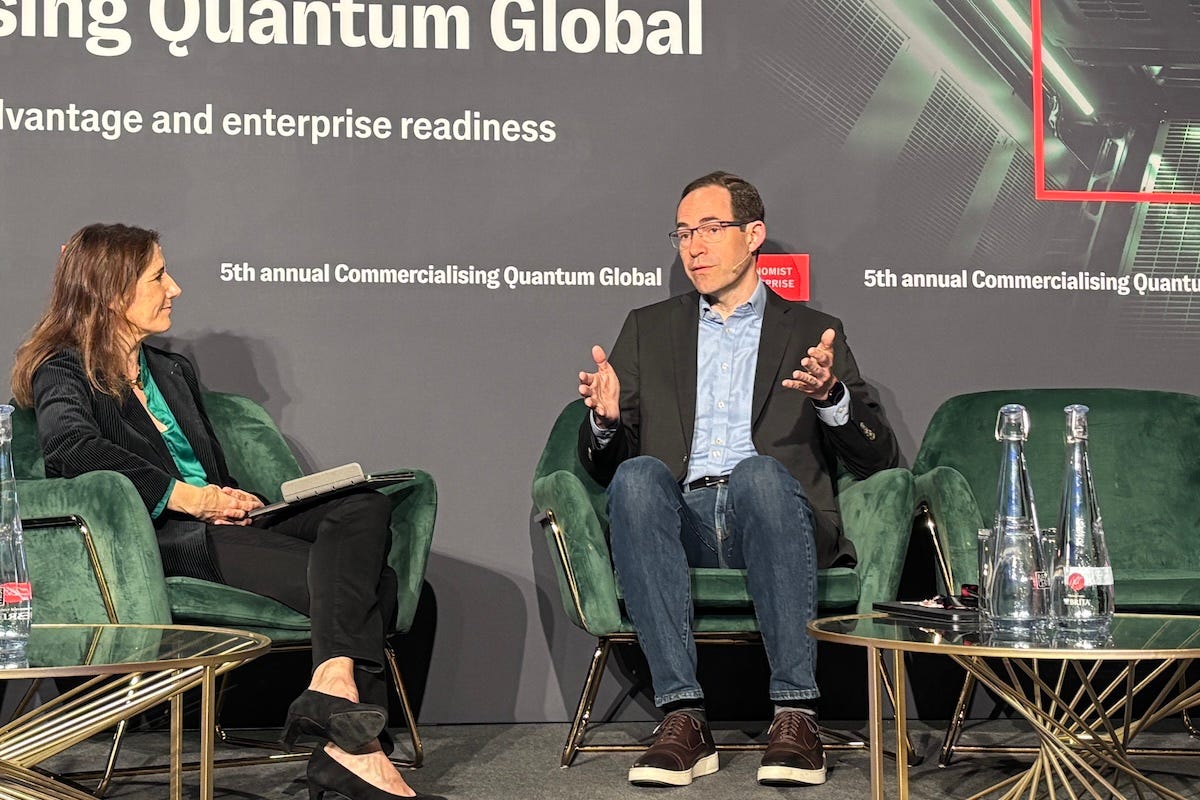
Buchholz discussed the strategy in a fireside chat at the Commercialising Quantum Global 2026, organized by Economist Enterprise, in London. The session, on building a “no-regrets” path to enterprise quantum computing, was moderated by Tamzin Booth, editorial director of Economist Enterprise and a former business editor at The Economist.
Booth has covered global business and technology for The Economist for more than two decades, including a stint as the publication’s Tokyo bureau chief.
Buchholz and Booth had discussed quantum-inspired techniques on stage together a year earlier.
Buchholz has worked in quantum computing for almost six years, moving through cycles of optimism and pessimism as the field has developed.
“Of late there’s a lot more optimism than not,” he said, pointing to progress on hardware and algorithms over the past year.
While Quantum computers are not yet able to perform tasks that are genuinely useful on their own, quantum-inspired techniques let companies extract business value today using existing hardware and governance processes, while building the internal expertise needed once true quantum systems mature.
Techniques already in use can later be ported directly onto quantum computers once the hardware is ready, extending their value beyond the current transition period.
“Cost is one of the biggest misconceptions,” he said. “It’s probably not as costly as most people think.”
He said organizations tend to fall into one of three broad postures, depending on how much risk they are willing to carry before the technology matures:
A strategic pause, watching developments before committing
An approach akin to an insurance policy, spending modestly without falling behind
A call-option approach, investing more heavily despite the risk it does not pay off
Companies can use these techniques without training anyone on quantum computing at all.
“I would view that as something of a lost opportunity,” he said.
He said the main costs are talent and hardware access, whether staff is retrained internally or specialists are hired externally.
Recent industry announcements suggest the timeline for enterprise-ready quantum computing is shrinking faster than expected. The techniques themselves take several forms. Quantum feature engineering, for instance, is a data-preprocessing tool for machine learning models, adapted from principles in quantum science to run on today’s classical infrastructure.
Buchholz compares it to a turbocharger: connected to a machine learning engine, the tool is designed to improve outcomes.
A second technique replaces Monte Carlo simulation for pricing derivatives and calculating value at risk.
Monte Carlo estimates outcomes by sampling potential scenarios millions of times. Deloitte’s alternative instead computes exact distributions, which Buchholz said can catch black swan tail risks that sampling-based methods sometimes miss.
Booth noted the technique could be especially useful given current market volatility.
Buchholz said Deloitte’s tools are only part of a wider wave of experimentation across the industry, with other quantum-inspired techniques being developed elsewhere.
Fraud detection pays off
Fraud detection is one of the clearest returns so far. Quantum feature engineering is particularly effective at spotting fraudulent transactions, since even modest accuracy gains carry significant financial weight.
Accuracy improvements of 20% to 40% are not uncommon in fraud detection, according to Buchholz.
He said companies rarely publicize the results, since talking publicly about a fraud problem can simply invite more fraud to deal with. Client confidentiality around fraud detection is common across the industry.
He added that the technique is already in production in a growing number of organizations. Governments are moving toward similar tools. Public sector fraud tends to be large in scale, driven by people pursuing large pots of taxpayer money, and agencies are increasingly focused on catching honest administrative errors as well, which can be just as costly to correct if left unaddressed.
In pharmaceuticals, some of the same computational methods are still being tested for scientific calculations, though results there remain preliminary, Buchholz said. Adoption still varies widely by region, based on the pattern of client requests reaching Deloitte.
“At the vast generalization level, the US is probably more adventuresome, the Japanese are quite adventuresome, the Europeans are somewhat adventuresome, and then there are little pockets here and there for everybody,” Buchholz said.
He also draws a distinction between the underlying quantum hardware, once it matures, and the quantum-inspired techniques described above. Bringing in an actual quantum computer will resemble an infrastructure decision, closer to acquiring a supercomputer or high-performance computing cluster than to deploying an application like generative AI. That is a difference in how companies should organize the adoption, not a reason to hold back.
"A quantum computer is a little bit more like, from an enterprise adoption perspective, having a supercomputer or a high-performance computing cluster," he said.
With inbound interest climbing and industry announcements accelerating, more companies are likely to move off the sidelines toward a no-regrets strategy in the coming year, pursuing quantum-inspired techniques now while preparing for the quantum systems still to come