


Technology companies building artificial intelligence (AI) data centers are knocking on miners’ doors for long-term copper supply, but few are ready to buy into a mine.
Most seek offtake agreements, which lock in a share of a mine’s future output, rather than equity stakes.
“It’s high on the mind of most of the people in the downstream, certainly in the new forms of demand such as data centers and AI,” said Duncan Wanblad, chief executive of Anglo American. “Those conversations are absolutely being had.”
“When people start to get their heads around the shape of the mining business, the capital intensity and the nature of the cycles in it, it’s less familiar to those types of businesses,” he said. “But given the scarcity issue, a lot of people are looking for ways to secure supply.”
Some technology firms have shown deep interest in taking equity stakes, though none has done so yet.
China has gone further in consolidating value chains. In nickel, for example, the mine and the processing plant are part of a much bigger chain, and financial viability is calculated over the whole rather than the parts.
Data centers use copper in electrical cables, busbars, transformer windings, circuit boards and processor heat sinks. In January, Amazon Web Services became the first customer for copper from Nuton, Rio Tinto’s bioleaching venture in Arizona, under a two-year deal to supply its US data centers.
Wanblad said Chile’s copper output is down about 8% year on year so far in 2026, largely because of weather, though part of the fall is structural.
“Resources are hard to come by; they’re very hard to permit and bring into production, and you are starting to see the impact of that going through,” he said. “This is not only a demand story; it’s probably as much of a supply story.”
Labor unrest is another pressure point. With copper trading near record highs, unions are seeking a bigger share of the gains, and strikes or threats of strikes have hit mines in several countries recently.
“With copper prices pretty much at an all-time high today, no one would be surprised that labor negotiations seek to attract some of that value,” Wanblad said. “The reality is that we have to plan these businesses through the long run, not just the short run.”
Anglo American is a London-based miner of copper, iron ore and other metals. In 2025, it agreed to merge with Canada’s Teck Resources to form Anglo Teck, a combined group focused on copper.
Storms wipe out buffer
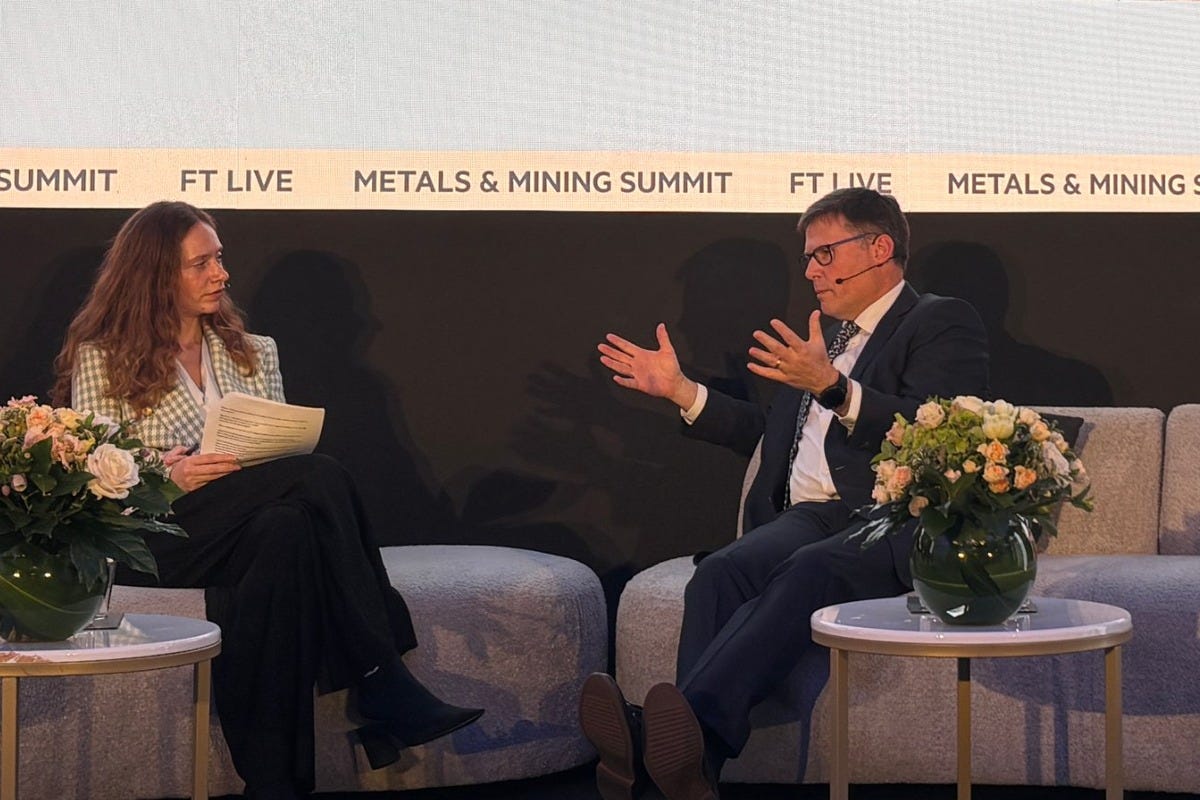
Wanblad spoke at the FT Metals & Mining Summit, organized by the Financial Times in London on October 15. Camilla Hodgson, the newspaper’s commodities correspondent, interviewed him in a keynote session on deals, supply risks and the copper market.
He said climate change is clearly affecting everyone, and extreme weather hit Anglo’s operations across several continents this year:
Floods in Australia early in the year took out large parts of its coal business
Floods in South Africa’s Northern Cape in May shut the Kolomela and Sishen iron ore mines
Snowstorms hit Los Bronces and Collahuasi in Chile in late July and early August
A cyclone-like storm damaged infrastructure at Minas-Rio in Brazil in September
“There’s been a lot of work over several decades now on improving the resilience to climate change in the business, so the vast majority of these events didn’t have a material production impact,” he said. “Certainly any contingency that we built up during the course of the year has pretty much been wiped out.”
Depending on how rain in Chile plays out, Wanblad is not concerned about meeting this year’s guidance.
Several of this year’s events were rated worse than one-in-200 or one-in-300-year occurrences. They are hitting every business in the sector, not just Anglo, and the whole industry needs to rethink the resilience of its underlying assets, he said.
Geopolitics adds another layer of risk, as governments from Washington to Beijing seek more control over critical minerals.
Wanblad said political uncertainty between a deal’s announcement and its completion turns into financial uncertainty, making boards more cautious about pulling the trigger. He called it a risk-management issue given today’s market volatility.
“There is no doubt that the world as we have it today has a material impact on the board’s view of whether a deal can be executed,” he said. “There seems to be an enormous amount of interest in doing deals, but there are not many deals that are being activated.”
Waiting on Beijing
China is the only authority yet to approve the Anglo Teck merger, and Wanblad said he has no plans to visit Beijing unless he needs to.
He said talks are proceeding as expected, with completion still due between September 2026 and March 2027, but declined to discuss details. A key part of the deal’s logic is combining Teck’s Quebrada Blanca copper mine in Chile with neighboring Collahuasi, co-owned by Anglo, Glencore and a Japanese consortium.
Talks with Glencore and the other shareholders are in the very early stages. Both mines have attractive standalone options, which they will weigh against a combination over the next few months before commercial negotiations begin.
“The rationale and the logic of it remain completely sound. This is one of the world’s most amazing adjacencies. This is growth that has got a very reasonable risk profile, so it’s one that doesn’t break the bank from a capital intensity point of view,” he said.
In Brazil, Anglo’s planned sale of its nickel business to China-backed MMG still faces concerns from the European Commission.
Wanblad said well over 100 parties had shown interest before Anglo narrowed the field to fewer than a handful and picked MMG. That makes a viable sale to another buyer unlikely, and if the MMG deal fails and markets do not improve, the business would very probably be shut.
Anglo runs an asset-backed trading business, mainly trading its own mines’ output. He said the merger’s much bigger equity book will add value, which forms part of the deal’s expected synergies, and Anglo plans to keep growing the business.
He declined to predict whether the US will impose further copper tariffs, but said any tariffs feed through into copper prices and where the metal ends up. The US is now well stocked with copper, and its Project Vault stockpile affects Anglo only indirectly because Anglo mostly produces concentrate rather than refined metal.
Trading will shape copper markets over time, but with new supply scarce and slow to bring on, Wanblad expects copper prices to remain well supported until the gap between supply and demand closes.