


Europe’s push to keep pace with data center demand is hitting a hard wall: not enough power, and not enough land already connected to the grid to build on.
One proposed fix is drawing mixed reviews across the industry. Utilities and energy companies are bundling land with a ready-made power connection, built specifically for a data center to move in on top. Some operators see a shortcut through years of grid queues. Others see a new dependency replacing an old one.
“It’s positive in the initial phases, and [the energy companies] are the owners in the beginning. But the models I’ve seen have them holding a minority stake once a site is commercialized,” said Rune Hogga, director of power at Bulk Infrastructure. “I see the collaboration with energy companies positively, but maybe not as the owner of the data center buildings.”
“Powered land can be a very complex project, but I would also like to see the flip side,” said Carlos Alves, manager of energy and capacity at Digital Realty. “Even if from a hundred opportunities there is one that becomes feasible, that can already mean something for us.”
Laurens van Reijen, chief executive of LCL Data Centers, said European Union rules block that combination outright in Belgium. A distribution system operator (DSO) or transmission system operator (TSO) must remain a neutral network manager rather than a market player.
Van Reijen said the alternative carries its own risk. LCL once turned down a 15-year biomass power deal over fuel-supply risk.
Similar offers from older industrial sites with spare capacity carry a geographic mismatch, he said. Those plants are rarely located near the internet exchange points and ports that data centers depend on, and the land beneath them is often held on concession rather than owned outright.
He pointed instead to the European Commission’s plan for “data center acceleration zones,” which would designate areas with spare grid capacity in each of the bloc’s 27 member states and fast-track permitting inside them.
The commission wants the region’s data center capacity to grow from 12 gigawatts last year to 28 gigawatts by 2030, and van Reijen said he expects the European Parliament to vote on the zones policy within months.
Already acting like utilities
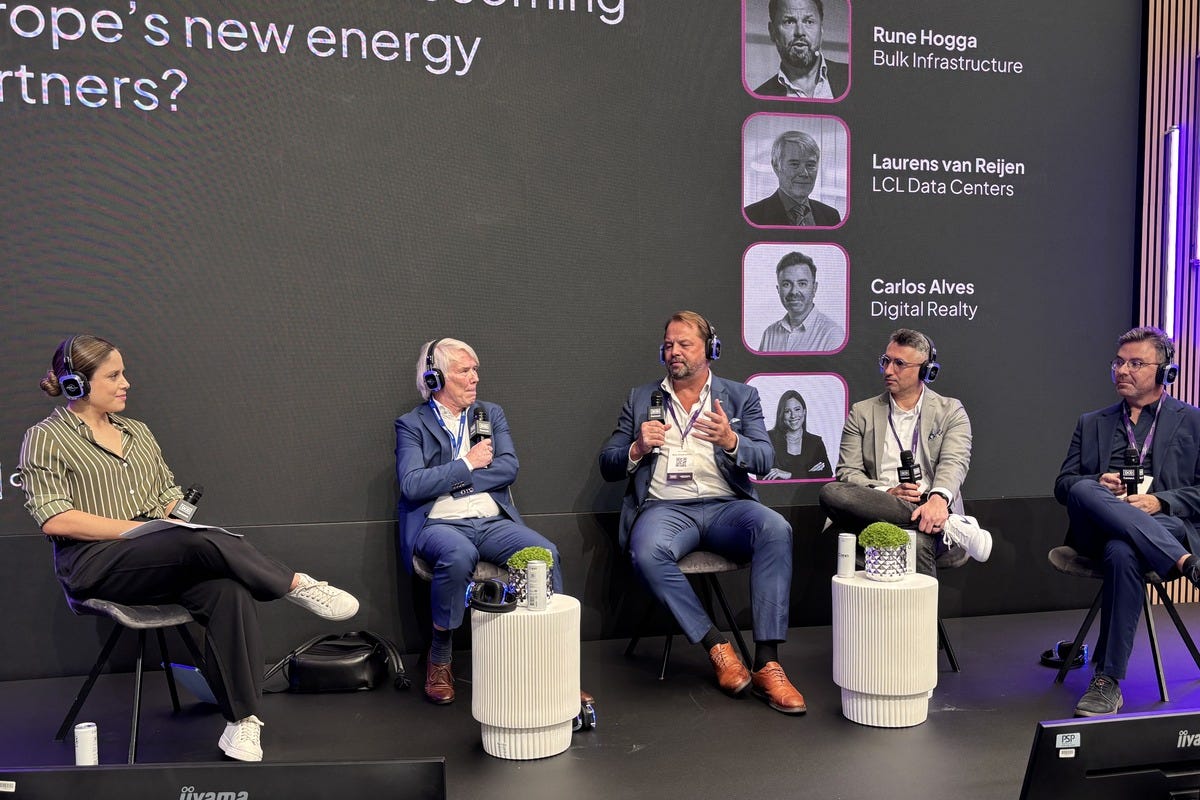
The panel, titled “Are data centers becoming Europe’s new energy partners?”, was held in London on September 16, at the DCD Connect London conference organized by DCD. Elsa Fucile, the company’s portfolio director for North America, moderated it.
Joining her were Rune Hogga of Bulk Infrastructure and Goran Arya, director of energy origination and structuring at Equinix.
Some operators are already behaving like power companies without calling themselves one. Van Reijen said LCL now produces 40% of its own energy from company-owned wind and solar assets, largely to meet customer demand for corporate power purchase agreements (CPPAs), long-term contracts that let a buyer purchase electricity directly from a generator.
“We are already energy companies because we do CPPAs for our customers,” he said. “I can imagine that in five or ten years we will be back here, and we will be a data center and energy company.”
Hogga said the scale of new sites is forcing similar questions even where operators have resisted the label. Two-gigawatt campuses tied to long-term power purchase agreements carry balancing costs that few utilities want to absorb alone, pushing developers to weigh whether to hold assets they could use to manage that risk themselves.
“It forces you to think about getting closer to being an energy company,” he said.
Not every operator wants to go that far. Arya, who spent 15 years at an energy company before moving to Equinix, said the firm has no interest in owning power generation, even though its sites run backup fuel cells and diesel generators.
“I don’t want to be an energy company again,” he said. “We don’t want to own generation on site. That is not our core business.”
Alves struck a similar note, saying the company’s core commitment is reliability, not energy supply. He said third-party firms can bridge operators and grid operators, provided the contractual boundaries between them are clearly defined.
Meanwhile, grid operators are tightening the rules for who gets to enter the connection queue in the first place. Van Reijen said Belgium introduced dedicated capacity lanes after its own queue became congested, splitting demand into fixed shares: 85% for battery storage projects; 10% for data centers; and 5% for industry, with unused capacity reclaimed after a year.
“The biggest thing that helped get the queue shorter was you had the proof you had the land,” he said. “Speculators didn’t have it, and that alone solved 30% of the queue.”
Other countries are moving further still.
Hogga said Finland now requires developers to hold a building permit before they can even apply for a power connection, up from no land-zoning requirement at all until recently. He said the same pressure now applies to existing Nordic industrial power allocations, freeing further grid headroom.
Flexibility now pays
Flexibility has quietly become its own market inside the industry. Hogga said the value system operators are willing to pay for flexibility in Norway has risen tenfold in four years, a price signal operators can no longer afford to ignore.
“If you don’t act toward those price signals, the system operators will have to implement other actions,” he said.
Alves said flexibility works best when designed into a data center from day one rather than retrofitted later, when adding equipment to a live site demands a much deeper risk analysis. He cited a European Union directive already requiring operators to report aggregated performance data to regulators.
“Retrofitting is really expensive,” he said. “The good thing about Belgium is that flexibility legislation only applies to new lines, not something existing, because retrofitting something old is very difficult and risky.”
Arya linked the same trend to public trust. He said the calculus goes beyond electricity price alone, pointing to water use and being a good neighbor to nearby communities as part of what he called the industry’s “social license to operate.”
“We’re all downstream of policy,” he said. “Once these are built, we are helping reliability of the grid where we operate.”
The type of workload also shapes how much flexibility a site can offer. Alves said a colocation facility aggregating dozens or hundreds of customers reads as more stable to the grid than one built purely for artificial intelligence (AI) training, which can demand large blocks of power from day one.
Arya said the distinction matters most between training and inference. Equinix focuses on inference, where firm delivery is contractually required and there is little room to flex. He said regulatory changes in the United States have already let operators deploy batteries and distributed generation to unlock additional grid capacity, calling it a model he wants Europe to match.
“That is much better geared towards what we can do for the grid operators,” he said. “But we need a partnership to understand where the constrained points are on their grid, otherwise we’re sort of shooting in the dark.”
New capacity is being built along similar lines. Van Reijen said cheap power and available land make the Nordics the obvious home for AI training, while inference needs to sit close to population centers such as Belgium’s telecom hubs.
“I’m always very jealous. I look at electricity prices in the Nordics, and it’s a tenth of our price,” he said. “I don’t believe inference will go to the Nordics.”
Alves said the two pulls will coexist rather than cancel each other out, since financial and real-time applications still need to sit within milliseconds of end users regardless of where power is cheapest.
With the European Parliament expected to vote on the acceleration zones proposal in the coming months, the panel’s operators said the industry’s next test is showing regulators it can be trusted with the additional capacity, not simply requesting more of it.