


Enterprise adoption of quantum computing has crossed a threshold few in the industry expected so soon. Large businesses are no longer evaluating whether artificial intelligence (AI) and quantum technologies belong in their strategy but are actively deploying them to tackle real operational problems.
A new study suggests the shift is already well underway. A survey of 1,003 senior business decision-makers across the United Kingdom found that 65% of respondents said their organization is already adopting or piloting quantum computing.
More strikingly, 41% of large UK enterprises estimated that quantum computing could unlock more than £100 million in value to their business in as little as one year.
“The era of enterprise quantum computing adoption has arrived. Companies are no longer asking if they should explore quantum, but how quickly they can implement it,” Murray Thom, vice president of quantum technology evangelism at D-Wave, told TechJournal.uk in an email interview.
“This study shows that UK businesses increasingly see quantum computing as a practical tool for tackling real business challenges, from supply chain optimization to manufacturing to AI,” he said.
Organizations actively engaging with quantum computing are estimated to have nearly twice the commercial value of those waiting for the technology to mature. They were also more likely to believe quantum is already delivering value today: 37%, compared with 16% of business leaders overall.
One in five UK business leaders surveyed said quantum computing is already a strategic boardroom priority. A further 34% described it as an emerging business tool, signaling that the technology has moved well beyond the domain of research scientists.
The data also suggests that early engagement sharpens an organization’s understanding of the technology’s commercial potential. Those already piloting quantum computing were significantly more confident about its near-term value than those still weighing whether to begin experimenting at all.
Surveyed UK business leaders identified several priority areas that would benefit most from improved optimization: workforce scheduling, cited by 90% of respondents, resource allocation at 89%, supply chain optimization at 88% and manufacturing processes at 82%.
These are precisely the kinds of computationally intensive problems that quantum annealing systems are designed to address, suggesting the UK enterprise market is already converging on the applications most likely to deliver near-term commercial value.
D-Wave is the world’s first commercial supplier of quantum computers and the only company to offer dual-platform quantum computing products and services, spanning both annealing and gate-model technologies. The company serves more than 100 organizations across commercial, government and research sectors through on-premises deployments and its Leap™ quantum cloud service.
AI pressures accelerate demand
The findings were published on June 3 in a report commissioned by D-Wave Quantum Inc. and conducted by Censuswide between May 7 and May 13, 2026. The report, titled “The Quantum Effect,” examines how organizations are moving from theoretical exploration of quantum computing into practical deployment.
One of the most striking findings is the extent to which AI disappointment is fueling interest in quantum. More than a third of UK business leaders said AI has delivered some return on investment (ROI), but results have fallen short of expectations. Nearly two-thirds expressed concern that existing energy infrastructure cannot support the continued expansion of AI.
Against that backdrop, 87% of respondents said quantum computing could help optimize AI-related processes and complex computational challenges.
Thom said quantum annealing systems are particularly well-suited to the large-scale optimization problems enterprises are already wrestling with, including workforce scheduling, resource allocation, and supply chain optimization.
“While it is possible to run simulated quantum annealing with a traditional computer, it is slower, less accurate and can be less energy-efficient than D-Wave’s real annealing quantum computers that organizations can use today,” He said. “This technology enables customers to go beyond modeling quantum effects in theory, and work with real, production-grade quantum systems built to tackle hard optimization problems in practice.”
Despite the momentum, significant barriers to quantum adoption remain. Cost concerns were the leading obstacle, cited by 46% of UK business leaders surveyed. A lack of internal expertise was flagged by 33% and limited awareness of the technology by 30%.
Education is the critical lever for closing that gap. It must be practical and business-focused rather than theoretical, giving leaders and technical teams just enough grounding to know where the technology can create value and how to act on that knowledge.
“The organizations making the greatest progress are those treating quantum as a practical tool rather than a future-gazing scientific endeavor,” Thom said. “Leaders and technical teams do not need to become quantum physicists. They just need enough understanding to identify where quantum can strategically deliver value, make informed investment decisions and translate early experimentation into long-term competitive advantage.”
Building quantum literacy across an organization requires connecting the boardroom and the engineering floor through a shared understanding of the technology’s potential. Businesses that develop this internal capability now will be better positioned to identify meaningful use cases and realize tangible outcomes as the market matures.
He said this is how organizations can begin to build a quantum workforce, moving teams from pilots to practical deployment and translating early experimentation into long-term competitive advantage.
Roadmap targets fault tolerance
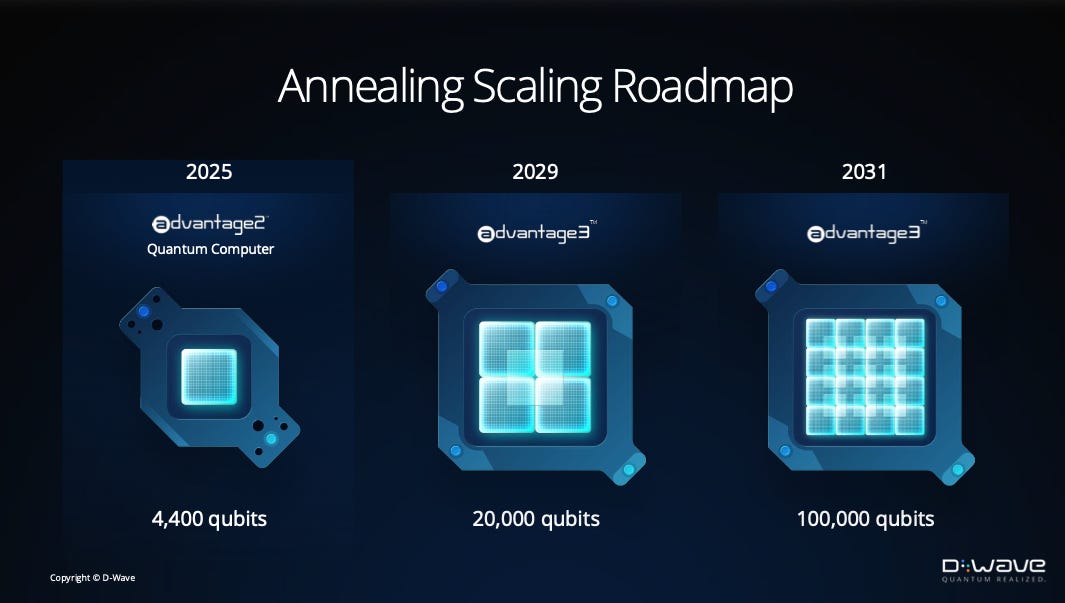
D-Wave has published detailed hardware roadmaps for both of its quantum computing platforms. On the annealing side, the current Advantage2™ system operates at 4,400 qubits. The next-generation Advantage3™ system is expected to reach 20,000 qubits by 2029 and 100,000 qubits by 2031, significantly expanding the range of optimization problems the technology can address.
The gate-model roadmap spans two distinct eras. In the post-NISQ (noisy intermediate-scale quantum) era, D-Wave targets 17 physical qubits with a 2x error reduction factor in 2026, scaling to 181 physical qubits and a 2000x error reduction factor by 2028.
The fault-tolerant era follows, with 10 logical qubits targeted by 2030 and 100 logical qubits by 2032, enabling circuits with millions of gates.
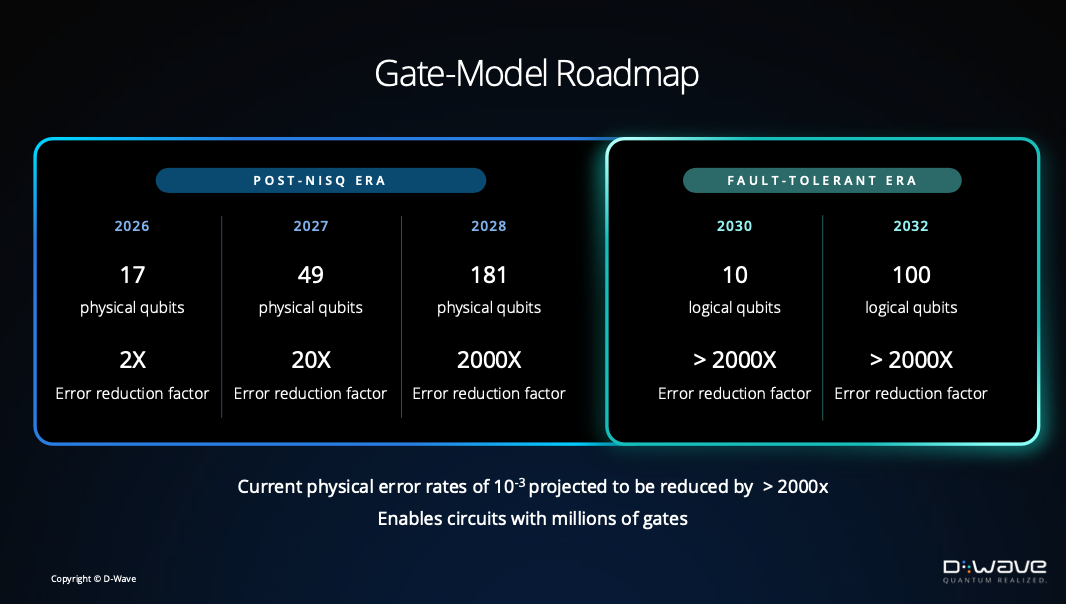
Hybrid quantum-classical solvers are already available through the Leap™ service and are in active use today. The gate-model roadmap is built around D-Wave’s superconducting dual-rail architecture, with current physical error rates of 10⁻³ projected to be reduced by more than 2000x over the roadmap period.
“D-Wave is the first and only company to offer dual-platform quantum computing products and services, spanning both annealing and gate-model quantum computing technologies,” Thom said. “This dual approach is central to delivering a comprehensive quantum computing platform capable of addressing customers’ full range of computationally complex problems.”
A paper published in the Chinese Journal of Computers, titled “Quantum Annealing Public Key Cryptographic Attack Algorithm Based on D-Wave Advantage,” drew widespread attention in 2024 when a research team led by Wang Chao of Shanghai University reported using D-Wave’s systems to factor a 22-bit RSA integer, raising questions about quantum computing’s implications for encryption.
Thom was measured in his assessment. He said the research uses a hybrid algorithm to factor small numbers and is a continuation of older work rather than a fundamental breakthrough.
“Breaking modern encryption would require quantum processors many orders of magnitude larger than today’s scale,” Thom said. “There are post-quantum encryption protocols available. D-Wave does not specifically focus on cryptography, but our technology has been used to power intrusion detection and threat detection applications.”
At the regional level, the UK emerged as the clear leader in European quantum adoption across the three countries surveyed. Germany followed at 60% and Italy at 46%. Thom said cities that combine commercial momentum, ecosystem development and research strength will be best positioned to become regional hubs as adoption accelerates.
That advantage is anchored in national policy support and funding, a strong concentration of academic and research institutions, and a growing ecosystem of founders and startups focused on turning quantum potential into tangible commercial value.
Within the UK, London is emerging as a significant regional quantum hub, anchored by strong academic infrastructure, national policy support and a growing network of startups. Thom said the coming years will bring expanded annealing and gate-model hardware capabilities as D-Wave advances both platforms toward broader commercial deployment.