



A quantum computing company has become the first to build both major types of quantum hardware.
The milestone follows a recent acquisition that brought advanced gate-model hardware in-house, adding to an existing lineup of annealing-based systems used for optimization work across industries ranging from manufacturing to logistics.
“D-Wave is the only dual-platform quantum computing company in the world,” said Andrei Petrenko, vice president of gate product management at D-Wave Quantum. “That means we are the only one who can provide products and solutions that target all classes of problems.”
No other publicly traded quantum computing company currently sells commercial hardware in both categories, annealing and gate-model, giving it a broader product line than its rivals, according to the company.
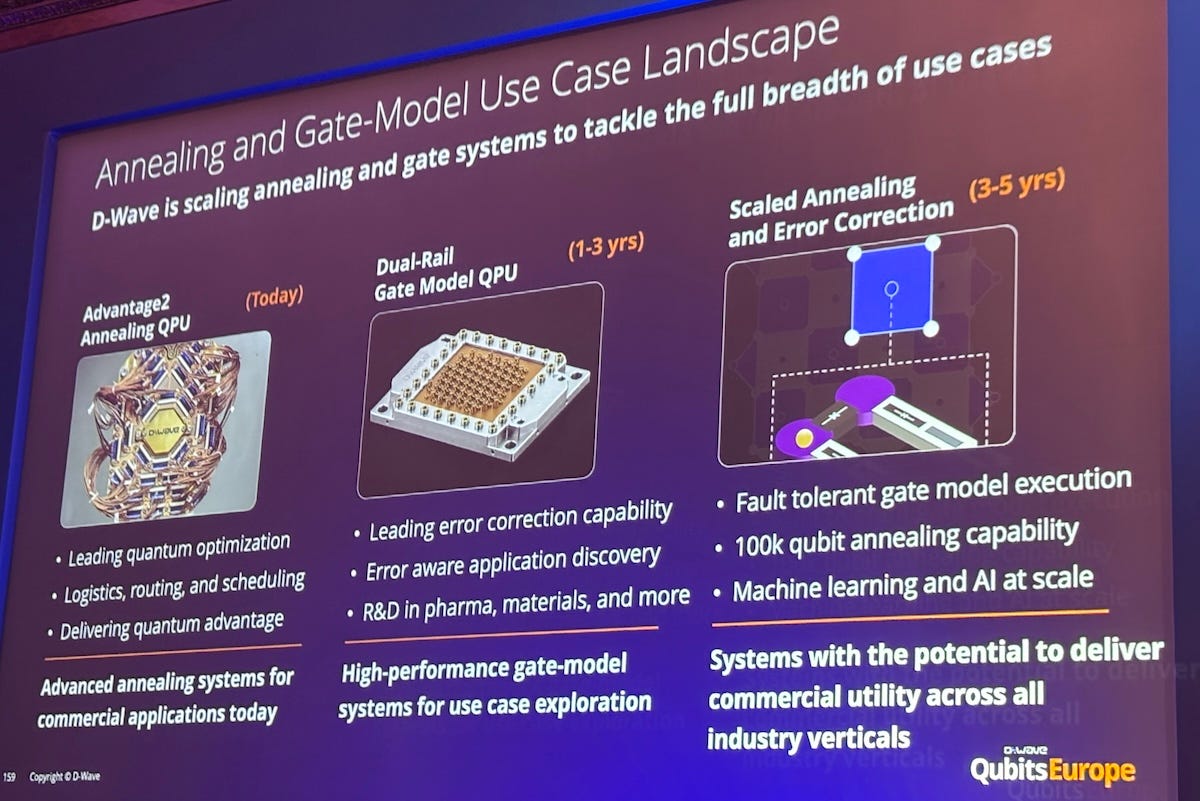
“These qubits are simply high-performance hardware,” Petrenko said. “They have world-class fidelities, and in the same package they’re high-speed devices.”
Its own benchmarks put single-qubit gate fidelity at 99.99%, two-qubit gate fidelity at 99.85% and measurement quality at 99.97%. The hardware combines the speed and ease of control of superconducting circuits with the high performance of natural qubits such as ions and atoms, which are typically too slow for practical use.
Quantum Circuits Inc, the company D-Wave acquired to gain the technology, was co-founded by physicist Rob Schoelkopf, a pioneer of the dual-rail qubit approach who is now its chief scientist.
The three-year roadmap runs from 2026 through 2028 across three processors called the DR17, the DR49 and the DR181, with the numbers reflecting each chip’s dual-rail qubit count. The DR49 is due in 2027 with a scalable module design and real-time control flow, ahead of the DR181 the following year.
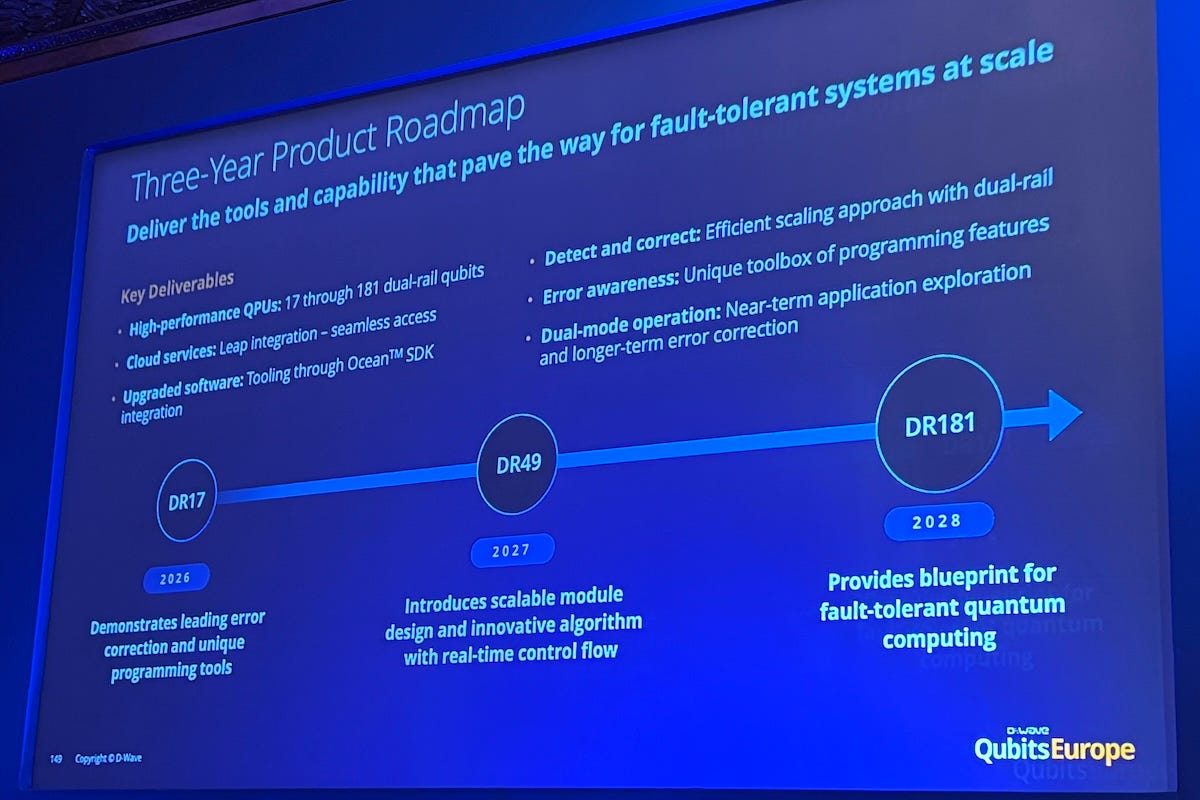
“The two central goals are error correction and near-term use case exploration, and the idea is from the DR17 through the DR181 to demonstrate a blueprint for fault-tolerant quantum computing,” he said.
The DR181 aims for a logical qubit error rate 2,000 times lower than the DR17’s physical qubit rate by 2028.
“We have high qubit performance and high speeds, plus consistent performance across our devices, something competitors don’t like to talk about,” he said.
D-Wave Quantum, listed on the New York Stock Exchange, has sold commercial annealing-based quantum computers for years and is now expanding into gate-model computing, after acquiring Quantum Circuits Inc in January 2026 in a deal reported to be worth roughly $550 million, among the largest in the young quantum computing industry.
Error detection built in
Petrenko presented at Qubits Europe, a quantum computing conference D-Wave organized in London in June, focused on real-world applications of quantum computing across industries. He previously served as head of product at Quantum Circuits Inc before the acquisition.
“No other conventional qubit modality can do this,” he said. “You can’t do this in a trapped-ion system, you can’t do this with neutral atom qubits, and you can’t do this with the typical transmon qubits that IBM, Google or anyone else uses.”
Photon loss is the dominant error mechanism in a dual-rail qubit and can be detected with high accuracy, he added.
The company calls this capability “mid-circuit error detection” (MCED), giving users a third data point beyond the usual zero or one. Paired with a separate error-aware measurement tool, it flags whether a qubit’s result can be trusted without disrupting the calculation.
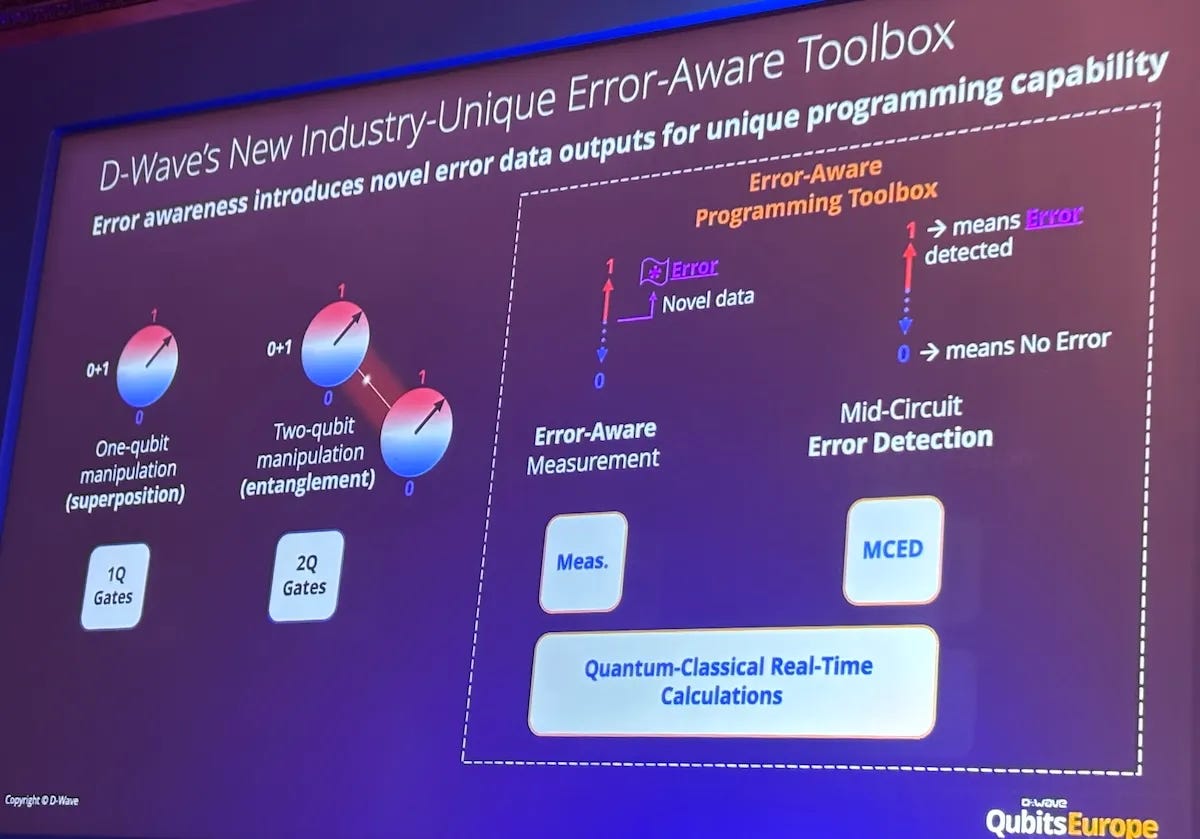
“The mid-circuit error detection can be placed wherever you want in the algorithm, and it returns a result, a zero or a one, without disrupting the state of the qubit,” he said. “For 181 qubits, you achieve an error rate better than 10-6.”
A conventional logical qubit needs roughly 1,000 physical qubits to reach that same rate, while its dual-rail approach needs roughly 100, a tenfold saving in hardware. It expects the hardware to aid pharmaceutical and materials research within one to three years, and AI applications further out.
Mayowa Ayodele, D-Wave’s lead solutions architect, also presented at the conference. She holds a doctorate in operations research and works with global enterprises on scheduling, logistics and finance problems.
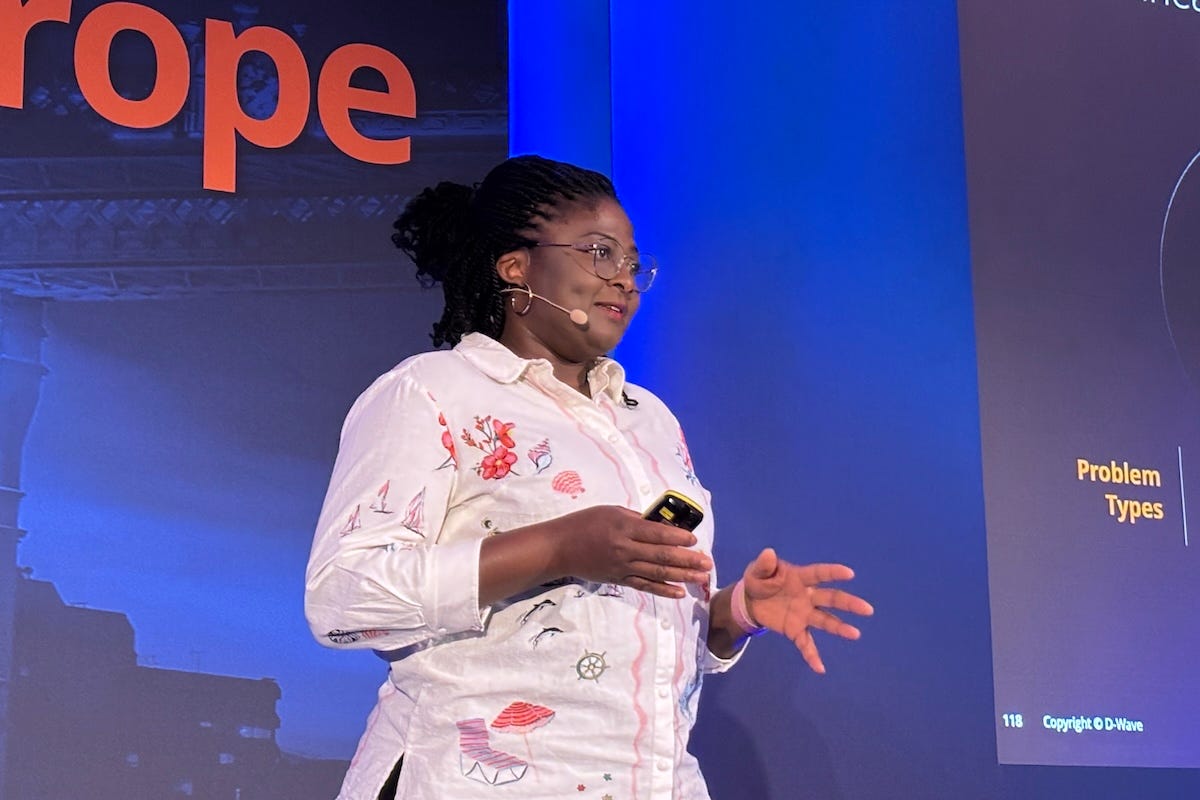
The optimization team, meanwhile, spends much of its time helping customers determine whether their problems are genuinely suited to quantum computing, weighing complexity, scale, and the cost of building a solution against the value it might deliver, before any code is written.
“The keys to success fall under three main areas,” Ayodele said. “The first is use case selection, the second is the right formulation, and the third is customer engagement.”
She pointed to its drug discovery work and a demonstration that replaced nearly a million years of computation with minutes.
“When it comes to problems we expect quantum to be better at, we are talking about three things: problems that are complex and large and have discrete decisions,” she said.
A pharmaceutical manufacturing example illustrates the point. Two production processes share early steps such as dispensing, blending and drying before diverging into either compression and coating or milling and encapsulation, with shared resources creating bottlenecks and scheduling constraints across both lines.
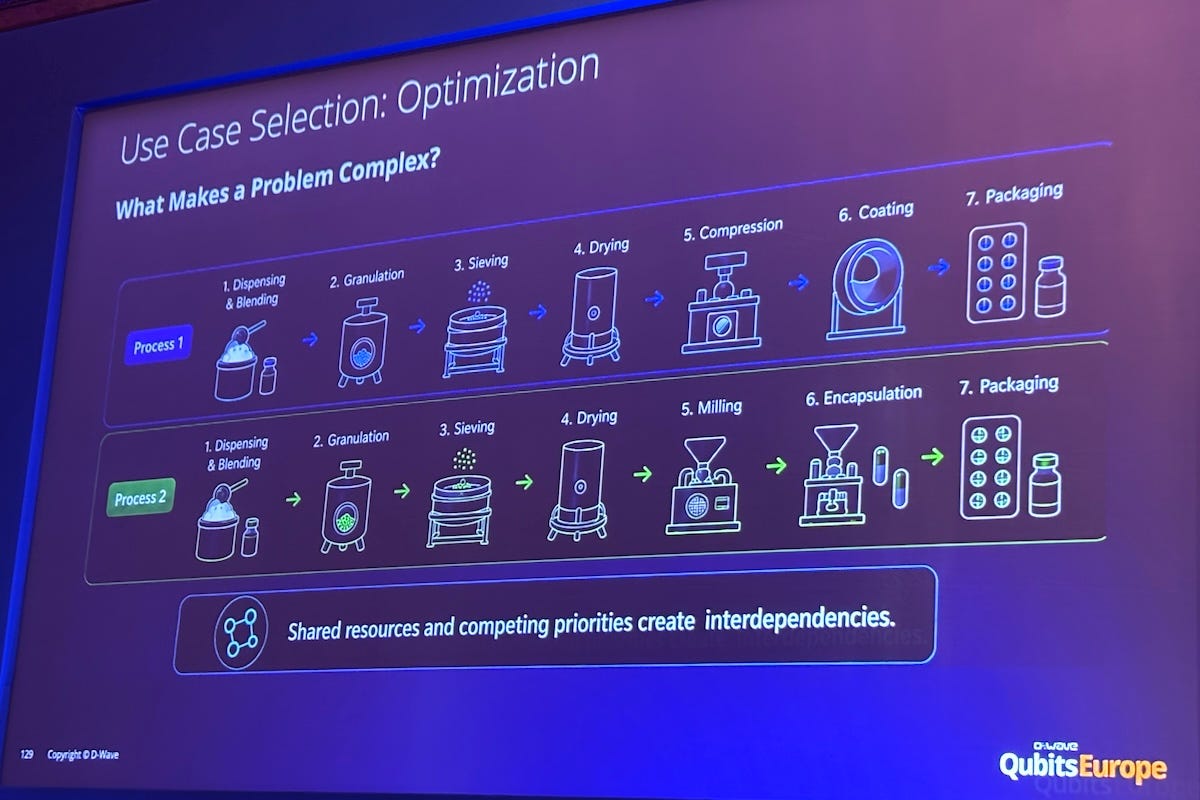
Discreteness comes in two forms: choices that are naturally discrete and continuous values that can be sensibly rounded.
“If I put this much money into creating that solution, am I going to get a higher return? Is it worth it?” she said.
That thinking underpins D-Wave’s Stride solver, which blends quantum annealing, tensor programming and other optimization methods.
Proven results in production
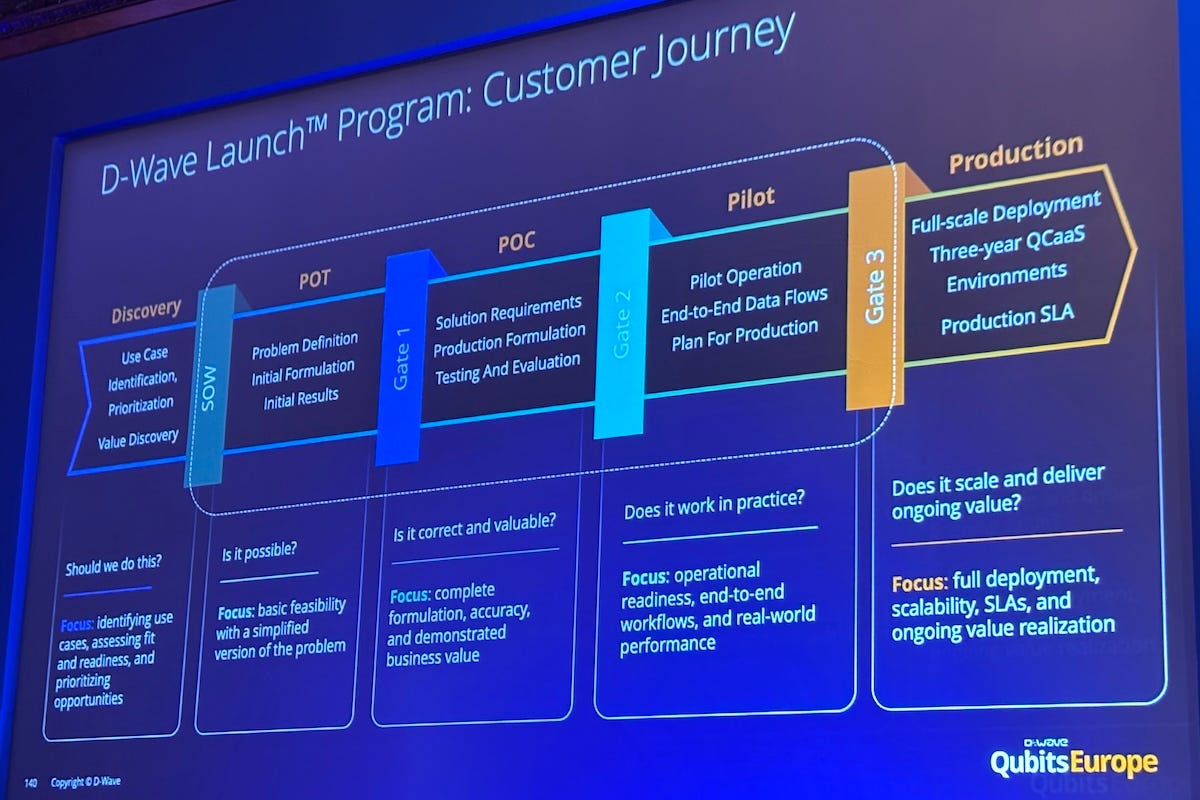
Once a problem clears that bar, D-Wave walks customers through a five-stage process before any solution reaches production, with each stage having its own checkpoint.
The stages run from Discovery through Proof of Technology (POT), Proof of Concept (POC), Pilot and Production, separated by three validation gates. Each stage answers a different question, from “Should we do this?” at the start to “Does it scale and deliver ongoing value?” at the end.
“As part of the contract, we offer customers the opportunity to take a training course, so they understand the context,” Ayodele said.
Its professional services team understands each solver’s strengths and how to match them to a customer’s rules.
“Our clients are the experts,” she said. “They know the problem more than we ever could, and they know what success looks like within their own business.”
Ford Otosan, a joint venture between Ford Motor Company and Koç Holding in Turkey, built a hybrid quantum application to optimize vehicle production sequencing in its body shop, aiming to cut downtime and support real-time decisions as parts and schedules change on the factory floor.
“It took them 30 minutes to schedule 1,000 vehicles,” Ayodele said. “With our solution, they could do that in less than five minutes.”
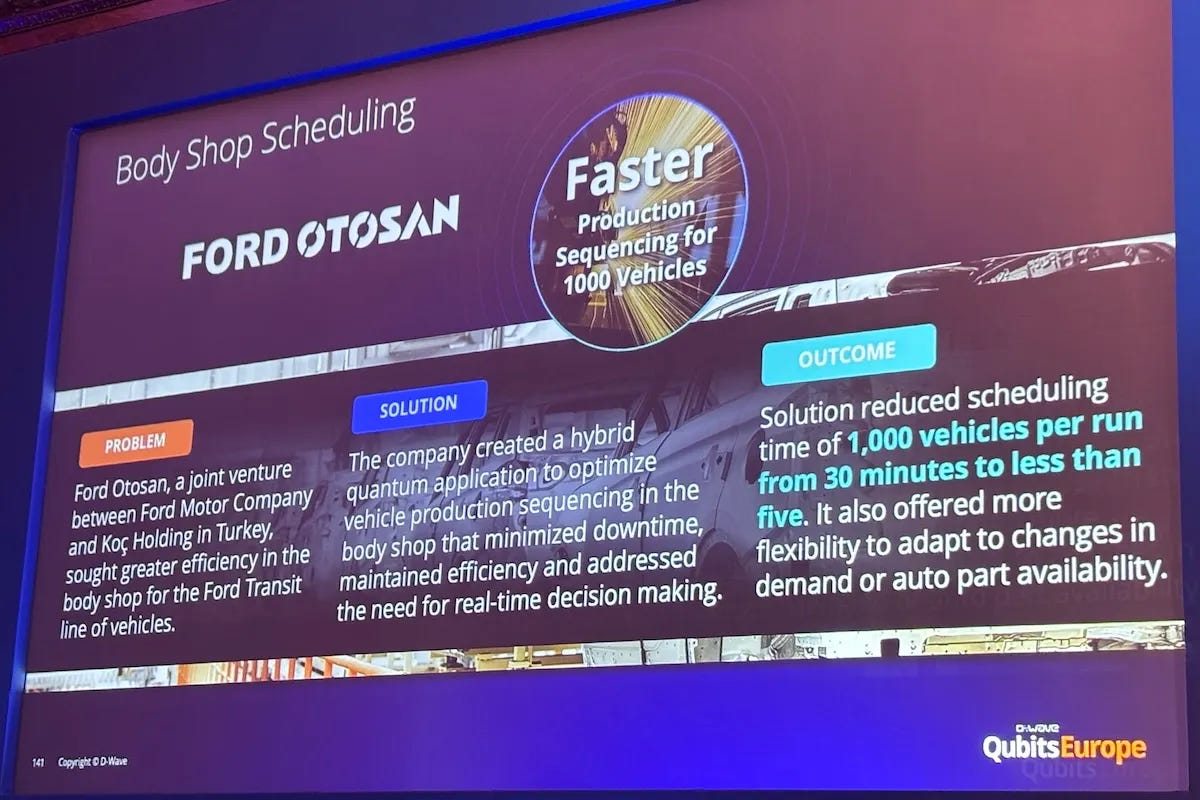
The solution also gave Ford Otosan more flexibility to adapt to changes in demand or parts availability.
A similar approach helped BASF, the world's largest chemical producer, which faced a scheduling challenge across its chemical production operations.
“It took another solver several hours,” Ayodele said. “With our Stride solver, it’s about five seconds, which we thought was really massive.”
D-Wave said the approach cut product lateness by 14%, reduced setup times by 9% and shortened tank-unloading time by 18%.
Its own roadmap for the optimization business points toward 100,000-qubit annealing systems within five years, alongside the newer gate-model line, which is still working toward fault tolerance.
D-Wave is now pursuing that same pattern of incremental wins on two fronts at once, refining its annealing systems for today’s optimization customers while pushing its new gate-model hardware toward fault-tolerant computing by the end of the decade, the two platforms advancing in step.