


The metals that feed batteries, chips and defense systems are being split into rival Eastern and Western markets as national security reviews reshape mining deals.
Chinese and Western buyers are now largely shut out of each other’s auctions for critical minerals. Regulators that once ran simple antitrust checks now examine supply chains and market access, and their expected reaction shapes how deals are structured from the outset.
“There’s clearly a divergence now between East and West on critical minerals around the world,” said Shea Small, partner, co-head of mergers and acquisitions (M&A) and co-leader of global metals and mining at McCarthy Tétrault, a Canadian law firm. “In anything that is critical minerals, gold and precious metals excluded, we are seeing China and Western countries largely excluded from each other’s auction processes.”
“Governments are more savvy regarding the overall flows and balances,” said Vance Scott, partner and managing director at AlixPartners and global co-leader of its energy and process industries practice. “If you think about the disruption that exists in the world right now, with the change in flows of supply chains and the concerns around transportation and market access, that’s causing regulators to think at another deeper level.”
He said scrutiny used to fall mainly on large mergers, depending on whether a country produced or consumed the commodity and how important it was to downstream industries. Individual asset sales are now examined too, and that risk feeds into transaction costs and the premium buyers demand.
“The companies that are going to succeed on the transaction front will anticipate that and try to manage ahead of that, and think about how that risk will be factored into their valuation and how that will impact their ability to secure and deploy capital,” he said.
Small said M&A practice had changed drastically over the past decade. Even on smaller deals, regulators’ likely response now drives the structure, with national security and supply-chain reviews added to antitrust. He said the White House is a new wild card that did not exist two or three years ago.
In Canada, 11 of the 16 investments sent to full national security review in the 2024-25 fiscal year involved Chinese investors. Similar reviews are rising in the US and Europe.
“Historically, China was willing to put more money on the table than others to acquire assets,” Small said. “That was the perception, and that has now disappeared in critical minerals.”
He said Africa and South America remain a different mix, where Chinese and Western bidders still compete for the same assets. The EU is examining Anglo American’s nickel sale in Brazil, while Chinese regulators are reviewing the Anglo-Teck merger.
Prices without benchmarks
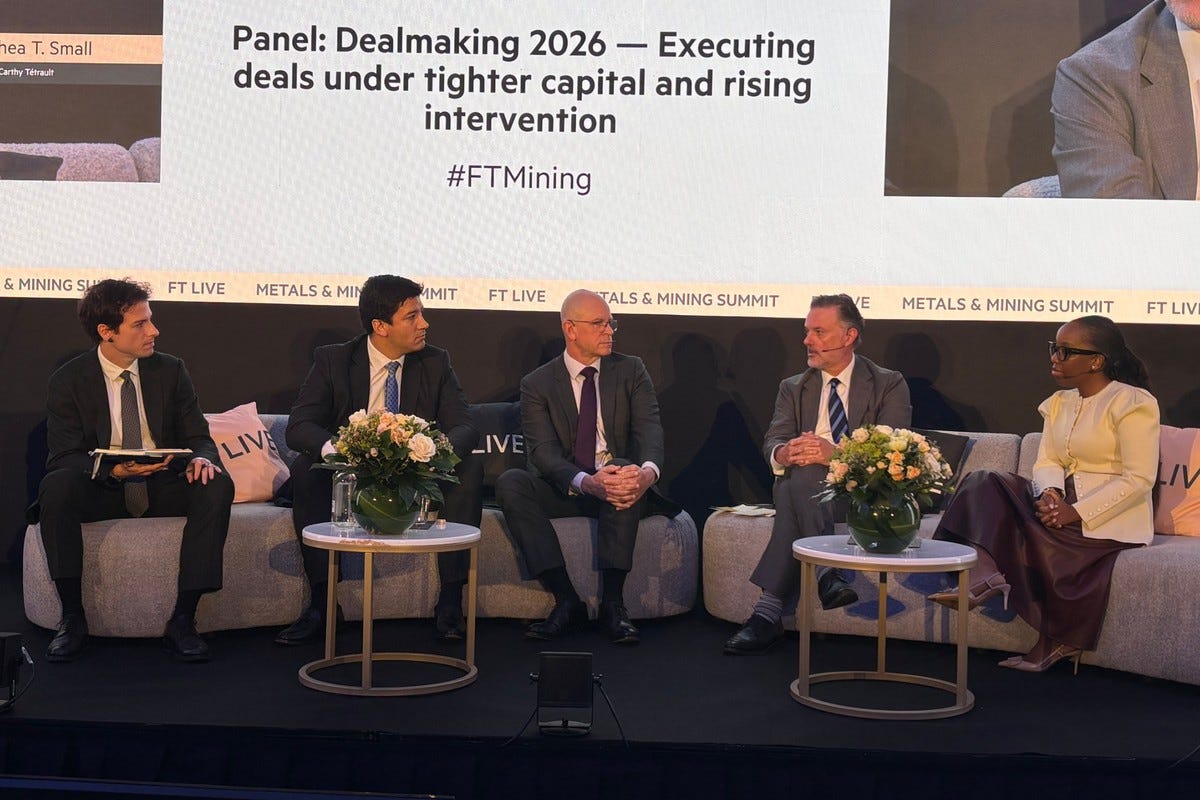
The panel, titled “Dealmaking 2026: executing deals under tighter capital and rising intervention,” was held at the FT Metals & Mining Summit 2026 in London on October 15. Alex Hamer, the Financial Times’ assistant companies news editor, moderated it.
Carlos Francisco Fernandez, chief executive of FinkaMetals, said metals fall into two camps, depending on how the market prices them.
“On one hand, you have copper, which is a metal that has a lot of depth and liquidity with Western benchmarks, and you have a similar story with gold,” he said. “In these markets, the capacity for buyers or acquirers to underwrite an asset and compete for it with confidence is a lot easier.”
Strategic metals such as lithium, cobalt, antimony and tungsten are a completely different story. They have no liquid Western benchmarks, most sales are bilateral, processing is heavily concentrated in China and export restrictions sit on top. That makes it far harder for buyers to bid with confidence.
“With that lack of transparency and understanding of the market, it’s more difficult to bid for an asset,” Fernandez said. “You don’t agree on the value of the asset because you cannot even agree on the value of the product that asset is selling.”
“What you need in the market is infrastructure that ultimately closes that gap, because the price discovery gap is becoming the valuation gap,” he said. “When you have a better understanding between buyer and seller of what the value of the product is, that will allow for transactions to happen a lot easier.”
Transparency also matters inside joint ventures (JVs), which miners use to share the cost and risk of developing large projects.
“Once the JV is set up, the sharing of the capex (capital expenditure) is one thing; how that material is then sold is a different question,” Fernandez said. “The successful JVs are those that can provide visibility on how material is being sold and on what terms to every JV counterparty.”
Scott said combining portfolios along the development cycle can create real synergy value. A partner further down the path can bring processing capacity and a downstream sales function that reaches markets, so producers avoid taking an unnecessary discount on the commodity price.
“You don’t have the outlay for processing kit, and you can repurpose, refurbish and bring those assets back to performance, and then get much faster access to markets,” he said. “There is value in speeding all that up.”
State plays four roles
Governments are moving deeper into the sector, with the US government among those getting involved upstream. Fernandez said state capital funds projects that private money alone would not, citing Chile’s state-owned copper miner Codelco.
“Today you have the state as a shareholder, as a lender, as a regulator and as a buyer at the same time,” he said. “That makes it a lot more complicated, and that’s new for most investors.”
Transparent pricing and full traceability of where metal is sold would protect acquirers, co-investors and governments spending taxpayers’ money, because they show assets were bought at fair market value, Fernandez said.
Sibusiso Ndlovu, director of metals and mining M&A at Standard Chartered, said boards would ask whether such partnerships stay stable.
“Investors will always reward stability,” she said. “The question that will remain is: is this going to provide stability over my operations? Not just when things are going well, but even when things go bad, I still need to know that I’m able to manage the situation in the event of a crisis.”
The geopolitical split is also changing where companies choose to be based. Small said some Canadian clients are weighing a move abroad, because being domiciled in one jurisdiction can automatically create a connection with that country for investment purposes.
“It is changing how people view where to set themselves up,” he said. “I’m not sure it’s going to get much bigger than being on the fringes, but it’s definitely a consideration.”
Valuations add another hurdle. Spot prices for most commodities have climbed far above long-term consensus forecasts, and junior developers often treat them as a proxy for their own worth.
“Valuation is probably one of the toughest things we’re facing in all the deals we’re trying to do right now,” Small said. “If you look at the implied valuation off those spot prices versus the long-term consensus, you almost can’t make a deal work.”
Buyers are bridging the gap with tools such as contingent value rights, he said. Gold deals are mostly share-for-share because prices can swing either way, while copper deals tend to be in cash, based on long-term consensus prices.
Ndlovu said some junior miners’ valuations have expanded on commodity prices rather than project progress, and that investors underwriting a mine must look 10 to 13 years ahead rather than 12 months, weighing today’s prices against the long-term demand that critical-mineral supply will have to meet.