



Satellite operators should assume hackers will breach their networks and design them to keep running, as long-hidden software flaws surface even in heavily scrutinized code.
The PHP2Shell flaw, patched on October 21, went unnoticed for at least 14 years in open-source code used by about 70% of the world’s websites. The project had thousands of contributors and numerous reviewers, yet no one ever disclosed the vulnerability publicly.
“In space, we have very little software development that has that many eyes on it. It’s reasonable to assume that there are similar or worse vulnerabilities in many of the software components that underpin critical space infrastructure,” said Daniel Gizinski, president of the Satellite & Space Communications segment at Comtech.
“Satellite networks that are successful out into the future aren’t going to be the ones that keep every intruder out. It’s simply not possible,” he said. “The question has to change. It’s not how do we keep them out. It’s how do we keep operating when somebody gets in?”
Satellite networks are a prime target in a highly contested domain, and attacks on ground networks have recently been an opening move in international conflicts. Yet space cybersecurity and development teams have far fewer resources than open-source projects such as PHP, he said.
“We’re going to have to design and develop networks that are able to not just try to keep adversaries out, but continue to operate in the event of an intrusion. We have to assume that at some point an adversary will have access to some portion of our network,” Gizinski said.
He said the perimeter model satellite systems have long relied on is no longer enough, and that these systems' resilience will define success in the next era.
Comtech, based in Chandler, Arizona, supplies satellite modems, amplifiers and troposcatter systems to military and commercial customers.
Eavesdropping from a rooftop
Gizinski delivered the keynote “Cyber Resilience in Orbit: Transforming SATCOM Networks Security” on October 27 at the Defence in Space Conference (DiSC) 2026 in London, a two-day event organized by and for the space and defense industry.
In a study published in October 2025, researchers at the University of California San Diego and the University of Maryland put a consumer satellite dish on a campus rooftop. With a few hundred dollars’ worth of equipment, they observed unencrypted military and industry traffic on 39 geostationary satellite links.
About half of the signals they analyzed were unencrypted, exposing T-Mobile backhaul traffic, including text messages and voice calls, as well as some communications from US military vessels.
“Satellites were doing their job. There wasn’t anything wrong with the way the satellites themselves were configured, but they were long-lived systems running on old assumptions that monitoring satellite traffic was expensive and non-trivial,” Gizinski said.
He said many systems still run on the outdated assumption that adversaries lack the capabilities to monitor, detect and attack them. He added that every satellite network should be encrypted, and that the rooftop experiment showed some military networks still run unencrypted today.
Satellite services are contested daily. GNSS (global navigation satellite system) jamming is widespread across Eastern Europe, and a cyberattack on Viasat’s KA-SAT network knocked out thousands of modems in Europe as Russia invaded Ukraine in February 2022.
“Satellite should be looked at as a key part of critical infrastructure. It’s carrying critical information. It’s a key part of maintaining an information advantage,” he said.
Under a framework from the US Cybersecurity and Infrastructure Security Agency (CISA), threats span the space, link, ground and user segments of a satellite system. Attack methods include spoofing, jamming, malware insertion and hijacking.
He said operators want more capacity, lower latency and more diverse paths across a variety of constellations and orbits. Software-defined ground infrastructure lets them reconfigure a network in minutes, but it also lets an adversary who gets inside do the same.
"Every new interface that we add is another way into the network. Software-defined everything gives us agility, but it also hands our adversaries a larger attack surface,” Gizinski said.
He said modernization by itself is not an adequate answer to security.
“Many of the satellite systems that we rely on today are 10, 15, in some cases 20 years old, and they’re built with that era’s understanding of cybersecurity,” he added. “Old architectures weren’t built for the threat velocity that we see today.”
Defense at machine speed
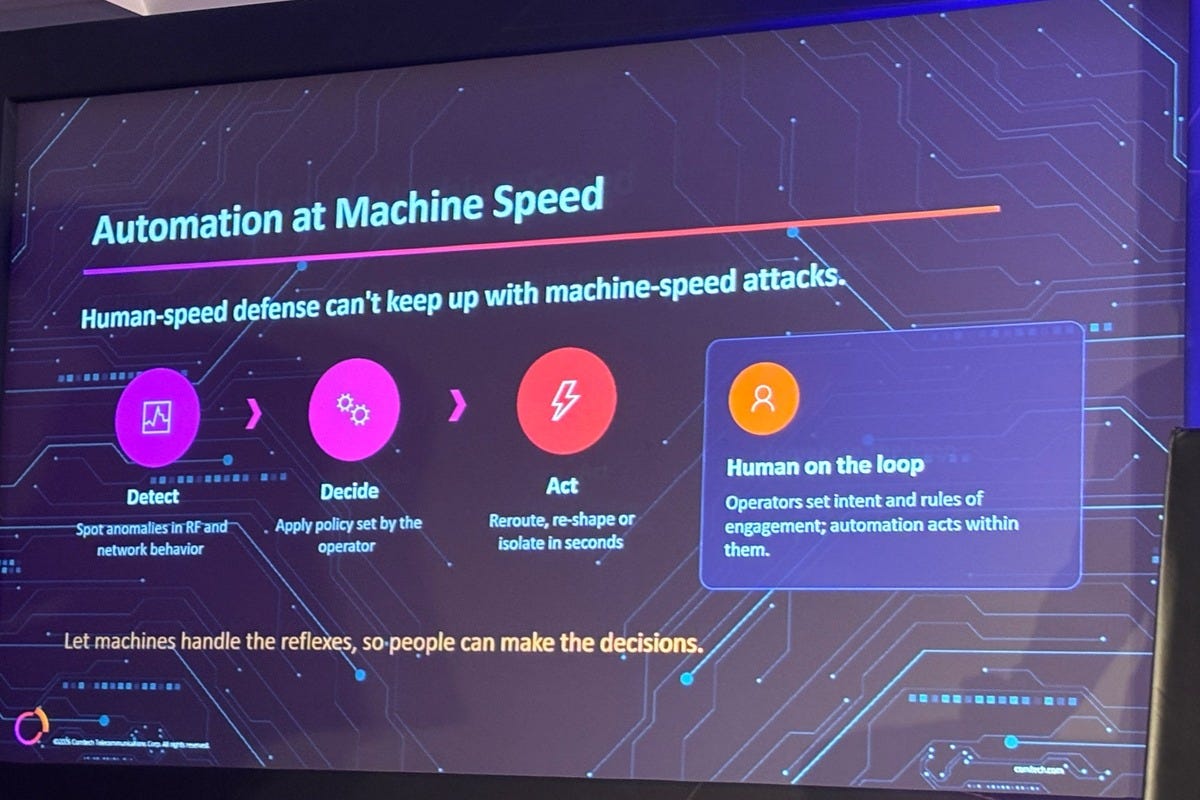
“These jamming and spoofing attacks play out faster than an operator can react on a dashboard. Human-speed defense can’t keep up with machine-speed attacks,” Gizinski said.
Automation offers a way out. Networks can detect anomalies in radio frequency (RF) and network behavior, apply policies set in advance and act on their own by switching paths, adjusting links or isolating parts of the network.
“Analytics and AI (artificial intelligence) help a lot with detection, but the principle matters more than the technology. You need people to set the intent and the rules of engagement, and then let the machines operate against them,” he said. “Let the machines handle the reflexes so that people can spend their time making the right decisions on a big-picture level.”
Military planners rely on PACE (primary, alternate, contingency and emergency) communication plans. He said humans execute these at human speed, often under pressure, while future networks will run them automatically within seconds under rules people have reviewed.
He cited the National Institute of Standards and Technology (NIST) SP 800-160 standard, which sets four resilience goals: anticipate, withstand, recover and adapt. Networks should degrade gracefully rather than suddenly, return to a known safe state and change so the same attack does not work twice.
Protected waveforms, such as direct-sequence spread spectrum, help links hold up in a contested environment. Digital intermediate frequency (IF) architectures also let traffic shift from one site to another if a path, gateway or site is attacked.
“If an adversary knows that a weakness is there and will be there, they can rely on it. Their cost per effect goes up the more you’re constantly reconfiguring and keeping your network up to date,” he said. “None of that can be retrofitted. Security has to be built in and not bolted on.”
He called on buyers to make cybersecurity a requirement, not an optional extra traded off against speed, and on builders to take responsibility for security in the way online retailers protect card payments. He added that the industry has come a long way but still has ground to cover.
“Systems that aren’t cyber secure aren’t fit for purpose in a modern warfighting environment, and that should be the mindset that we all look at this challenge with,” Gizinski said.
He also called for closer collaboration between government and industry, within industry and among governments, saying sharing threat intelligence is the fastest way to reach the right answer.
He said today’s adversaries are far more sophisticated than the university team on the San Diego rooftop and are not limited to a few hundred dollars of equipment. He added that the real question is whether the industry is building networks that can ride through a meaningful attack or just report that they are down.