


Companies are wasting money on the wrong artificial intelligence applications. An 85% project failure rate reveals a fundamental mismatch between technology capabilities and business needs, according to a quantum computing executive who argues that hybrid quantum-AI systems offer a more promising path forward.
The problem isn’t the technology itself, but rather how organizations are deploying it, with chatbots and email assistants delivering minimal business value compared to time-series applications that could generate double the return on investment.
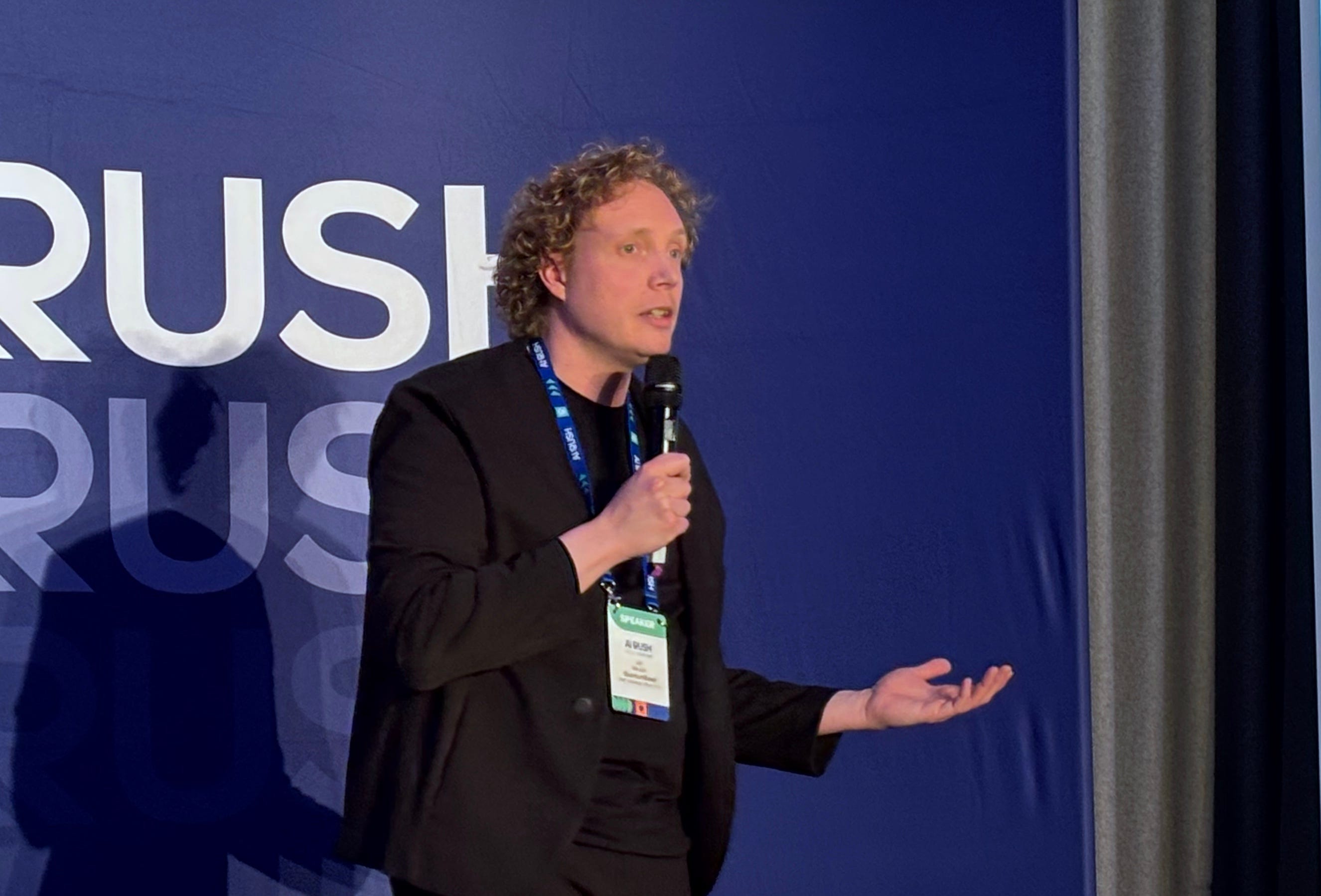
“Right now, there’s a big hype that everyone is chatting with their documents or writing emails with Copilot, and companies are spending a lot of money on this kind of application,” said Jan Mikolon, Chief Technology Officer for Quantum Computing and AI at QuantumBasel. “But I can say the business value behind that is quite small.”
“There are a lot of projects that are still failing, and this is a study from McKinsey that is highlighting that roughly 85% of all the AI projects that we are having are failing,” Mikolon said. “The problem is not the technology; most of the time, we are using the wrong use cases.”
Mikolon pointed to time series data from machines, production lines, and vehicles as a largely untapped opportunity. He said that estimates suggest that time series has a 2x higher return on investment for AI applications than current generative AI deployments.
Time series applications involve analyzing data points collected over regular intervals, making them ideal for predictive maintenance, energy forecasting, financial trading, and supply chain optimization. This type of data is generated continuously by industrial equipment, transportation systems, and infrastructure networks, yet many organizations overlook these applications in favor of more visible generative AI tools.
The critique comes as organizations rush to integrate large language models into everyday workflows, often applying them to legacy processes without questioning whether those processes still make sense. Mikolon said quantum-AI hybrid systems could address AI’s fundamental limitations while delivering measurable performance gains in high-value use cases.
These hybrid approaches combine classical machine learning with quantum algorithms to uncover patterns that traditional AI systems cannot detect, he said.
Mikolon presented his analysis during a keynote at AI Rush in London earlier this year.
QuantumBasel was founded in 2022 on a 70,000-square-meter campus in Arlesheim, near Basel, Switzerland. The facility installed IonQ’s Forte Enterprise ion-trap system in December 2024, marking the first time an IonQ quantum computer has been operated in Europe. The campus also founded QAI Ventures, a global venture capital firm that supports quantum innovators from laboratory research through initial public offerings via acceleration programs and capital investments.
Mikolon said the facility provides researchers and companies with access to quantum computers from multiple vendors, creating a neutral testing ground for comparing different quantum computing approaches.
Hybrid Systems Outperform
QuantumBasel positions itself as Europe’s hub for quantum innovation, transforming a historic site of industrial excellence into a focal point for Industry 4.0 technologies.
Mikolon said his team has developed meta-learning approaches that combine predictions from multiple AI models, with quantum algorithms providing an additional performance boost. The approach has been tested on visitor prediction systems and energy trading applications.
“We are thinking that the first quantum advantage will be hybrid, so we are combining classical AI with quantum algorithms,” he said. “A meta learning approach is actually perfect for time series data. It takes the prediction of different AI models and combines them to outperform any single model.”
The team trained hybrid systems for different use cases and observed consistent performance improvements. He said the results demonstrate that adding quantum solutions into classical AI pipelines can deliver the next performance boost that organizations are seeking.
Research conducted by IBM has shown that quantum AI models can detect patterns invisible to classical systems, he said.
In one fraud detection case study, both a classical AI model and a quantum AI model achieved similar accuracy rates, but analysis revealed that they identified different patterns. The divergence suggests that quantum systems process information in fundamentally different ways, potentially catching fraudulent transactions that slip through traditional detection systems.
“Both models perform in the same way in terms of accuracy,” Mikolon said. “When we assume that both systems are seeing the same patterns, then all dots should be on this line. But this is not the case here.”
This divergence is a strong sign that quantum computing in AI can uncover patterns that classical computers cannot, he said.
The IBM research used a visualization technique where authentic transactions appeared as blue dots and fraudulent ones as red dots. If both AI systems were detecting identical patterns, their predictions would align perfectly along a diagonal line. The scatter of points away from this line demonstrated that quantum models were identifying different risk indicators than their classical counterparts, Mikolon explained.
Addressing Data Drift
Beyond pattern recognition, quantum computing could help solve one of AI’s most persistent deployment challenges: model robustness when input data differs significantly from training data.
“One of the biggest problems that we are facing right now is robustness around AI,” Mikolon said. “Robustness means that when the input data is really different from the training data of an AI model, most of our AI models will fail, especially in time series. This is a concept that we are calling data drift.”
He said that quantum computing has great potential to overcome these limitations, particularly in applications where data distributions shift over time. Machine learning models struggle to maintain performance when data drift occurs, making them unreliable for critical business operations.
He said quantum computing’s ability to search through massive solution spaces more efficiently than classical computers makes it particularly well-suited for optimization problems. He illustrated the advantage with a simple example: finding a single item hidden in one million drawers would require 5,000 steps on average using classical methods, but only 1,000 steps with quantum computing.
“These kinds of optimization solutions, we are already doing with companies like Hermes, a big logistics company from Germany,” Mikolon said. “They are interested in optimizing their routes for their vehicles and delivering packages for their customers. It’s already happening right now.”
He said use cases for quantum-AI hybrid systems range from precision medicine to energy trading, with any application involving time-series data a potential candidate.
QuantumBasel maintains access to quantum computers from multiple vendors in the United States and Europe, allowing the team to test different approaches across various hardware architectures.
Precision medicine applications could benefit from quantum AI’s ability to identify subtle patterns in patient data that correlate with treatment outcomes. Energy trading systems must process vast amounts of real-time market data and weather information to optimize buying and selling decisions. Both domains generate continuous streams of time-stamped data where small improvements in prediction accuracy translate directly to significant economic value.
The campus aims to become a center of excellence for quantum and AI research, with the long-term goal of producing Nobel Prize-winning work. Mikolon emphasized that the facility is designed to make quantum computing more accessible to businesses exploring how the technology can address their specific challenges.
As companies reassess their AI investments in light of disappointing returns from generative AI applications, Mikolon’s message is that success requires matching the right technology to the right problem rather than simply applying the latest trend to existing processes.