


Cohere, a Toronto-based enterprise artificial intelligence (AI) company, is building every layer of its technology in-house to give enterprise clients full control over systems that handle sensitive data.
The company says renting components from multiple vendors can leave gaps in security and accountability. That risk grows as agentic systems take on more decision-making within critical business workflows, from customer service to regulatory compliance, where a single misstep can exact real financial or reputational costs.
“Most agent platforms are not embedding their own generative or retrieval models, so they are pulling in third-party models,” Ryan Lewis, Head of UK & Northern Europe at Cohere, told TechJournal.uk in an interview. “We are one of the few companies out there today that have a vertically integrated stack, not just the models, but the search retrieval system, the application layer and the agent architecture and framework. All of it is built in-house at Cohere.”
“Having such critical work take place in the enterprise, and having the risk of that being shut off, is a real consideration that enterprises are starting to wake up to now,” he said.
Lewis said this matters across sectors that handle sensitive data, from banking and healthcare to the public sector.
“You think about the large banks, healthcare companies, and more recently, high-stakes enterprises that have to make decisions quickly under pressure, having fast systems that they can control in their own infrastructure,” he said. “We do a lot of work in the public sector, for example.”
He added that Cohere’s agent platform also includes a governance layer, giving customers full control and visibility into what their agents are doing in a live production environment.
Cohere was founded in Toronto in 2019 by Aidan Gomez, Nick Frosst and Ivan Zhang.
Gomez, the company’s chief executive, co-wrote the original Transformer research paper that underpins nearly every generative AI model on the market today.
In 2022, Cohere launched Cohere Labs, an open science initiative that has since grown to more than 4,500 community members and produced over 100 research papers.
Cohere raised close to $1 billion across four funding rounds between 2021 and 2024, then added roughly $600 million across two further rounds in the summer of 2025, taking its valuation to about $7 billion.
Its investors include chipmakers AMD and Nvidia, Salesforce Ventures, PSP Investments and the Healthcare of Ontario Pension Plan.
Lewis said that building every layer in-house lets Cohere run efficiently in private deployments, supporting hundreds or even thousands of users on as few as two to six graphics processing units (GPUs), while giving customers a single vendor accountable for the entire stack.
Talking to the data
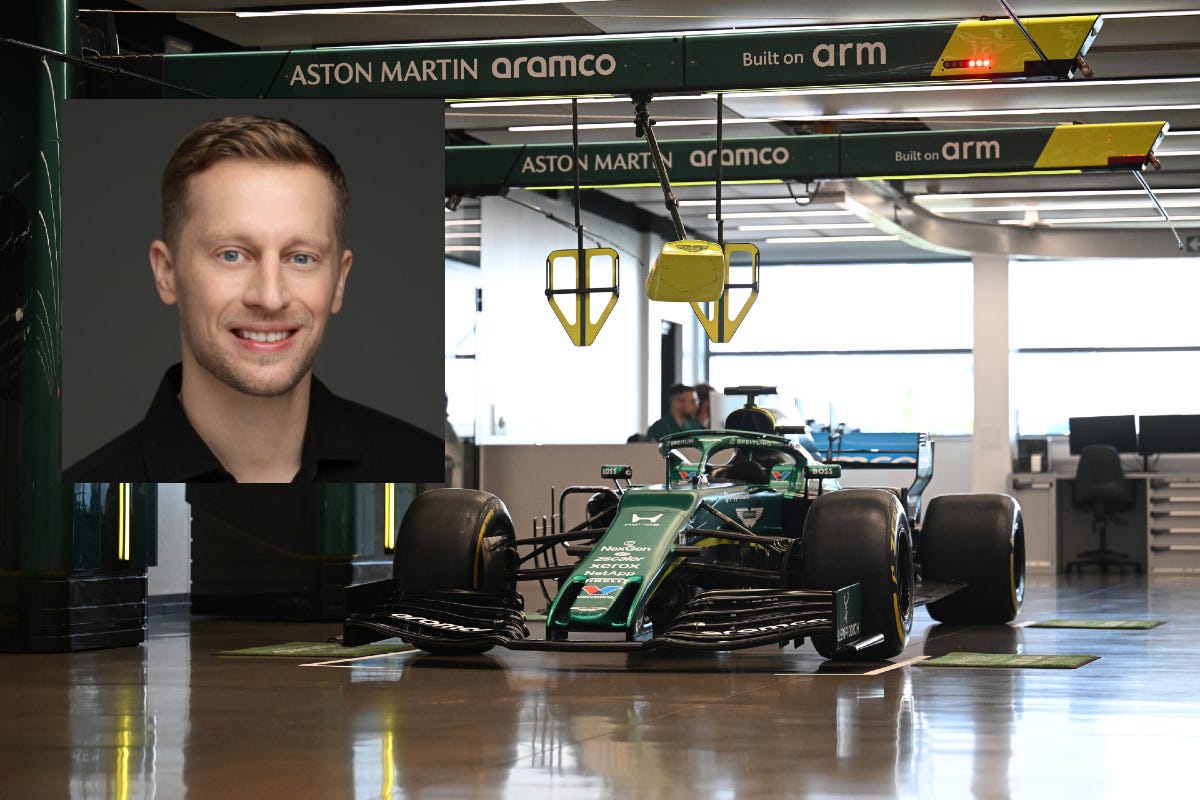
The interview took place on the sidelines of the AMR Network Technology Forum, an event organized by the Aston Martin Aramco Formula One Team at its Silverstone campus on July 3, focused on building an AI ecosystem in Formula One.
Cohere is now deploying North, its agent platform, directly into Aston Martin Aramco’s operations.
“Having the ability to tap into data that’s sitting across their entire estate, stuff they wouldn’t necessarily be able to access before because it’s confidential or hypersensitive, and running in their own environment, comes as a huge advantage,” he said.
He described the exchange as similar to talking to data and systems in natural language.
“That means things like deep research reports, comparing different statistical anomalies, and getting a response back much faster than having to dive into different systems,” he said.
Lewis declined to share specifics such as GPU numbers or training time for the partnership, citing confidentiality.
He said Cohere could customize models for domain-specific or language-specific needs when doing so would improve performance for partners, including Aston Martin Aramco, though that is not always necessary.
Speaking on the panel, Lewis said there is so much data packed away in Formula One teams, across different systems, modalities, and sometimes languages, and that making sense of it quickly is itself a major opportunity for AI in the sport.
“Instead of having a single agent do these things sequentially, now you have each agent being an expert in this workflow, so the diagnostic agent is going to meet with the simulation agent and the telemetry agent, and they synthesize those insights and create reports and responses that give these teams faster insights and time to value,” he said on the panel.
“The way Cohere sees it is empowerment. We don’t think AI is going to replace the high-value things within organizations. We want to give people the power to do the things that are mundane and routine that are slowing them down from making the executive decisions,” he said, also on the panel.
He added that this approach was built to work in the most sensitive environments, where companies might otherwise hesitate to use AI models at all for fear of losing control of trade secrets.
Sized for the task
During the interview, Lewis pointed to Cohere’s partnership with LG CNS as an example of its customization approach elsewhere.
The South Korean firm wanted the best Korean-language model on the market and asked Cohere to outperform larger general models with a smaller one tuned specifically for Korean and its own enterprise work.
“We custom-trained a model for them to deliver those capabilities to their customers,” he said.
Industry jargon is often missing from the data sets used to train large language models (LLMs), he said, citing telecommunications terminology as an example, and helping a model understand such language inherently is a consideration whenever Cohere works with a partner.
Cohere builds its models entirely from scratch rather than adapting or distilling from other companies’ systems, he stressed, which lets it create variants tuned for specific tasks. Command A Translate, released last August, was one such variant and became a top-performing translation model in the market.
The company’s approach to ownership varies by product.
Its newest open-source model, Command A Plus, is available to download from Hugging Face under a commercial Apache 2.0 license, giving customers full access to its weights, while other Cohere products remain under more restrictive commercial licensing terms depending on the deployment.
“It’s a commercial Apache 2.0 license, so our customers own the workflows and the logic around that,” Lewis said. “Sometimes it might be a commercial license; sometimes it might be open source. We make those decisions on a case-by-case basis.”
Whichever license applies, Cohere’s main purpose is to ensure customers retain sovereignty over their own data and workflows, he said.
On June 15, Cohere announced it was nearly tripling its London office footprint to more than 14,000 square feet, positioning it deeper in one of Europe’s busiest AI hubs.
The expansion is part of a European push that has included a planned tie-up with Germany’s Aleph Alpha, the acquisition of Reliant AI, and memorandums of understanding with Spain’s Indra Group and the UK government. Cohere’s customers in the UK include the Aston Martin Aramco Formula One Team and language services company RWS.
Asked how Cohere positions itself against larger rivals such as Google and OpenAI, Lewis said the comparison is not straightforward, since those companies are not pursuing the same strategy.
“There’s a variety of companies that build models from scratch. Where Cohere is much different is its strict focus on enterprise AI and on sovereignty,” he said. “As a Canadian company, we work exceptionally well with all countries in Europe and internationally. We’re Canadian by nature but very international in our presence.”
He said some larger model labs are focused elsewhere and that he expects agentic AI adoption in Formula One and other high-stakes industries to accelerate over the next few years.