


National semiconductor strategy is usually framed around the idea of sovereignty. A number of industry leaders now think that framing undersells the case for working together.
Industry leaders say framing chip partnerships around sovereignty encourages countries to protect what they already have rather than build what they lack. A simpler framework works better: build, partner, buy.
“In the European Union (EU), politicians confuse sovereignty,” said Ivan Stojanovic, program manager for the semiconductors domain at NXTGEN Hightech. “We make it so difficult to collaborate with each other because we’re so scared and protective, and we set different priorities.”
“Sovereignty as a term is potentially even a bad term,” he said. “It’s not bad to be sovereign in terms of protecting your technology, but make sure the technologies you bring in become unsurpassable together with your partners. That’s different from sovereignty.”
Stojanovic’s own work makes the point concrete. He said the Netherlands has a history of building the equipment needed to produce semiconductor chips, and pointed to ASML as the clearest example.
He said a group of engineers had built a machine that could make chipmaking faster, better and cheaper, and pitched it to Philips Semiconductor. Philips turned them down and told them to do it themselves, so they started ASML in a shed.
“We got ASML, and we hope we can build the BSML and the CSML as well, together with you guys,” he said.
Stojanovic is also a business developer at OostNL, the regional development agency for the eastern Netherlands, covering photonics, semiconductors and heterogeneous systems. ASML is not part of the NXTGEN Hightech program he leads.
“We’re good with equipment, but it’s useless if you don’t know who you’re making it for,” he said. “What do the foundries want to do with it? What do the customers want to have packaged?”
NXTGEN Hightech is a €1 billion Dutch innovation program, backed by €450 million from the National Growth Fund, built to develop the next generation of high-tech equipment by 2030.
Its semiconductors slice, which Stojanovic leads, is worth about €200 million and is funding 15 to 20 new tools for next-generation chips, spanning lithography, advanced metrology, advanced packaging and imprint technologies.
He pointed to Salland Engineering, a Zwolle-based test house now owned by Advantest, which tests some of Europe’s most advanced AI chips. He said that kind of expertise comes only from working closely with partners, not from sitting and waiting for it.
“Sovereignty shouldn’t be a scary term,” said Paul Slaby, managing director of Canada’s Semiconductor Council. “It doesn’t mean you control everything. It comes down to three things: build what you can where you have the capability, partner with trustworthy friends, and buy what you can’t access otherwise. Build, partner, buy. That’s sovereignty to me.”
“Semiconductor business is a global business,” he said. “No country can really own a complete supply chain, and it’s wise to establish your capability in certain critical parts of it. Then you have cards to play.”
The point echoed through the rest of the discussion. No single country, the panelists agreed, holds enough of the semiconductor supply chain to go it alone.
Strength in different places
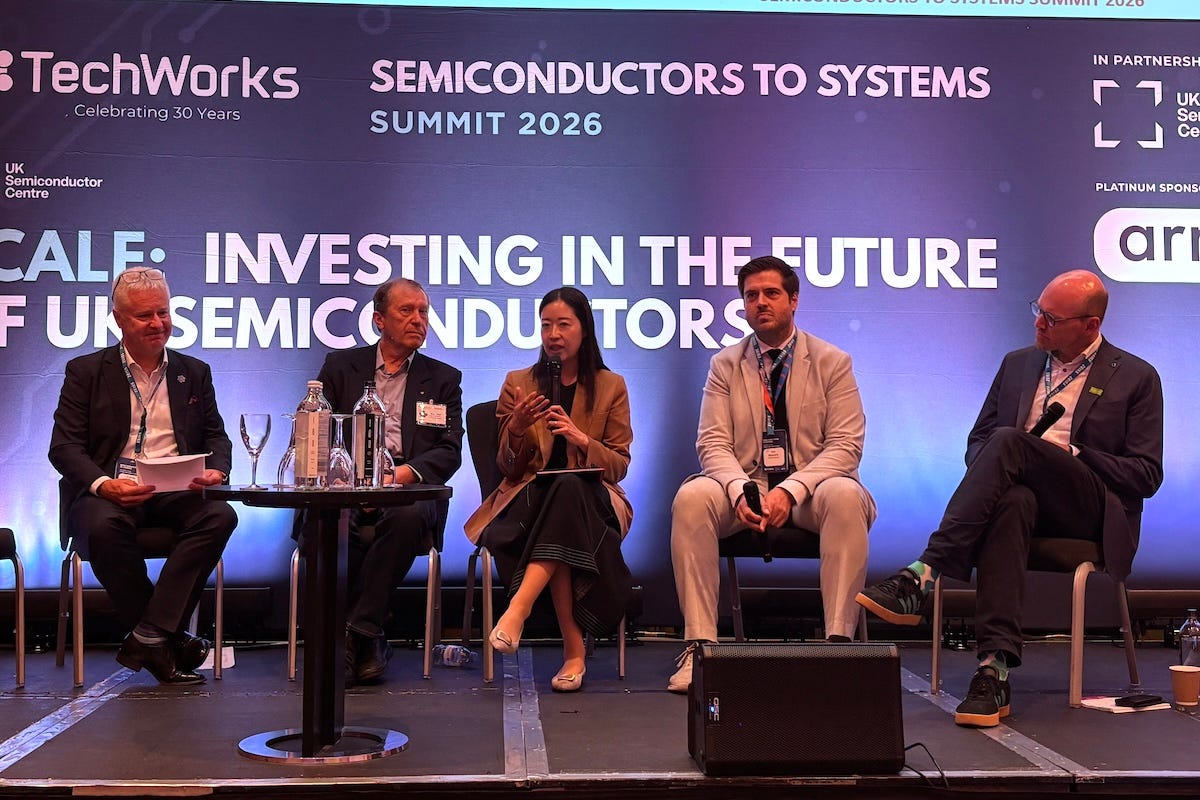
The debate took place at the Semiconductors to Systems Summit on August 26, 2026, in London. TechWorks, which organized the event in partnership with the UK Semiconductor Centre (UKSC), had Charles Sturman, its chief executive, moderate the panel. The discussion focused on how the UK and its international partners can build effective semiconductor collaborations.
Sayaka Tomihara, counselor at the Embassy of Japan in the UK, said access to semiconductors isn’t something Japan can achieve alone. “We need to partner with like-minded countries to be sure we have access, even in difficult situations.”
She said Japan’s prime minister visited London in June and signed an agreement between the UKSC and Rapidus, under which the UK contributes chip design expertise while Rapidus builds leading-edge semiconductor production capacity, with the latter due to come into focus in the coming year.
Andreas Lippert, chief operating officer for investor services at Saxony Trade & Invest Corp, said Saxony is the number one spot for chip production in Europe. He said Saxony also runs a shuttle wafer program in Dresden, making it easier for startups to use TSMC’s clean room there to produce their own wafers.
“Most of the European chips are produced there, so there’s a lot to offer in terms of front-end chip production capacity,” he said.
“Canada has strong foundational know-how in telecommunications and networking, which led to competency in photonics,” he added. “We also have strong capability in sensors and MEMS (micro-electromechanical systems), and in packaging and assembly.” Canada is also home to the largest chip packaging and assembly plant in North America, in Bromont, Quebec, he said.
Tomihara said disruptions during the COVID-19 pandemic, Russia’s invasion of Ukraine, and recent tensions in the Gulf have left consumers facing shortages of cars and air conditioners, making the public newly aware of how exposed economies are to semiconductor supply chains. That awareness helped drive Japan’s decision to build Rapidus, she said.
“Rapidus is looking for development partners,” she said. “We already have partners in the US, IBM and Tenstorrent, who are studying the design of what they want Rapidus to make. We want partners from Canada, the EU and the UK to join this effort.”
From talk to action
Sturman said the UK has strong passive silicon photonics capability at Cornerstone in Southampton and pockets of active laser capability, but not the whole picture.
“We’ve got cutting-edge silicon nitride, and we’re starting to develop thin-film lithium niobate,” Stojanovic said. “If you bring that together, there’s really strong potential to make unique things happen.”
Slaby said Canada does not plan to build mega fabs in silicon because that game is over. Instead, he pointed to optics, optical computing and photonics, which solve the data center and artificial intelligence (AI) problem by replacing copper interconnects between chips, within chips and between racks.
“Optical interconnect is explosive,” he said. “Anything we can do jointly there has phenomenal prospects for the future.”
Turning that kind of complementary capability into a real partnership takes more than an introduction, Slaby said. “You have to get on the plane and show up. That’s the first rule of business.”
He said Canada’s Semiconductor Council sent a delegation of 12 companies to the UK about a year and a half ago, and TechWorks reciprocated with a delegation of 24 UK companies to Canada’s Chips North Executive Summit.
The two sides then put in place bilateral funding for joint research and development (R&D) projects and signed a formal collaboration agreement, a template that Canada is now repeating with Germany, France, Spain and Japan.
“It’s not a one-off thing,” he said. “These are steps, and you keep on maintaining it.”
Slaby said the council also mapped its member companies against political ridings, giving each chief executive a direct line to their own member of parliament (MP) to help shape policy and strategy at a national scale.
Lippert described an AI-driven regional platform designed primarily for small and medium-sized enterprises (SMEs) to find technology partners without having to survey the entire landscape themselves.
“We call it Tinder for companies,” he said. “They can enter the platform, enter their topic, and they’re matched automatically with potential partners. For a company with 30 employees, it’s difficult to oversee the whole technological landscape.”
Stojanovic said the culture of collaboration, not funding, may be Europe’s real advantage. Recalling a panel he hosted, he asked an American investor what she envied about Europe. Her answer was blunt. The US has plenty of money but doesn’t collaborate or share facilities well, while Europe does, she told him.
Asked what they would want to see achieved within a year, panelists’ answers ranged from a shared test facility to a note of caution about how long some of the underlying advantages will take to develop.
“We could put together a common project with a cluster from the Netherlands, using an existing shared resource, a test and reliability center often funded by European money, to bring it closer to commercial success,” Lippert said.
Stojanovic pointed to a validation center that would co-develop processes together with foundries and equipment manufacturers.
“The question is whether such a center is needed, not just in Europe but elsewhere too,” he said.
Slaby was more cautious about one often-cited advantage: Canada’s critical minerals.
“It takes about 10 to 15 years to get a mine productive, and most of Canada’s mineral potential sits in areas with no roads,” he said. “There’s huge potential, but it requires huge investment and a real concentration of capital to make it happen in any manageable timeframe.”
With Rapidus already recruiting, a UK-Canada funding template being extended to four more countries and a shared validation center under discussion, the panel’s own test of progress is simple: whether any of these ideas becomes a working project within a year, or stays just a plan.