


Canva is folding artificial intelligence (AI) into the everyday tools people use to build presentations, documents and videos, while drawing a sharp line against the flood of generic AI-generated content spreading across the internet.
The distinction is deliberate. AI that helps finish a specific piece of work, whether a slide deck, a video edit or a brand-consistent design, is treated as a feature worth building. AI that produces interchangeable content at scale, with no clear owner or voice, is treated as the problem worth fighting.
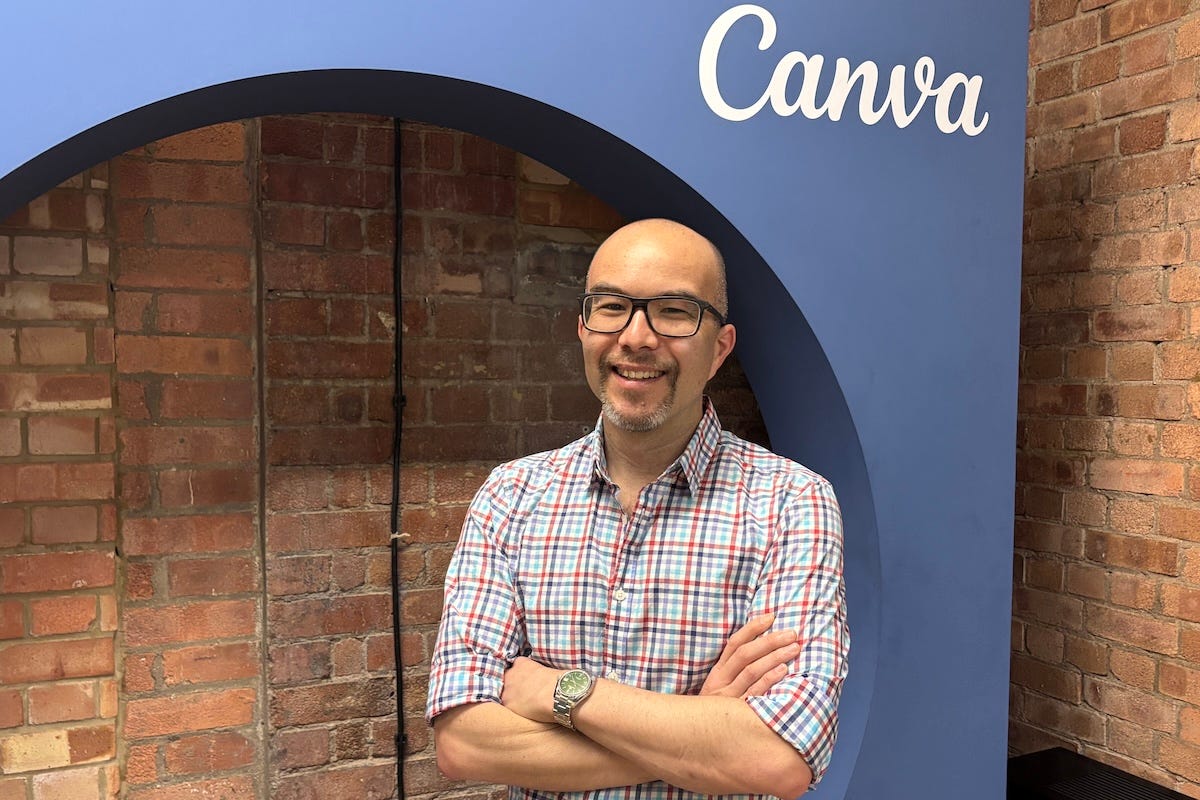
Cameron Adams, cofounder and chief product officer of Canva, described that ambition in practical terms.
“You can start a strategy doc, move that into a presentation, create a whiteboard for your team to brainstorm on, and create videos to go out to your social channels,” Adams said.
In his presentation, Adams said the biggest threat to design isn’t a rival company, but sameness.
“You ask an AI tool for a Spring Fair flyer, and you’ll get something like this,” he said. “When you want to stand out in a sea of content like that, where do you go?”
He said the answer is inside Canva itself, where AI-generated slides and video can be fine-tuned and kept consistent with a company’s brand kit, its logos, fonts and photography, rather than published as-is.
TechJournal.uk raised competition from rivals such as Adobe Express in the Q&A session. Adams’ answer was blunt.
“We don’t see a lot of competition from that part of the market,” he said.
He pointed to Canva’s brand-kit tools and its ability to span multiple design types, from presentations and documents to videos and websites, at an accessible price, as what keeps enterprises on the platform.
Adobe, the company behind Photoshop and Acrobat, built Adobe Express as a free rival powered by its Firefly generative AI engine. The tool sits inside a unit Adobe calls Acrobat plus Express, which passed 900 million monthly active users last quarter, up more than 25% year over year.
A less direct rival is CapCut, the free video-editing app from ByteDance, owner of TikTok. It had more than 323 million monthly active users as of mid-2024 and remains one of the world’s most downloaded apps.
Despite the crowded field, Canva’s own numbers point to strong momentum. Enterprise revenue grew 100% year over year, and its AI tools have now been used 34 billion times, a sign that building AI into finished work, rather than generating content wholesale, is resonating.
“People often don’t need the mega-expensive frontier model to run the work they’re planning on doing,” Adams said. “They can take a second-tier model that’s five times faster and 30 times cheaper, and use that to do a better job because it matches their needs better.”
That mix of smaller and open-source models is central to how Canva funds the AI features driving its strategy. The company’s machine learning platform runs on Anyscale, built on the open-source Ray framework, which Canva has said cut its cloud computing costs by about 50%.
The stakes are real. Canva cut its 2026 growth forecast from around 30% to 20% in August, after AI costs ran ahead of plan, eroding the near-zero marginal cost that once made software so profitable.
On the prospect of an initial public offering (IPO), Adams stuck to a familiar line.
“We’re always IPO ready,” he said. “But in terms of the timeline, we’re in no rush.”
He added that staying private lets Canva make long-term moves that publicly listed rivals cannot, an advantage he said has become more pronounced over the past two years.
New tools cut costs
Adams was speaking at a Canva media briefing in London on September 15.
The briefing, organized by Canva to outline its product roadmap and AI strategy, centered on Canva AI 2.0, a conversational design tool launched in April that remembers a user’s brand, past documents and previous presentations, weaving them into anything new a user asks it to create.
“The demand exploded before the economics were ready,” Adams said, describing a surge in usage that forced Canva to pause the product’s wider rollout.
Users of the tool were three times more likely to use AI generally, pushing Canva’s AI users to 75 million and straining the company’s infrastructure. About 120 in-house researchers spent four months retuning models and shifting workloads across global compute providers to bring costs under control.
“We’ve managed to reduce cost per task by 90%, which then enables us to roll out to even more users, and also to include free users,” Adams said.
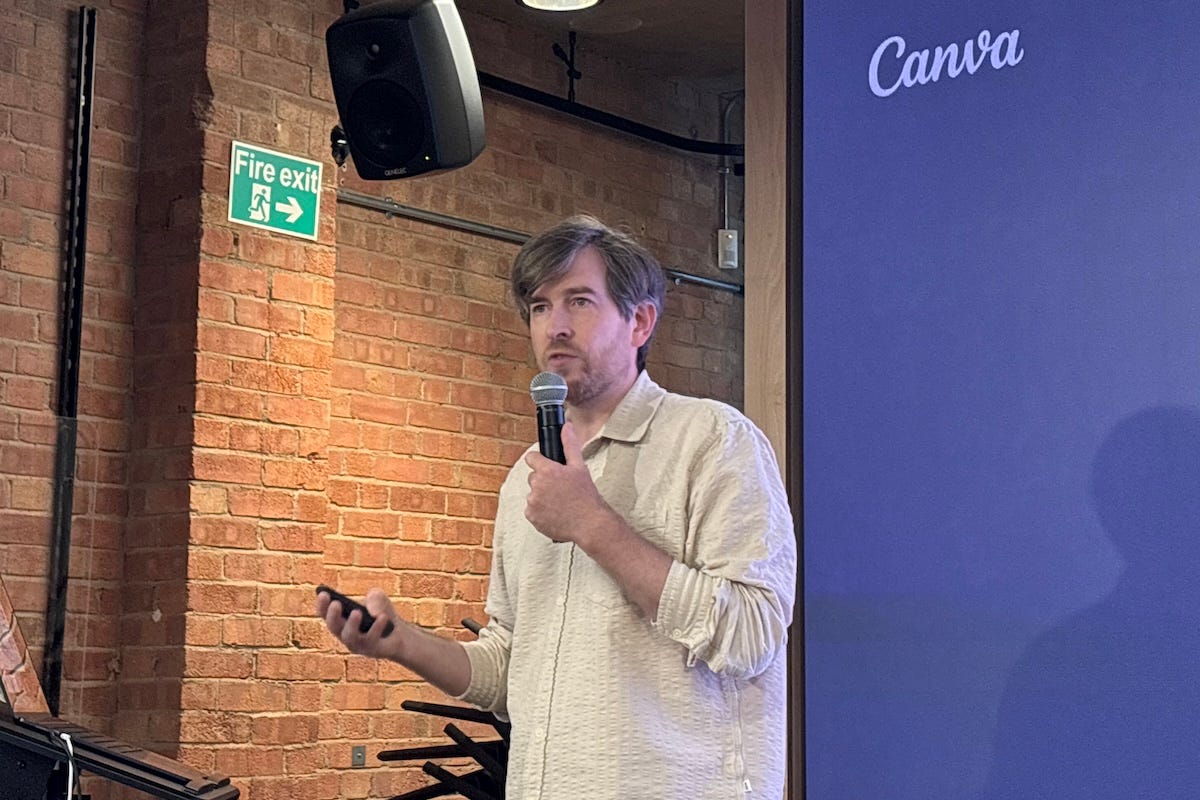
Duncan Clark, cofounder of the data-visualization tool Flourish and head of Europe, Middle East and Africa (EMEA) at Canva, said Canva’s product lineup splits along similar lines to its approach to AI.
“The visual suite is for the vast majority of people with no specialist design skills,” Clark said. “Then we have the ProSuite for people who need extra firepower for their craft.”
He said much of Canva’s enterprise resilience comes from adoption that starts long before any formal contract is signed.
“We just have this incredible bottom-up adoption,” he said. “Often when we go and speak to a company for the first time, there might already be 10,000 users in that company signed up who haven’t yet been consolidated into a full agreement.”
The centerpiece of that ProSuite is Affinity, a UK-based challenger to Adobe’s professional design software that Canva acquired in March 2024 for roughly $1 billion. Canva made Affinity’s core tools free in 2025, and more than 7 million advanced users, including professional photographers, have downloaded it since.
“We said free forever. We really meant it,” Clark said. “Our model with Affinity has always been that the core price should be free.”
Canva paired Affinity with Cavalry, a Manchester-based motion-graphics company it acquired in February 2026, and Flourish, the visualization tool Clark co-founded before joining Canva in 2022. Together they form the Canva ProSuite.
“This is going to be the most powerful designer ever on iPad,” Clark said of an Affinity app for Apple’s tablet yet to be released.
UK growth funds giving
The UK has emerged as one of Canva’s most important markets.
Users there created 224 million designs over the past 12 months, roughly 750,000 UK small and medium-sized businesses now use the platform every month, and Canva employs about 300 people in the country, with three buildings now clustered around a London square.
Its UK enterprise customers include National Grid, a 700-office estate agent chain and Coca-Cola’s Euro-Pacific division, alongside a growing community of independent trainers and creators who run Canva workshops across the country.
Getting the product right in each market means paying attention to local quirks, Clark said.
“In most of the world, if you search for hemp, you actually are looking for a farmyard picture,” he said. “But in the UK, hemp (cannabis) obviously means something quite different.”
Canva extends that same local focus into education, partnering with the Scottish Digital Learning Program to let every local authority in Scotland give schools free access to the platform, and building Learn Grid, a library launched six months ago with more than 50,000 curriculum-aligned lesson materials.
Britain also punches above its weight in Canva’s non-profit base.
“5% of the non-profits that use Canva are based here, which I think shows the real social conscience and social impact that’s happening,” Adams said.
Two UK non-profits show how that plays out on the ground:
The Scottish Drug Forum uses Canva to produce its own education materials in-house, saving time and the cost of outsourcing.
Stop Hunger Now, a global charity, localizes Canva templates so volunteers worldwide can adapt them for local campaigns.
That local work sits inside a wider philanthropic model Adams called Canva’s “two-step plan”: build one of the world's most valuable private companies, then use that value to do good.
“Build one of the most valuable companies that does the most good,” he said, describing the plan's philosophy.
More than 1 million non-profit organizations worldwide use Canva for free, part of a giving program funded by a 30% equity stake set aside for the Canva Foundation, which has delivered $150 million to date.
A separate $150 million commitment goes to GiveDirectly, which gives cash directly to people in poverty rather than dictating how they should spend it. Canva said 90% of recipients rose above the extreme poverty line within three months, and school absenteeism among their children fell 60%, with $100 million of the commitment already deployed.
Canva has also given $4.7 million to disaster and conflict relief since 2021, covering natural disasters and wars.
It has funded a solar farm in the United States that its print providers use to cut their carbon emissions, and under a program called One Print One Tree, it plants a tree for every print order placed through the platform, a tally that has reached 18 million against a target of 30 million.
As Canva’s private valuation keeps climbing, so does the fund it has set aside to give away.