


Tokenization is moving deeper into mainstream finance, but the rapid spread of new blockchains is creating a practical problem for institutions that must decide where assets should live, how they should move and who should be accountable when systems fail.
The risk is that a technology designed to make markets faster and more efficient could create fresh silos. For asset managers, the choice of blockchain is no longer a technical experiment. It is a distribution, compliance and governance decision.
Kim Hochfeld, global head of cash, securities lending and digital assets at State Street Investment Management, said the firm receives frequent approaches from new blockchain projects, making chain selection operationally demanding.
“We have to put every chain that we’re going to operate on through our internal risk and governance process,” she said. “That is not a limitless resource.”
“Why would I go on to chain A versus chain B versus chain C?” she said. “For me as a product manufacturer, it is all around distribution. Where are my potential investors? How do I want to reach them? Where do I want my product to be delivered?”
Hochfeld said privacy and transaction speed are important, but those requirements are increasingly treated as table stakes. The bigger question for an asset manager is whether a chain helps the firm reach the right investors while meeting its internal risk and governance standards.
That issue matters because tokenization promises to put traditional assets into digital wrappers that can be transferred and settled more efficiently. But if too many chains compete without common standards, liquidity may be split across systems instead of becoming easier to access.
Nick Kerigan, managing director and head of innovation at Swift, said the industry should expect consolidation over time. He did not expect thousands of blockchains to operate at scale.
“What I strongly believe in this space is that these chains need to be able to work together,” Kerigan said. “History tells us, from other innovations, that there will be lots and lots of new things, and eventually they will consolidate.”
“The most likely future is that there will be more than one chain, but there won’t be thousands and thousands,” he said.
Swift is implementing a blockchain-based ledger on top of the Swift network. Kerigan said the company has chosen open-source technologies because institutions need confidence that the underlying systems will be sustainable in the future.
Collateral use case
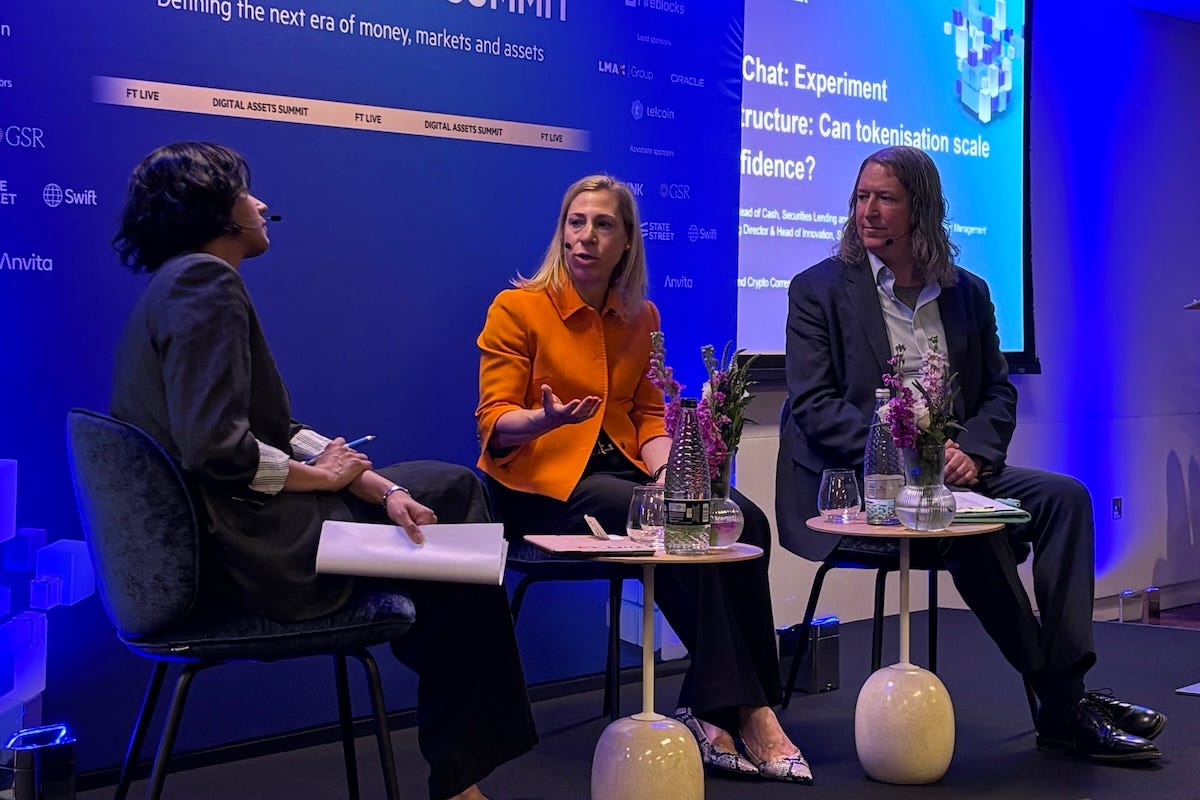
Jill Shah, US trading and crypto correspondent at the Financial Times, moderated the fireside chat, titled “Experiment to Infrastructure: Can tokenization scale with confidence?” The session took place at the Financial Times Digital Assets Summit in London on May 13.
The discussion focused on what tokenized systems need to operate with the resilience, governance, and regulatory confidence expected of financial-market infrastructure.
For Hochfeld, institutional adoption begins with education. Organizations must educate senior leaders, operating teams, investors and regulators before tokenization can be used at scale.
“I would start with education,” she said. “That is from the top of the organization all the way to the bottom. It is with our investors and particularly with the regulators.”
Education, however, is not enough. Institutions also need use cases that solve specific market problems. Otherwise, tokenization risks staying at the pilot-project stage.
“We need a few killer use cases. There is a real need for tokenized money funds in a collateral context,” she said.
Hochfeld pointed to the UK gilt crisis in 2022 as one reason why the collateral use case matters. The Financial Conduct Authority (FCA) and the Bank of England recognized the need for better ways to mobilize collateral after that period of market stress.
She said tokenized money funds could enable collateral to move more efficiently, potentially around the clock. That matters for asset managers because money-market products are already large, established pools of assets. Tokenization could give them new roles in collateral management, digital settlement and institutional liquidity.
“If you can mobilize that use case, what does that mean for an asset manager like ourselves?” she added. “It means we suddenly have a brand new multi-billion-dollar, if not multi-trillion-dollar, use case for a product that we have been managing since 1970.”
State Street Investment Management manages about half a trillion dollars of cash, according to Hochfeld. The collateral use case could double, triple, or quadruple the firm’s cash franchise if tokenized money funds were widely adopted.
That would shift tokenization away from a narrow crypto-market story. In this framing, the technology would not only create new digital assets. It would also wrap traditional products in new structures, open new distribution channels and give long-established instruments a more active role in market infrastructure.
Hochfeld also cited the success of BlackRock’s spot bitcoin exchange-traded fund (ETF) as a reason why asset managers have paid closer attention to digital assets. The product brought real flows, assets under management and revenue, making the commercial case more visible to traditional financial institutions.
Multi-money future
Interoperability remains one of the industry’s central challenges. The term is often used loosely, but for financial institutions, it refers to whether tokenized assets, digital money, and blockchain networks can operate together securely and at scale.
“We love the word interoperability, but that is just a long word for saying, how does this all work together?” Kerigan said. “How is it able to work together securely and at scale?”
The challenge is partly technical. He said privacy on blockchains remains difficult because banks want transaction details to be visible only to parties involved in a transaction. That expectation can sit uneasily with the open design of many blockchain systems.
“Technology is still an issue,” he said. “Yes, things are solvable with technology, but some of these are also very hard technical problems, like putting privacy onto blockchains.”
He said the matter is also a governance problem. Cross-chain movement raises questions about who is responsible when a token moves from one blockchain to another, especially when regulated institutions are involved.
“Crossing over these chains is a real institutional function. Somebody needs to be responsible to ensure that happens,” he added.
Hochfeld said asset issuers must know whether a token can move from one chain to another in a safe, secure and compliant way. They also need to understand where their responsibility starts and ends if something goes wrong.
Regulatory clarity is therefore becoming a competitive factor among jurisdictions. She said State Street would not launch a tokenized product in a market where the operating rules were unclear.
“We would never launch a product where we did not have clarity around how it was going to operate,” she said.
She added that the US has made significant progress, while the UK is catching up after a period of uncertainty. Jurisdictions in the Middle East and Asia, including Singapore, have also advanced in some areas, supported by greater investor understanding and clearer regulatory frameworks.
Kerigan said several forms of digital money could coexist. Stablecoins, tokenized commercial bank deposits and tokenized central bank money could all have roles in future settlement systems.
“We will end up in a multi-money world,” he said. “You will see stablecoins alongside the tokenization of commercial bank money in the form of tokenized deposits, and also alongside the tokenization of central bank money and reserves.”
For asset managers, the form of money may matter less than reliable access and settlement.
“As a product manufacturer, we are almost agnostic as to how you would want to access our product,” Hochfeld said. “You can come with fiat or a stablecoin.”
Fiat money is government-issued currency that is not backed by a physical commodity such as gold.
She said the key requirement is 24/7 liquidity. That same demand may soon affect securities lending as more equities and bonds move on-chain.
“As you get more and more equities and bonds coming on-chain, and those are moving 24/7, you need the cash collateral piece to be moving at the same speed,” she said.
The next phase of tokenization will therefore be judged less by the number of chains in the market than by whether institutions can connect assets, cash, collateral and responsibility across a smaller number of trusted networks.