


The metals industry is only at the start of a new upswing, as years of thin investment in mines meet a wave of infrastructure spending.
Investment in new mining capacity peaked around 2011, and the market hit bottom in 2016. Little money has gone into growth capacity since then, leaving supply tight just as spending on data centers, power networks and other long-neglected infrastructure takes off.
“Most of the clients that I see all say exactly what they said back in 2003, which is: we’ve missed it. We’re going to stay on the sidelines,” said Evy Hambro, global head of thematic and sector investing at BlackRock.
“If you reference where we are today and compare it to where we were back then, all of the signposts point to a very early stage in the cycle. Our conviction is that we’re in the early phases of what looks to be one of the most exciting cycles of the last few decades,” he said.
Hambro said he dislikes the word “supercycle” and that the early-2000s boom is better called the China cycle.
It grew out of long underinvestment in the 1990s, when commodity prices fell in real terms. Chinese demand then arrived at a scale and speed few had seen before, and the upswing lasted many years.
This time, the new cycle has been widely expected for years. Asked whether it could prove slower or more gradual than the China cycle, Hambro, a 32-year sector veteran, said he always struggles with commodity price forecasts because prices tend to be outputs of what drives them.
“When you talk about the price change, you’ve got to think about it in the context of what it’s doing to the profitability of the companies. Right now, these are great margins,” he said.
He said companies are making very good earnings in many commodities, but the market is not yet pricing in sustained margins or further growth. That caution creates a big opportunity that investors and other companies can take advantage of.
BlackRock, based in New York, is the world’s largest asset manager. Hambro also heads its natural resources equity team and co-manages the BlackRock World Mining Trust. He has been with the firm and its predecessors since 1994.
Hyperscalers need power
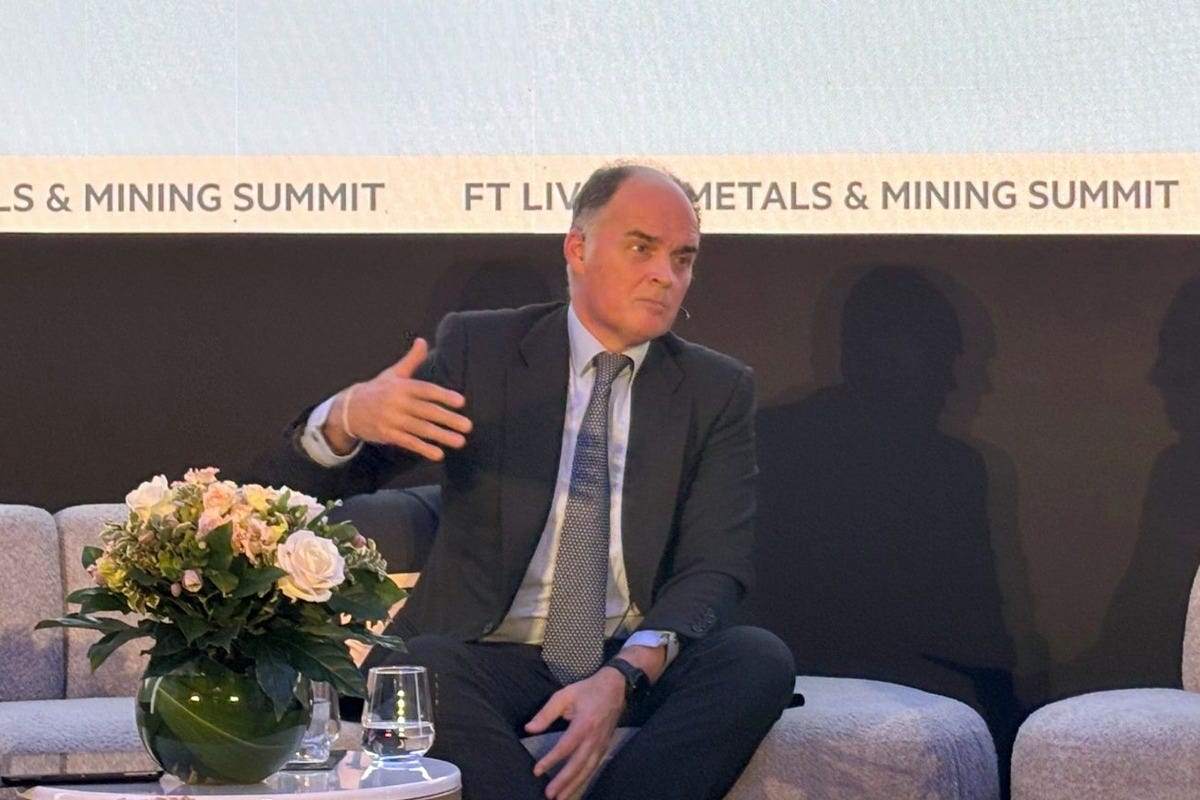
Hambro spoke at the FT Metals & Mining Summit 2026, organized by the Financial Times in London on October 15. Leslie Hook, world news editor of the Financial Times, interviewed him in a keynote session on the investor perspective. The two-day summit brought together leaders from across the global metals and mining industry.
He said the current cycle differs from the last one in where its demand comes from.
“The China cycle was one-dimensional. China provided all of the demand growth, and the rest of the world was flat to down in terms of commodity consumption. This global capex (capital expenditure) cycle is across a variety of different industries,” he said.
“The global capex cycle is on fire, and everybody’s putting money into all the infrastructure that hasn’t been invested in for decades, or hundreds of years. The UK is surviving on Victorian infrastructure.”
That spending is pushing up the cost of capital, which shows in interest rates and in talk of scarce capital. None of it can be built without commodities, and earlier panelists at the summit had stressed how important power has become.
“Everybody’s talking about hyperscalers, but none of that works without power. That’s very materials intensive,” he said. “It looks as though we have a lot of money to be spent over many years. It’s going to require an enormous amount of hard materials.”
Hyperscalers, which run giant cloud and artificial intelligence (AI) data centers, rely on power grids that use vast amounts of copper.
Hambro said different factors drive different phases of a cycle. At present, demand growth is coinciding with many commodities struggling to add capacity. Inventories are being moved around the world for different reasons, creating shortages in some regions and price gaps between markets.
“Right now, demand is beating supply in terms of its importance. But prices wouldn’t be rallying if supply wasn’t tight,” he said.
He said capital now moves quickly between asset classes. At the start of 2026, money was poised to flow into industrial commodities, but the conflict in the Middle East diverted attention toward fossil fuels. The conflict has now run for about six months.
“We live in a world where capital rotates incredibly quickly, and the speed of capital rotation is going to accelerate, although it already feels very fast,” he said.
Room for more automation
Hambro said the industry has plenty of room to grow, in both volumes and margins.
“The industry has done its best to keep up with technology. But there’s a lot more opportunity to be able to deploy technology to improve efficiency and productivity across many of the assets,” he said. “We’re seeing more automation. There’s a lot more to come, and I’m quite encouraged about that when it comes to margins.”
New capacity does not come cheap. Hambro pointed to a figure from Vandita Pant, BHP's chief financial officer, who told the summit earlier that new copper capacity costs about $30,000 a ton.
“When you’re talking about those kinds of scale investments, that can very easily consume companies,” he said.
He said miners could share the capital burden with partners and split up the capital stack in different ways. Bigger companies probably have an advantage on the cost of capital.
“There are definitely advantages to being bigger. But I don’t think it’s about being big for the sake of being big. If you can be big for other reasons, then there’s obviously a lot of advantage in that,” he said.
Buying a copper company already in production brings cash flow the next day, while building a new mine can mean waiting three or four years. He said the earliest movers in copper mergers and acquisitions probably secured the cheapest options, but plenty of opportunities remain.
He also questioned whether miners need to tie up capital in assets that do not produce commodities.
“Is it necessary for a mining company to own a desalination plant? Does it need to own a railway?” he said.
Such assets are part of the production process, but other investors may pay more for them. Selling them would release capital to reinvest in the core business and compound growth.
Hambro said miners must also remember the last cycle, when too many big projects were funded with debt at the wrong time. When demand growth slowed, companies fell into balance-sheet distress and lost investors’ trust. Many have since set out clear capital allocation frameworks.
“When the cycle starts again, and there’s new management running businesses, it’s very easy to forget the pain that many of the businesses went through,” he said, adding that sticking to those frameworks should rebuild trust.
He also warned that many black swan scenarios could still hurt the sector, so investors need a diversified approach. They could back the right theme but pick the wrong companies and miss the opportunity entirely. He hopes investors’ attention will return to industrial minerals once the conflict finds an off-ramp and supply-chain disruptions ease.