


The world’s largest copper producer expects artificial intelligence (AI) and data centers to deepen a structural copper deficit it sees arriving around 2028.
Traditional drivers such as urbanization, industrialization and population growth have not gone away. AI and digitalization on one end and power grids and the energy transition on the other are now amplifying them, while copper mining is, by definition, a depleting industry. Data centers need the metal for power distribution, cabling and cooling.
“Copper is an attractive story because structurally there is a deficit coming, and there is depletion happening. Even to stand still, we need a lot more projects to come in, and we are not standing still because the demand is going up,” said Vandita Pant, chief financial officer of BHP.
“Between now and the mid-2030s, almost eight to 10 million tons of copper units are needed incrementally. You need eight to 10 Escondidas, and that’s a big challenge for the industry.”
Escondida in Chile, the world’s largest copper mine, produces about 1 million tons a year. Pant said BHP believes the structural deficit is still ahead, as some supply returns to the market first.
Asked whether the AI cycle had lost some momentum and whether US tariffs might be dropped, she declined to share BHP’s copper price forecasts. She said copper is nonetheless already short for tactical reasons, and tariffs could create arbitrage in the market.
“There are tactical deficits because, as an industry, we guide to something and produce something else. Even if it’s not structural, we haven’t delivered as an industry on what we said we would,” she said.
“AI and data centers are one driver of copper demand. But that anticipation of demand can also lead to more demand from a financialization perspective.”
Headquartered in Melbourne, BHP traces its roots to 1885. Copper accounted for more than 50% of its underlying earnings before interest, taxes, depreciation and amortization (EBITDA) in fiscal 2026. Its portfolio also spans iron ore and steelmaking coal, with potash (potassium-bearing salts) to follow next year.
Hyperscalers come calling
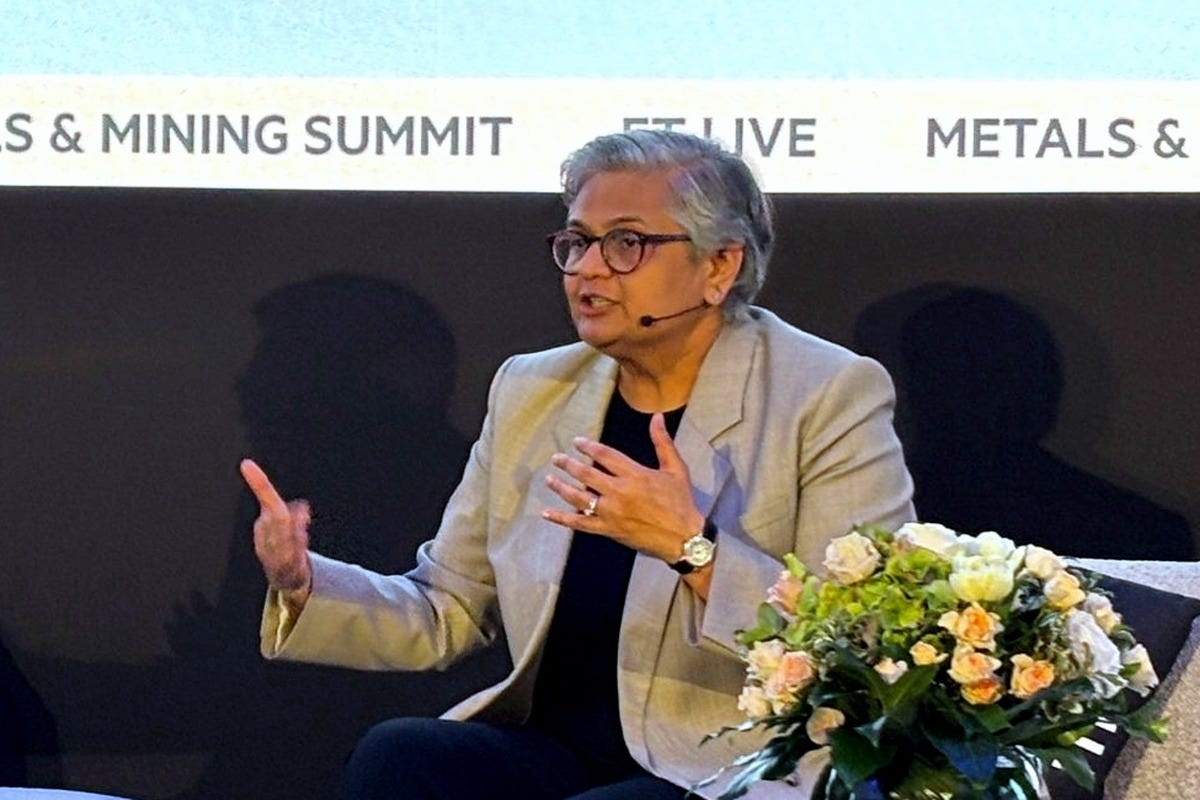
Pant was speaking at the FT Metals & Mining Summit, organized by the Financial Times (FT) in London on October 15. FT natural resources editor Dan Thomas moderated the keynote interview on BHP’s strategy and copper.
Asked whether hyperscalers are approaching miners as partners or investors, Pant said BHP does hold talks with them.
“Around two, three weeks back, we announced with Amazon a deal to give them the assurance of the life-cycle carbon footprint of the copper that they are using in their projects in data centers. There’s a lot of innovation as well as partnerships going on with the customer,” she said.
Under the pilot announced on September 22, BHP will create and sell Environmental Attribute Certificates (EACs) for copper concentrate and cathodes from Escondida, which runs on renewable power. Amazon can retire them against copper in its power, cooling and computing infrastructure, including chips, interconnects and cold plates that enable AI.
Tracking the emissions of physical copper is difficult because the metal passes through smelting, refining, fabrication and manufacturing before it reaches end users. The pilot will test eligibility criteria, a governance framework and safeguards against double counting.
The model is called “in-setting” because the certificates cover only emissions within copper supply chains.
“Whether equity investment is the way in is a different issue, because the competitive advantage and the core capability needed for doing mining is digging it out of the ground,” Pant said.
“But that’s not to say that there aren’t partnerships with customers in terms of the kind of product which is needed and the kind of considerations which they have, either carbon emissions or something else.”
She said customers want suppliers that reliably deliver what they promise, a challenge shared across the industry.
BHP is developing four copper projects at once to meet that anticipated demand. Its growth options span Chile, South Australia and Argentina, with Resolution in the US as a longer-term prospect.
Building beats buying
BHP’s own copper projects cost about $16,000 per ton of capacity, rising to about $30,000 for greenfield sites. Pant said that pipeline gives BHP 5% compound annual growth in copper output until the mid-2030s.
She said BHP’s options are mature. Investment decisions on Copper South Australia, Escondida and Vicuña are due within 12 to 18 months, with environmental permits under way and royalty agreements and Argentina’s fiscal incentives in place. Copper South Australia is set to grow from 320,000 tons to about 500,000 tons by the early 2030s.
Buying growth costs far more. Pant said the market value of listed copper-focused miners works out at $80,000 to $85,000 per ton of their output, before any takeover premium.
She said acquisitions are still an option, but a transformational merger would need synergies rather than resting on the copper price. BHP bought OZ Minerals in 2023 and has raised copper output by 30% over three years. She said its Vicuña joint venture with Lundin could become one of the world’s top 10 copper assets.
Copper should keep growing as a share of BHP’s business without the company becoming a pure play, she said.
Pairing copper with iron ore, steelmaking coal and potash gives BHP stable cash through commodity cycles. It spends about $11 billion a year on growth projects and still expects $50 billion of attributable free cash flow over five years at spot prices after that spending, while paying out 50% of earnings to shareholders.
It has also unlocked $6.5 billion through joint ventures and infrastructure deals in the past eight to nine months, with the proceeds funding both growth and shareholder returns.
“Copper is something which should increasingly be a bigger part of our portfolio. Having said that, the unique proposition of BHP is a very well-balanced, diversified portfolio,” she said. “As the industry needs to grow massively, to support what the world needs in terms of digitalization, energy transition, traditional drivers of demand and food security, as an industry we have to invest a lot.”
“Most industries which are in a growth phase look for not just one lever; they look for every lever to create value. And mining is no different.”
Labor is another supply factor. BHP has just reached a three-year agreement with its union at Escondida, and Pant said fair pay and productivity are a normal part of bargaining.
“In Chile, it’s quite a systematic way in which these things happen. There’s a framework of negotiation,” she said.
With investment decisions on Copper South Australia, Escondida and Vicuña due within 18 months, BHP aims to show tech customers that it can deliver the copper it promises.