Russia deployed its first anti-satellite (ASAT) weapon into geostationary orbit (GEO) in May 2024, marking a threshold that Western space planners had long feared. The satellites, designated Cosmos 2589 and 2590, now operate at the altitude used by military communications and early warning systems that allied forces depend on most.
The deployment was the culmination of more than a decade of escalation in low Earth orbit (LEO). GEO hosts the satellites allied forces rely on most: broadband communications, missile warning and signals intelligence. A co-orbital weapon at that altitude can disable those assets in ways ground-based strikes cannot replicate.
“We know Russia has been working on counterspace programs documented in the public domain. We also know they are moving that capability to GEO satellites,” said Tony Holt, chief technology officer for space at BAE Systems Digital Intelligence. “The threat is there, and we need to be prepared.”
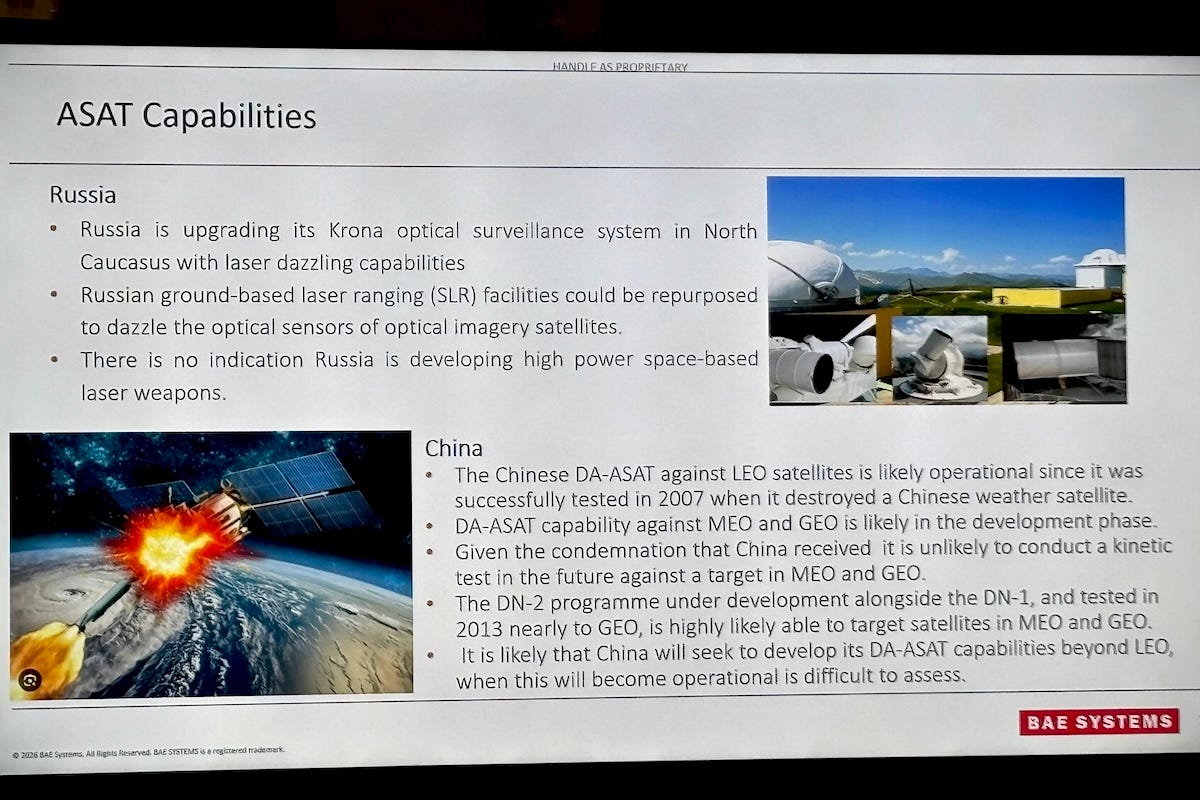
"This is the scariest bit," Holt said. "Russia is upgrading its Krona optical surveillance system in the North Caucasus with laser dazzling capabilities. Its satellite laser ranging (SLR) facilities could be repurposed to blind the optical sensors of imagery satellites. There is no indication Russia is developing high-power space-based laser weapons."
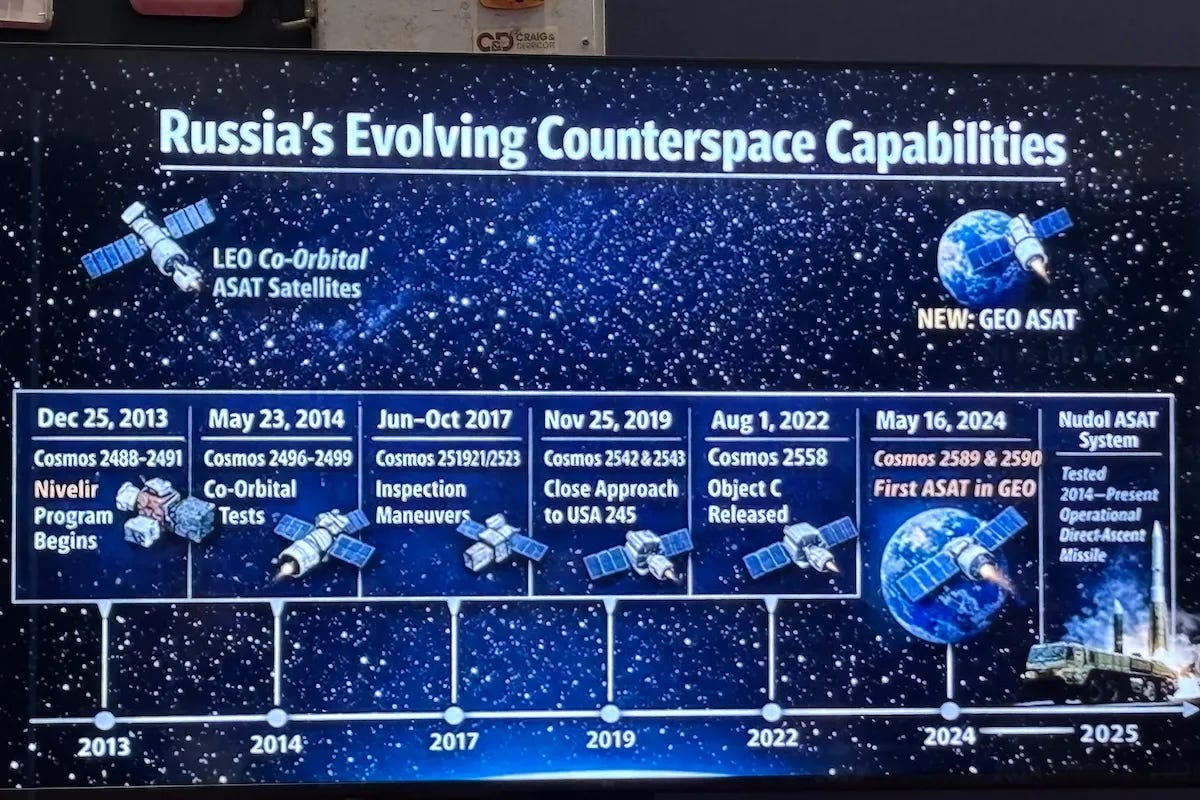
Russia’s Nivelir program began in December 2013, advancing through co-orbital tests in May 2014 and inspection maneuvers between June and October 2017. In November 2019, Cosmos 2542 and 2543 conducted a close approach to USA-245, a US surveillance satellite. By August 2022, Cosmos 2558 had released a sub-object into orbit.
The Nudol direct-ascent ASAT missile, tested since 2014 and now described as operational, provides a further layer: a ground-based system that can strike LEO satellites without extended orbital maneuvering.
Together, the two programs give Moscow anti-satellite reach spanning multiple orbital regimes.
BAE Systems launched its Azalea satellite cluster into LEO in November 2025 aboard a SpaceX rideshare mission. The four-satellite formation fuses radio frequency (RF) and synthetic aperture radar (SAR) data using artificial intelligence (AI), delivering near real-time intelligence to defense, security and civil customers.
From jamming to cyberwar
Holt presented the analysis at the 2026 Space-Comm Expo Europe in London, organized by Space-Comm Expo Europe in partnership with ADS Group. The session focused on ensuring national security through international collaboration.
With more than 30 years of experience across spacecraft operations, avionics and satellite missions, he has previously served as chief sales and innovation officer at In-Space Missions and engineering director at Surrey Satellite Technology.
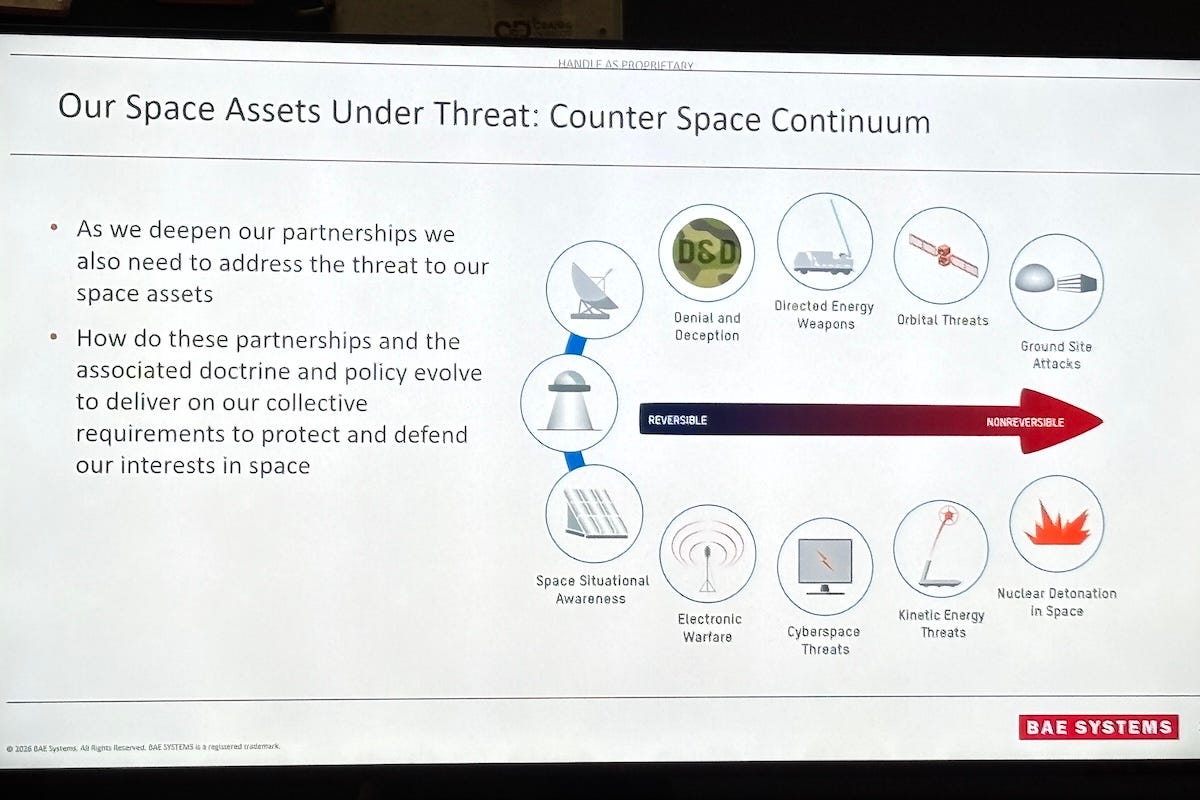
Space assets face a counterspace continuum stretching from reversible, sub-threshold threats through to non-reversible effects. Sub-threshold threats include denial and deception, jamming and cyberspace supply chain attacks, all difficult to detect, contextualize and attribute.
At the non-reversible end sit kinetic strikes and nuclear detonation in space. Space situational awareness (SSA) underpins attribution across the full spectrum.
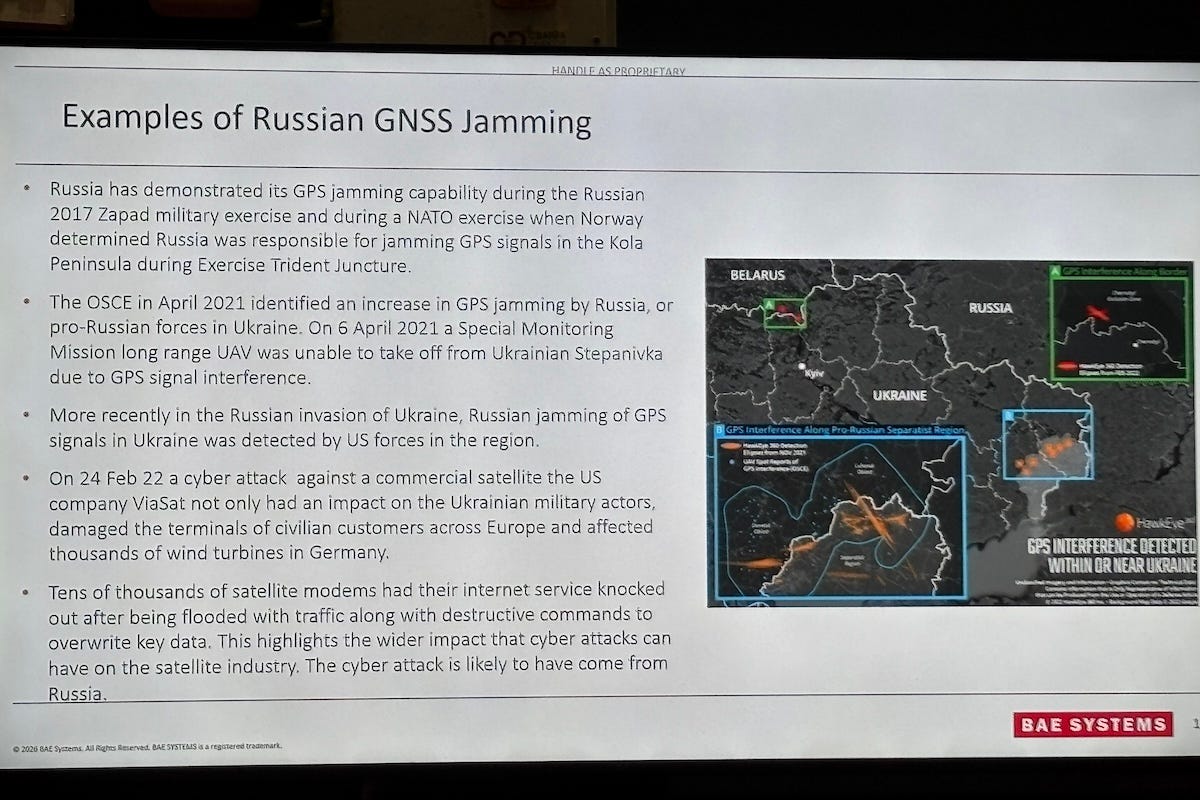
Russia has demonstrated global navigation satellite system (GNSS) jamming across multiple incidents. During its 2017 Zapad military exercise and the North Atlantic Treaty Organization’s (NATO) Trident Juncture exercise, it jammed Global Positioning System (GPS) signals over Norway’s Kola Peninsula.
The Organization for Security and Co-operation in Europe (OSCE) identified a surge in GPS jamming by Russia or pro-Russian forces in Ukraine in April 2021.
On April 6 that year, an OSCE long-range unmanned aerial vehicle (UAV) was unable to take off from Stepanivka due to signal interference, disrupting a civilian monitoring mission.
The most consequential Russian attack came on February 24, 2022. A cyberattack on ViaSat, a US commercial satellite operator, simultaneously disrupted Ukrainian military communications, cut broadband for civilian customers across Europe and knocked tens of thousands of wind turbines in Germany offline.
Tens of thousands of satellite modems were taken down after being flooded with traffic and struck with commands designed to overwrite key data. The attack is likely to have come from Russia.
“It is not just GNSS jamming. It goes beyond,” Holt said.
The ViaSat attack illustrated how a strike on a single commercial operator can cascade simultaneously across military, civilian and industrial systems, the kind of vulnerability that underpins the broader case for collective space defense.
Lasers and collective defense
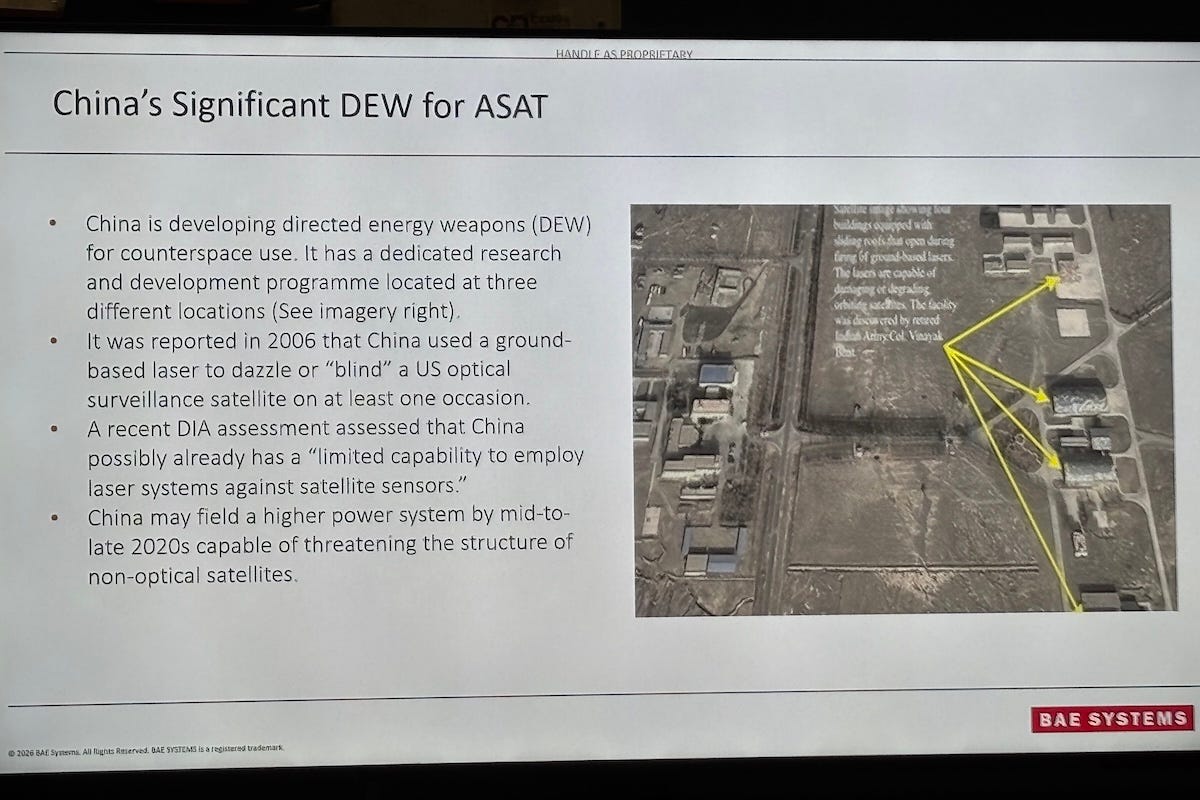
China presents a parallel counterspace threat. It installed communications and radar jamming equipment on two fortified outposts in the Spratly Islands in the South China Sea, with satellite imagery commissioned by the US military confirming antenna masts at both locations.
“China has significant jamming technologies. They have significant electronic warfare (EW) counterspace capabilities against GNSS and satellite communications,” Holt said. “We cannot ignore it. We need to be prepared.”
Chinese military doctrine integrates space, cyber and EW under a single command structure, making the incorporation of jamming into counterspace operations highly likely. The full extent of cross-service integration, however, remains unclear.
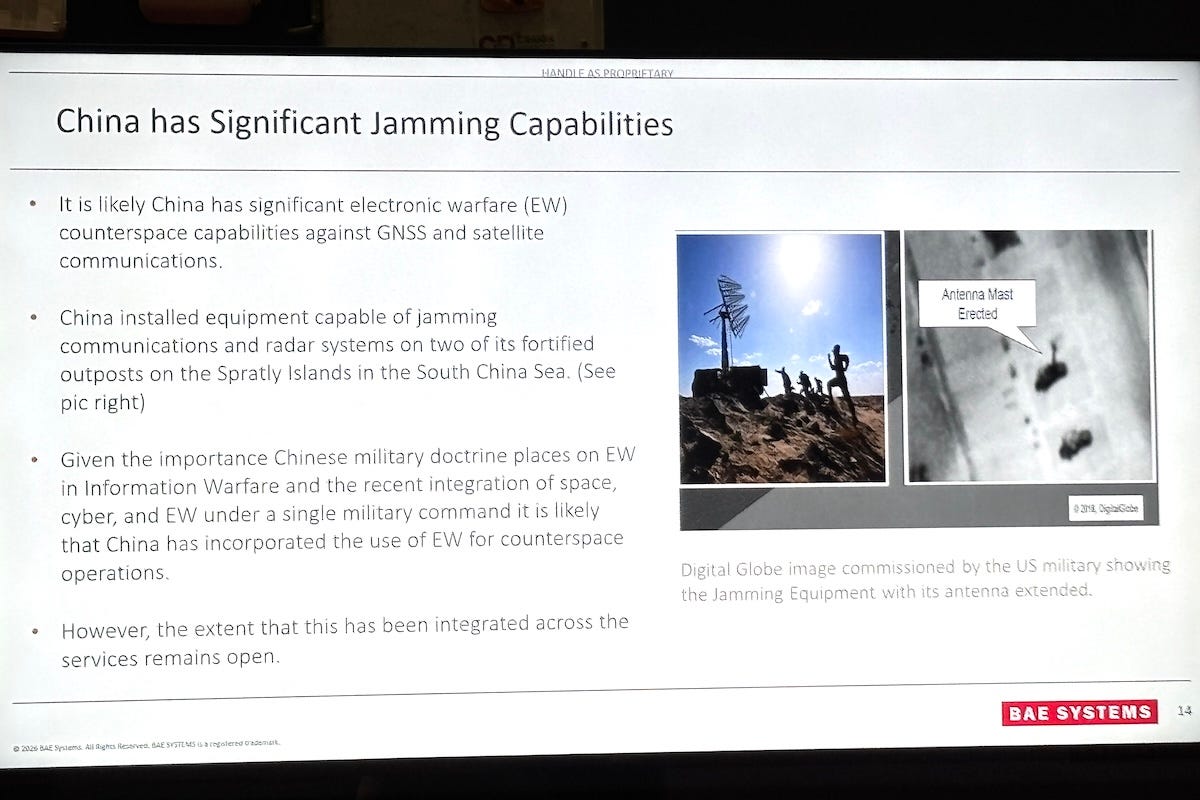
China is also developing directed energy weapons (DEW) for counterspace use, with a dedicated research and development program confirmed at three locations by satellite imagery. It was reported in 2006 that China used a ground-based laser to dazzle a US optical surveillance satellite.
A US Defense Intelligence Agency (DIA) assessment concluded China possibly already holds a “limited capability to employ laser systems against satellite sensors.”
China’s direct-ascent ASAT (DA-ASAT) program likely became operational against LEO satellites after a 2007 test that destroyed a Chinese weather satellite, creating a large debris field and drawing widespread condemnation.
The DN-2 program, tested in 2013 to near-GEO altitude, is assessed as highly likely capable of targeting satellites in medium Earth orbit (MEO) and GEO. Holt said directed energy is the more probable path of future escalation, with further kinetic tests unlikely given the 2007 condemnation.
He said China may field a higher-power system by the mid-to-late 2020s capable of threatening the physical structure of non-optical satellites.
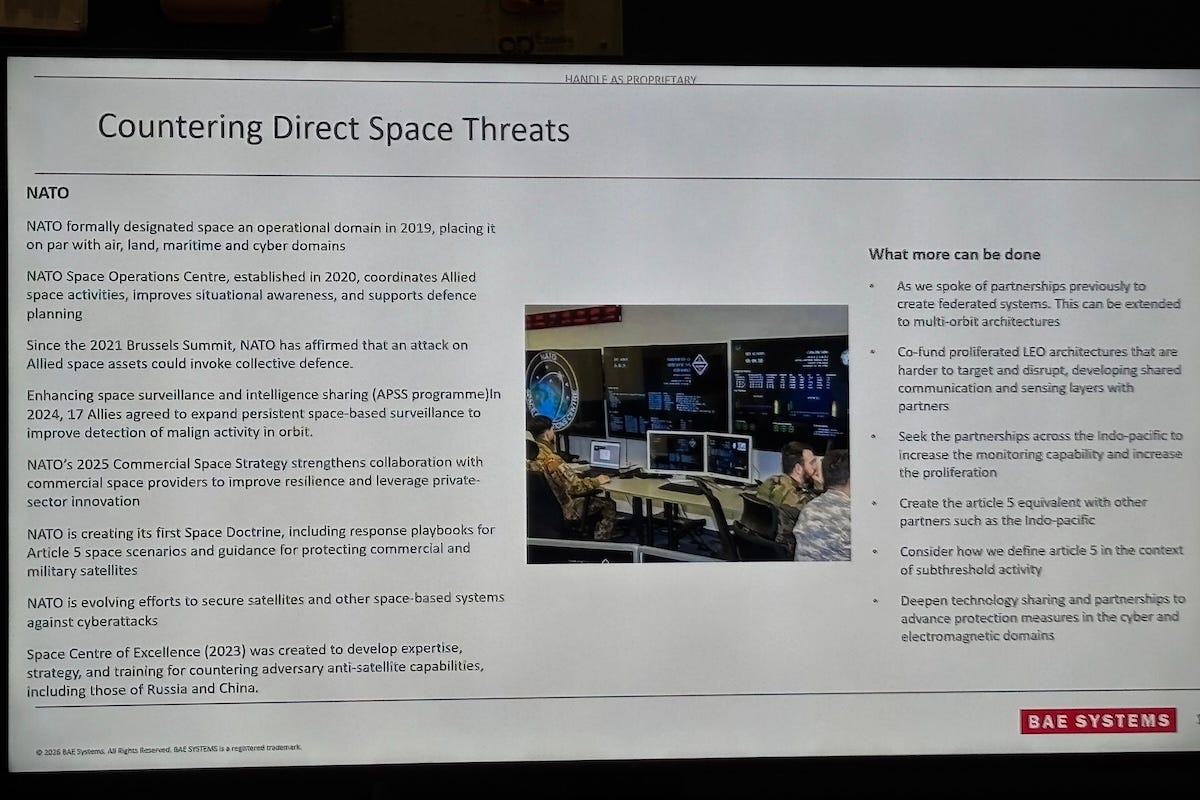
NATO formally designated space an operational domain in 2019 and established its Space Operations Center in 2020. Since the 2021 Brussels Summit, the alliance has affirmed that an attack on allied space assets could invoke Article 5 collective defense.
In 2024, 17 allies agreed to expand persistent space-based surveillance, and NATO’s 2025 Commercial Space Strategy deepened ties with private-sector providers.
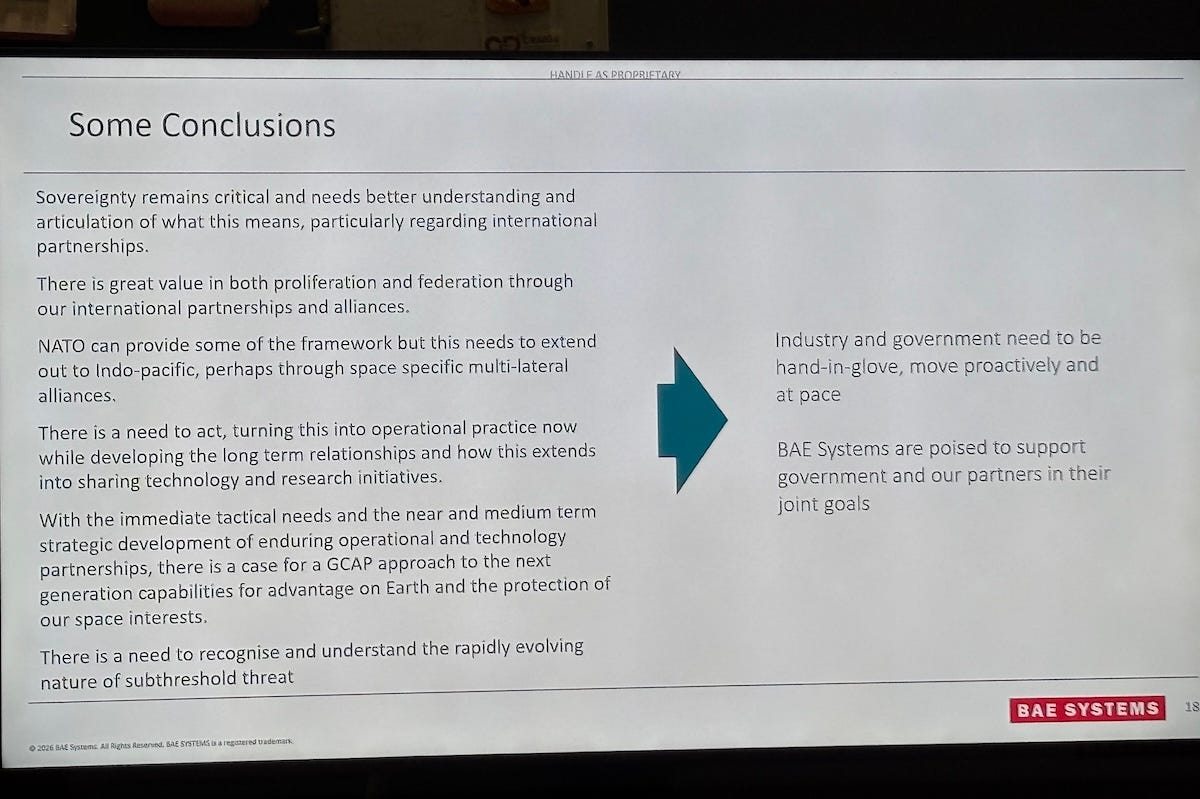
Holt called for action beyond the existing framework, proposing co-funded proliferated LEO constellations that are harder to target, expanded Indo-Pacific partnerships and an Article 5-equivalent commitment for Indo-Pacific nations. NATO’s alliance structures, while valuable, have proved too slow for the pace of threat.
“Sovereignty remains critical and needs better understanding and articulation of what this means, particularly regarding international partnerships,” he said. “We need to act now. We need to turn talk into action.”
He drew a parallel with the First World War: Britain and France developed tank technology but Germany operationalized it first.
The same risk applies in space today, with adversaries moving faster to operationalize counterspace capabilities than Western alliances have managed to match. A Global Combat Air Programme (GCAP)-style approach to next-generation space protection could help close the gap, but only if industry and government commit to moving proactively and at pace.