


AVK, long known as a supplier of standby generators and backup power systems for data centers and other critical facilities, has repositioned itself as a strategic power‑systems provider as the rapid growth of artificial intelligence (AI) infrastructure collides with electricity‑grid constraints across Europe.
The shift reflects a broader industry-wide rethink as hyperscale facilities seek new ways to secure reliable power while advancing decarbonization. One example is a new project in Dublin that shows how developers are redesigning data‑center energy infrastructure when public electricity networks cannot expand quickly enough to meet demand.
Pure Data Centres Group (Pure DC), a hyperscale cloud and AI data‑center developer active across Europe and the Middle East, launched Europe’s first large‑scale data‑center microgrid at its Dublin campus on March 11. The 110‑megawatt on‑site system, developed with AVK, allows the campus to generate electricity during early development stages before full grid capacity becomes available.
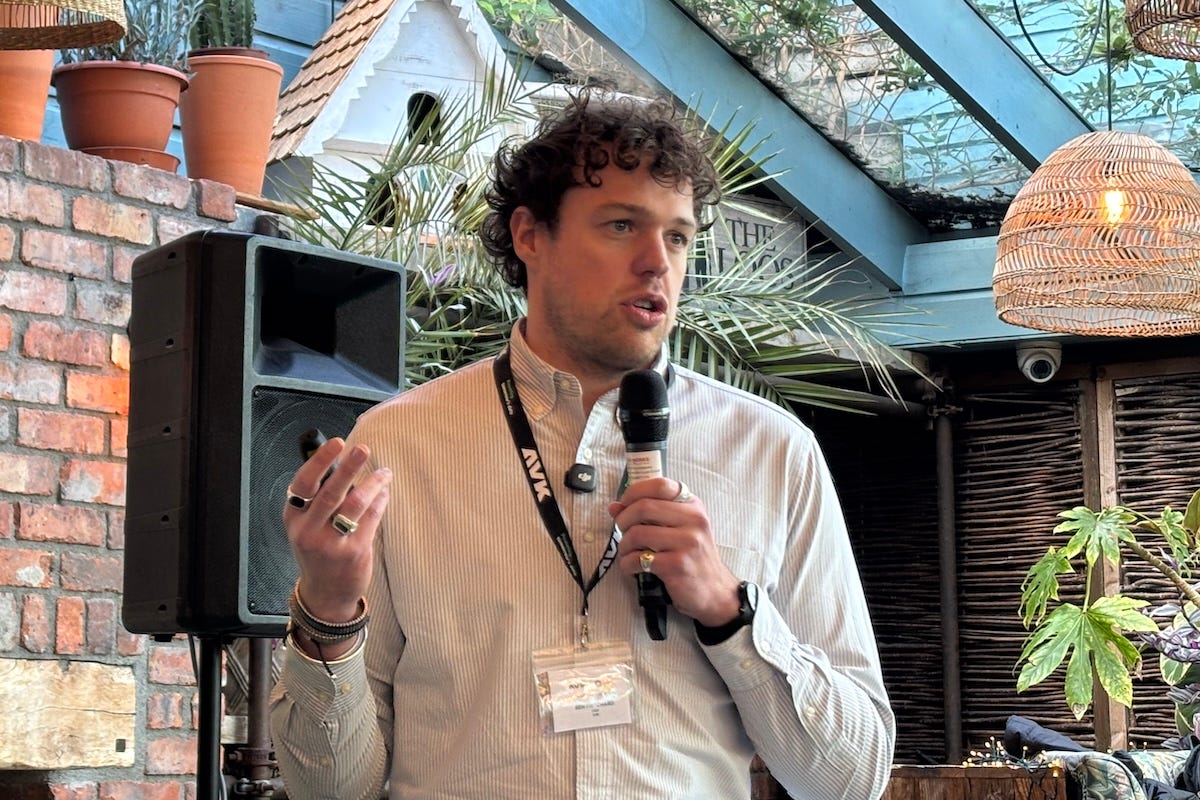
“AVK as a business completely transformed its model. We moved away from being just a standby generator provider into a strategic power-systems solution provider,” said Ben Pritchard, chief executive officer of AVK.
“The biggest challenge was moving into the unknown. None of us truly knew what the journey would look like. No template ever existed for a data-center microgrid like this,” he said.
Pritchard said the transformation was driven largely by a structural shift in the digital infrastructure sector, where access to electricity has become one of the most significant constraints on new data center development.
“Seven years ago, grid constraints weren’t even a feature. Data centers were built in a very traditional way with two grid connections, a backup power source and UPS (Uninterruptible Power Supply) systems,” he said.
Today, however, many new facilities must design alternative power architectures from the outset, as securing grid connections is becoming increasingly difficult.
Reinventing power architecture
Pritchard spoke during a media tour on March 11 of Pure DC’s new data-center campus in Dublin, where developers have deployed a large on-site microgrid designed to supply power independently of the national grid.
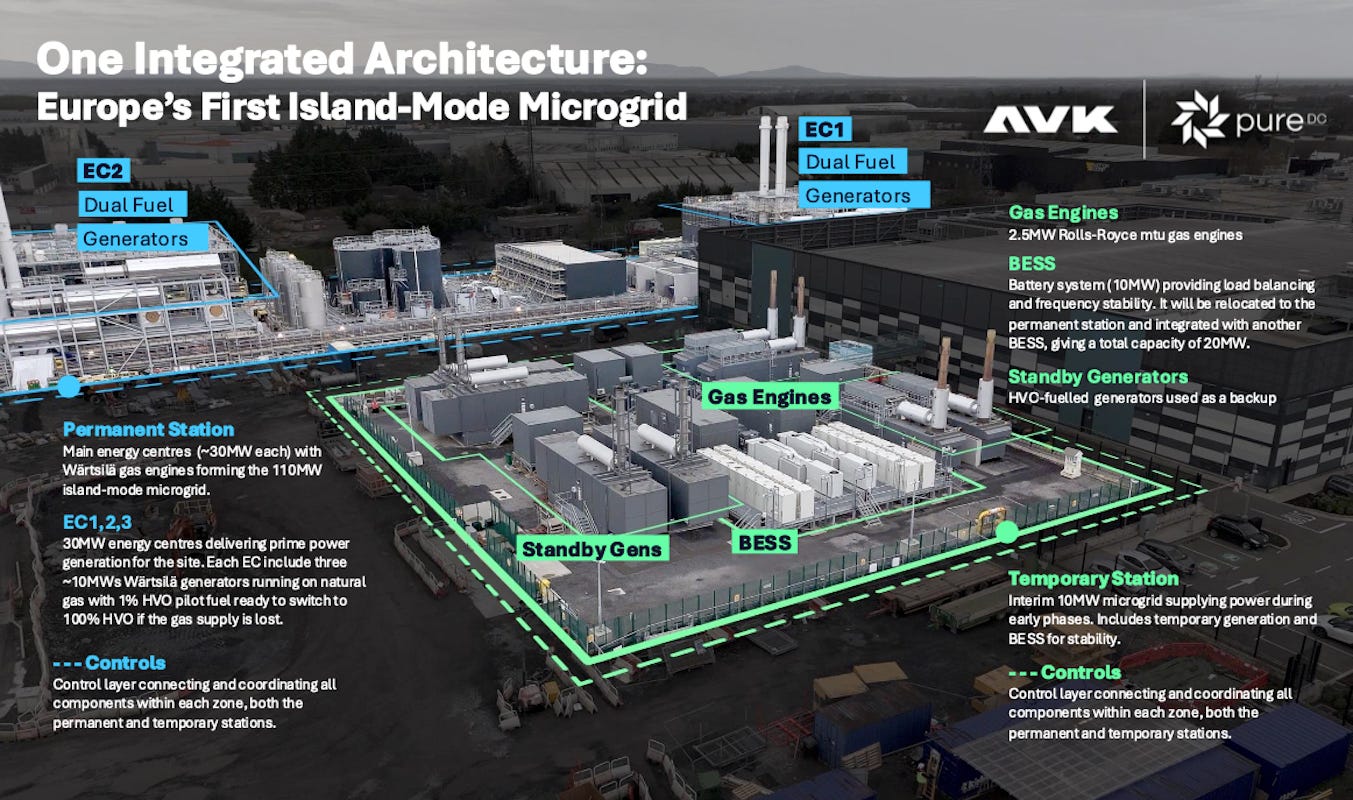
Located in the fiber‑rich Ballycoolin area, the campus is designed to deliver 54 megawatts across three data centers: DUB01 (14MW), DUB02 (24MW), and DUB03 (16MW). DUB01 has been operational since 2024 and supports high‑density workloads with advanced cooling and power infrastructure.
In 2023, Pure DC also acquired an additional 25 acres west of the site for a potential 90-megawatt expansion, subject to permitting and power availability.
Pritchard said building such systems requires combining multiple technologies rather than relying on a single generation method.
“It was very apparent that one design wasn’t going to facilitate this. It wasn’t just going to be a group of gas engines. We had to move into an integrated engineering architecture with layers of technology,” he said.
The architecture incorporates several power layers designed to achieve “five-nines” reliability or a standard of 99.999% availability typically required by hyperscale data centers.
These include:
gas-powered generation systems that provide a primary electricity supply
battery energy-storage systems (BESS) that balance load fluctuations and improve efficiency
liquid-fuel backup generators capable of maintaining operations in the event of a gas supply failure.
In the early stages of a data center’s life, computing load ramps up slowly, meaning engines would otherwise run inefficiently at low output.
Battery storage can absorb excess generation or discharge electricity when demand rises, smoothing fluctuations and improving overall system performance. It also allows the facility to maintain stable operations while gradually scaling capacity as customers deploy new computing workloads.
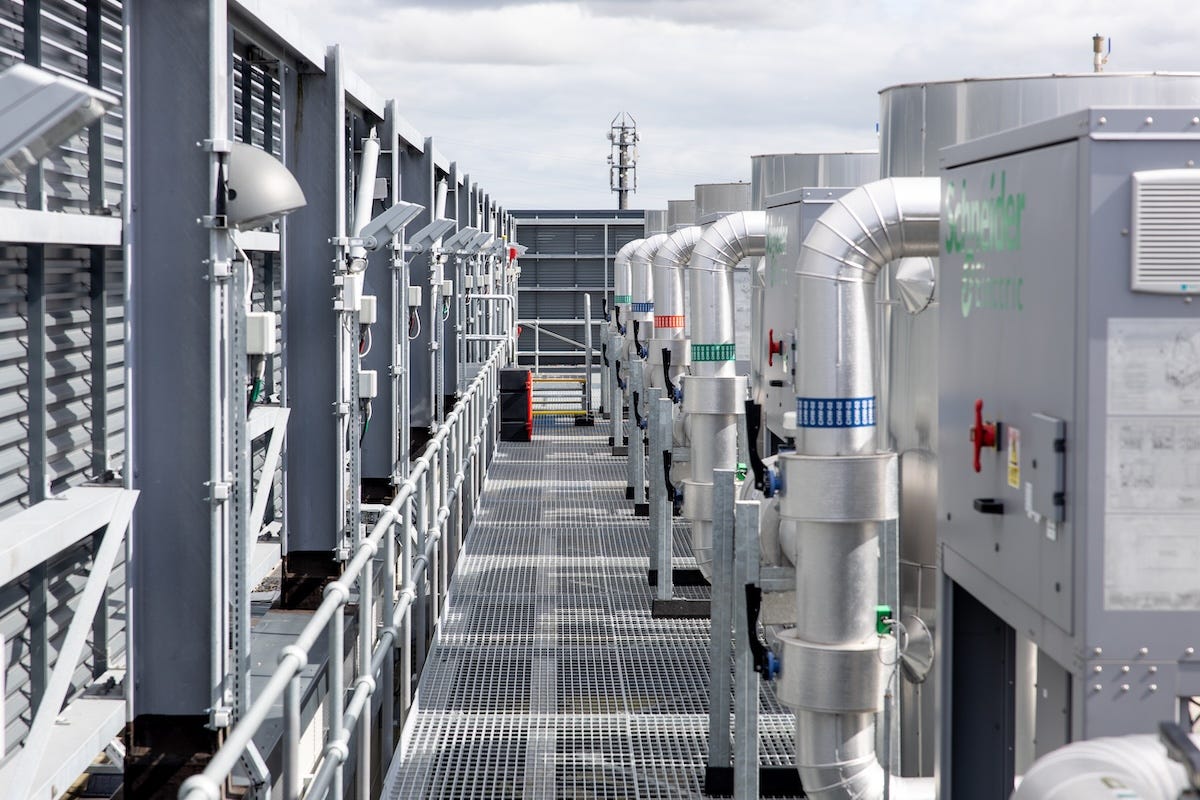
Pritchard said designing such systems required AVK to bring in expertise from several adjacent industries, including gas‑engine engineering, energy‑storage integration and high‑voltage control systems.
The company also expanded partnerships with technology suppliers, including Rolls‑Royce and Finnish engine manufacturer Wärtsilä, whose larger dual‑fuel engines are used in the permanent microgrid design planned for the Dublin campus.
Pritchard said the dual‑fuel configuration allows the engines to run primarily on natural gas but switch automatically to hydrotreated vegetable oil (HVO) if the gas supply is interrupted, ensuring uninterrupted data‑center operations.
He said the complexity reflects the operational requirements of data centers, which must maintain uninterrupted service even as computing workloads ramp up unpredictably.
“When you design a system for a manufacturing plant, you usually know exactly how the equipment will behave. With a data center, you know the final capacity you need, but the ramp rate of the load is completely undefined,” he said.
“This is actually the blueprint for microgrids. Everything that we applied to this scheme will be applied to larger schemes and future microgrids.”
While microgrids are sometimes described as temporary solutions until grid connections become available, Pritchard said the systems can play a more active role in energy infrastructure.
“People often talk about microgrids as a bridging solution, but it’s much more than that,” he said. “What we’ve built removes demand from the grid and, once connected, allows the infrastructure to participate in grid activity.”
Biomethane decarbonization test
Alongside the power-system design, the project has also tested new approaches to lowering emissions from gas-based generation.
Pure DC on March 12 announced that its Dublin campus achieved what it described as Europe’s first successful biomethane proof of concept for data-center operations.
During 2025, the facility matched all of its operational natural-gas consumption with certified renewable biomethane attributes.
The biomethane was accounted for through a combination of Irish Renewable Gas Guarantees of Origin and European biomethane certificates that track renewable-gas production and consumption across the market.
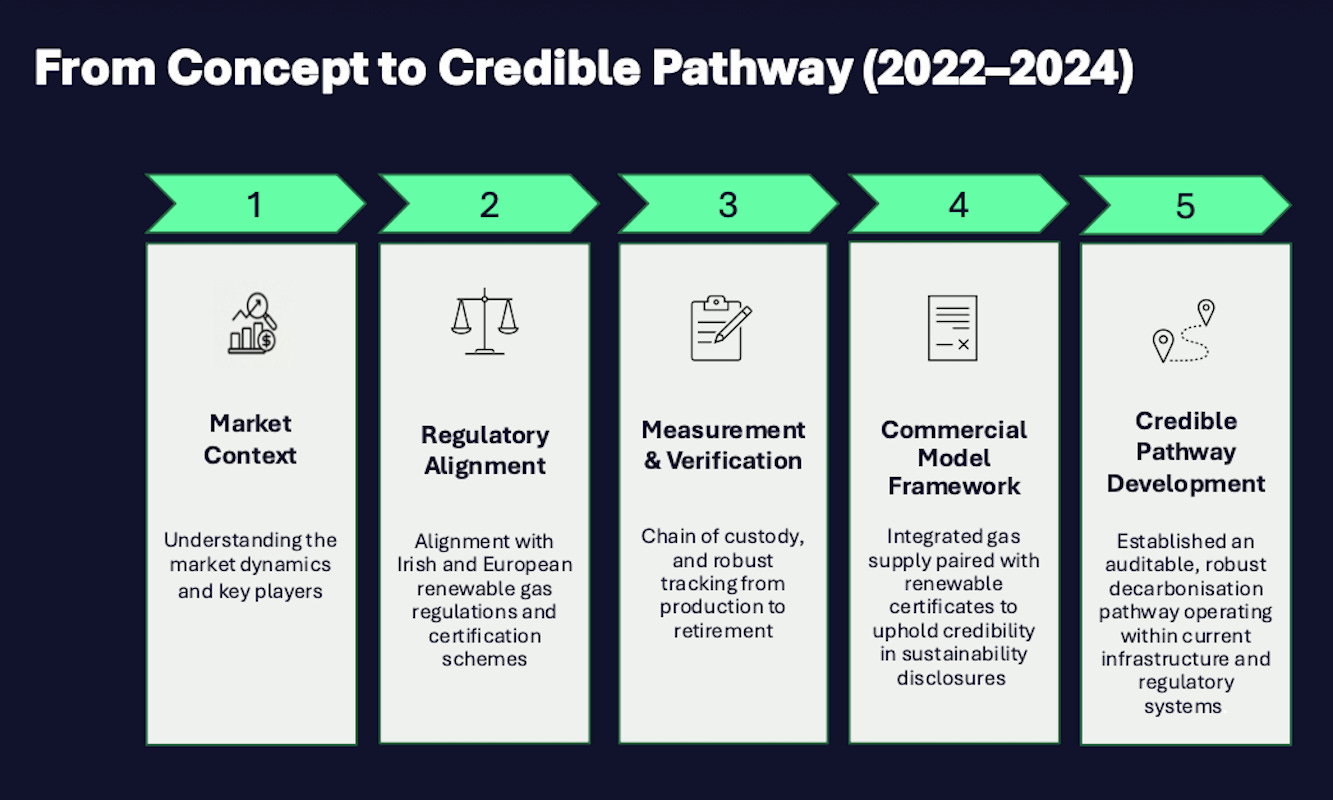
The accounting framework aligns with established European reporting standards, including the EU Emissions Trading Scheme (ETS) and widely used corporate climate-reporting methodologies.
The initiative also reflects Ireland’s broader policy strategy to expand renewable-gas production while reducing emissions from large energy users.
Ireland’s national biomethane strategy aims to scale domestic renewable-gas supply while stimulating demand from sectors such as transport and industrial infrastructure.
Pure DC said the proof-of-concept project demonstrates that renewable gas could act as a transitional mechanism for decarbonizing power systems where grid-based renewable electricity remains constrained.
Designing sustainability from the start
Maria Jose Rivas-Duarte, director of sustainability and ESG at Pure DC, said the project’s environmental strategy was embedded in the design process from the earliest stages.
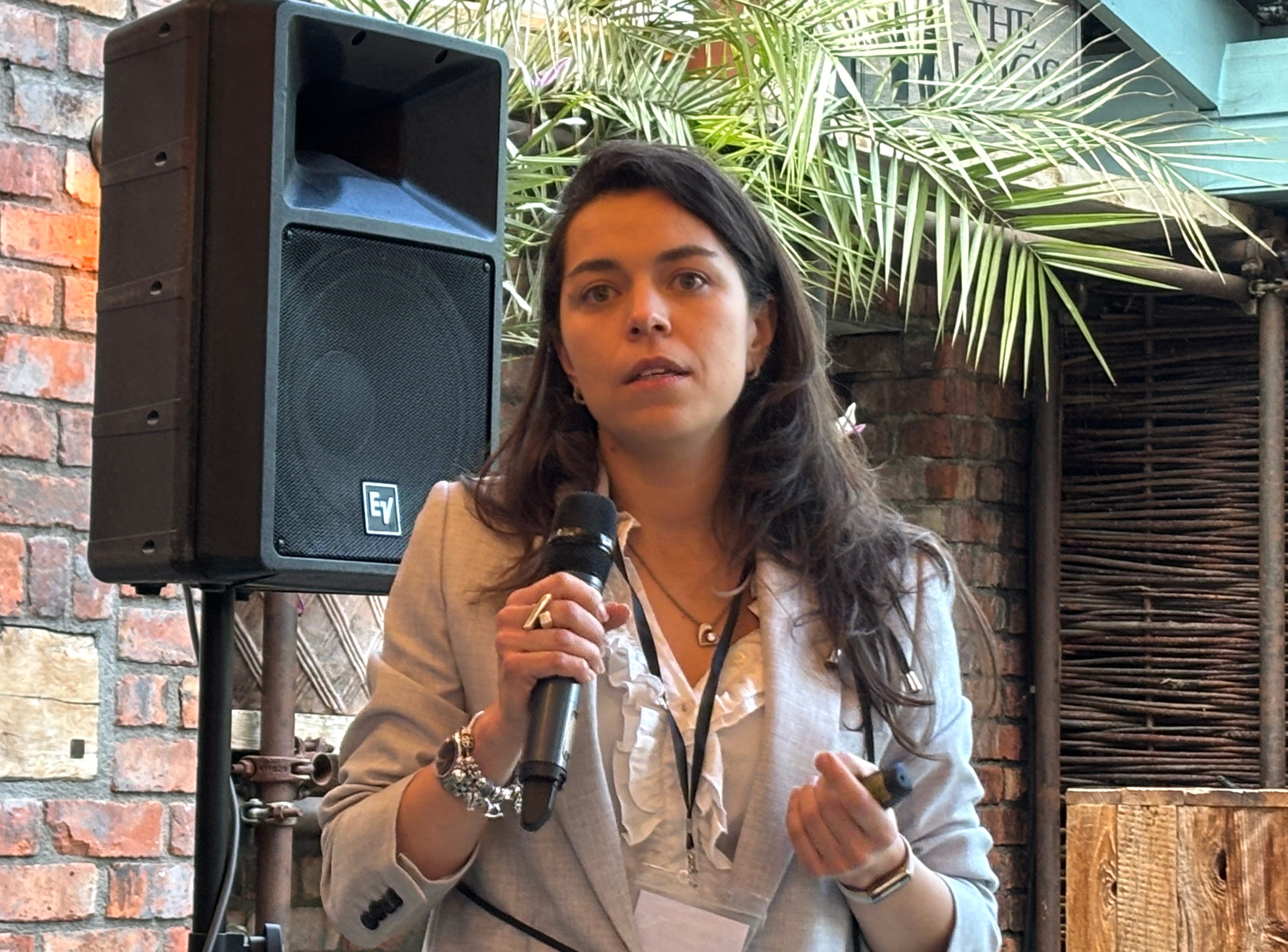
“For us, sustainability is not a bolt-on afterthought. We think about this from the very onset of design,” she said.
She said the company evaluates several environmental dimensions simultaneously when designing new data centers, including energy use, water consumption, construction emissions and waste management.
The approach also considers the full lifecycle carbon impact of both the facility and the supporting power infrastructure.
“When we decided to go for an off-grid solution through a microgrid, decarbonization became critical. We knew we were going to use gas and have emissions,” Rivas-Duarte said.
To address that challenge, the company worked with energy suppliers and regulators to source renewable biomethane attributes linked to gas injected into the European network.
“In 2025, we delivered in a live data center 100% of operational gas backed by biomethane,” she said.
The supply mix included both domestic and imported renewable gas, reflecting the early stage of Ireland’s biomethane production sector. During the proof‑of‑concept phase, roughly 40% of the biomethane supply originated from Irish production, while the remainder was sourced through European renewable‑gas markets.
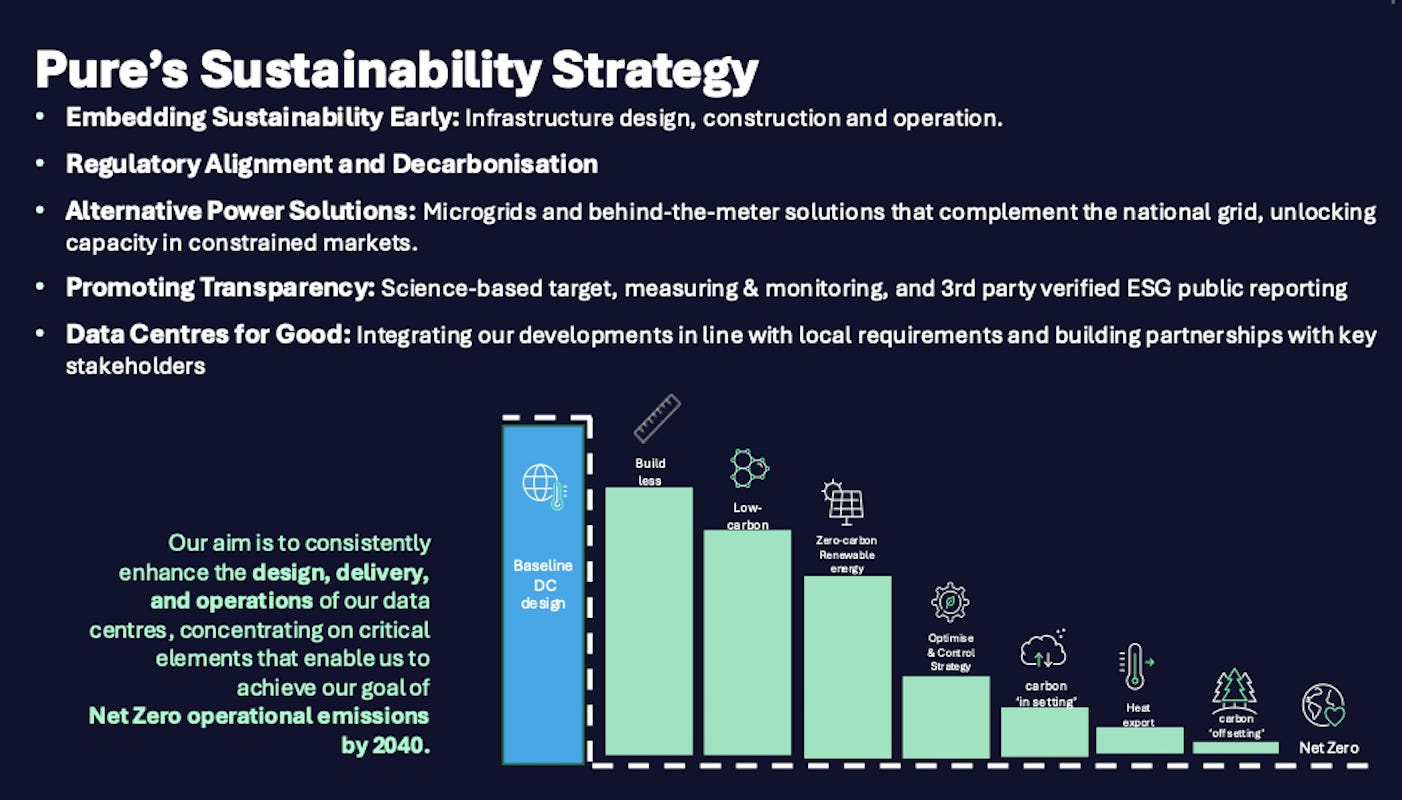
Rivas‑Duarte said the blended approach helped demonstrate that renewable‑gas accounting frameworks could work for large digital-infrastructure facilities as domestic supply gradually expands.
She said renewable gas should be viewed as a transitional pathway rather than a permanent solution.
“This approach demonstrates that resilience and decarbonization do not need to be decoupled. We can deliver power and decarbonization at the same time,” she said.
Looking ahead, Pure DC plans to explore long-term biomethane purchase agreements, expand renewable-energy integration and develop partnerships that allow excess heat from data-center operations to be exported to district-heating systems.
The company has set a target of achieving net-zero operational emissions by 2040.
Pritchard said the broader industry will increasingly need to integrate energy infrastructure directly into digital infrastructure projects.
He added that in the energy transition, mass electrification and rising grid demand do not always align, and that data centers deploying microgrids and dispatchable power could become part of the solution.