


Spacecraft built to inspect and remove space junk are being pulled into military work as allies treat orbital control as a defense priority.
Getting close to an object that sends out no data is the core skill, and defense customers now want it.
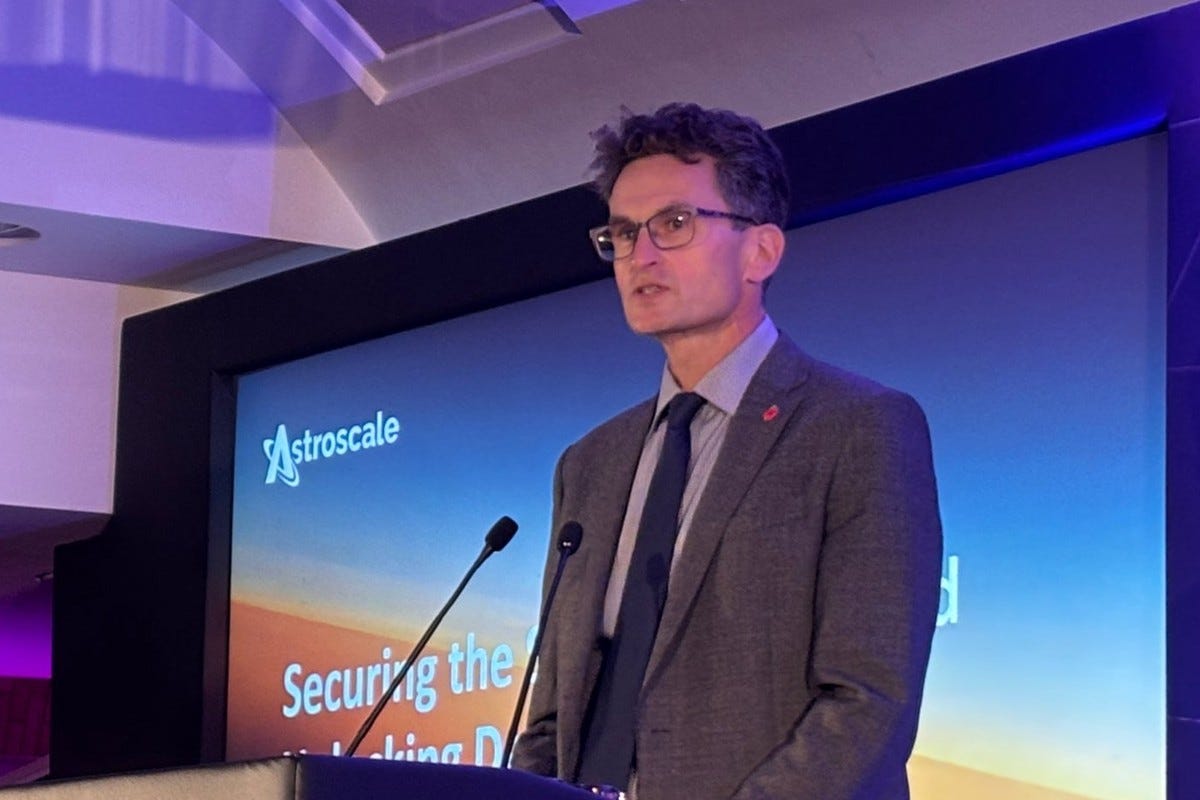
“One of the biggest things we’re seeing across all of our entities globally is the big demand in defense for what we are doing,” said Nick Shave, UK managing director of Astroscale.
“We are seeing quite a shift in narrative, particularly in the threat environment we’re seeing in orbit, and the term space control is becoming quite well used,” he said. “Developments in the commercial, civil and institutional world can translate to support defense in quite a big way.”
Shave said the term featured in the UK’s Strategic Defence Review last year.
He said Rear Admiral Tony Williams, director of the Space Systems Portfolio at the National Armaments Director Group, had described the same shift earlier that day. It was also clear at the recent UK Space Power Conference.
Astroscale develops all its software and flight dynamics in-house and treats them as its core intellectual property.
“What we’re trying to do is deploy that core capability of RPO (rendezvous and proximity operations) into some of these areas,” he said.
Astroscale was founded in Tokyo in 2013 to remove space debris and service satellites in orbit.
Its UK arm at Harwell, set up in 2017, was the group’s second entity. It was followed by two sites in the US, in Denver and Washington, DC, and one in France.
Shave said the group is working on 10 missions, three or four of them in the UK. They include a refueling demonstrator called Provisioner for the US Space Force and a mission with UK Space Command.
That mission is Project LEDA, a £15 million Ministry of Defence (MoD) contract announced on October 28.
Astroscale UK also leads Orpheus, a £5.15 million mission for the Defence Science and Technology Laboratory (Dstl). Its two satellites, built by Open Cosmos, will study the ionosphere and improve space situational awareness.
Harder than docking
Shave spoke at the fourth Defence in Space Conference, an industry-run event in London on October 27 and 28.
He said most telecom and Earth observation satellites hold their station in geostationary or low Earth orbit for years. Craft that close in on other objects must keep moving, so their system, trajectory and safety design all differ.
“RPO missions are very different. We have to move around. We need agility in orbit. We need to predict what’s happening to an object that we’re approaching, without any information on that object, and that’s a really difficult thing to do,” he said.
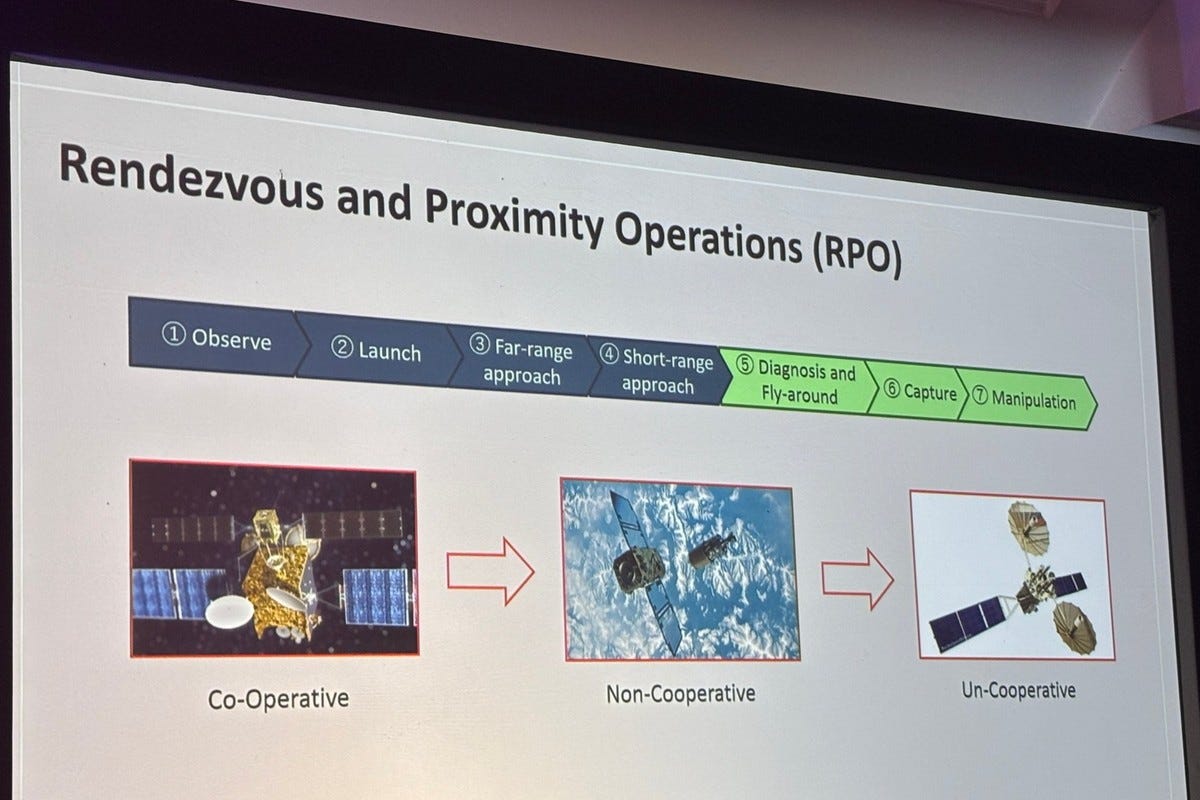
He said a capsule docking with the International Space Station has an easier job because both sides are controlled. Astroscale sorts RPO targets into three types:
cooperative targets, such as the space station, which help the approaching craft
non-cooperative targets, such as dead rocket bodies, which give out no data
uncooperative targets, the hardest of the three
Uncooperative targets are where defense comes in. Astroscale’s work today is mostly non-cooperative, but it is already looking at uncooperative missions.
An approach runs in stages. The craft first closes from tens of thousands of kilometers to a few hundred using ground-based tracking data. It then switches to its own sensors and, from about 200 meters behind the target, moves in autonomously, matching any tumble before a capture.
The company’s ADRAS-J mission, launched by Rocket Lab in 2024, put those skills to the test.
“We had to launch within a five-second window, and they did it. We saved a load of fuel, and we could then extend the mission,” Shave said.
ADRAS-J came within about 15 meters of its target, a 3.5-ton Japanese rocket upper stage about the size of a double-decker bus, in November 2024. Its inspection found a satellite still attached to the launch adapter ring, which the launch company believed had been deployed.
Shave said that changed the stage’s center of gravity, something an inspection mission is meant to find.
“What you’ve learned operationally in flight is absolutely essential to enable us to go forward for the next mission,” he said.
Built to back away
The spacecraft Astroscale is building now carries 14 thrusters and both electric and chemical propulsion. Ground stations around the world back it up, and it may also use inter-satellite links.
“It’s critical that we do not create debris in orbit, and we manage the space environment as best as we can. But we have to make sure that we can fail safe if a sensor goes out of limits, or something goes wrong with a thruster in orbit,” Shave said.
He said the craft approaches along a “safety ellipse” from behind the target, so if a sensor or thruster fails, it drifts over the object rather than hitting it.
Astroscale runs millions of simulations on the ground to test the safety of its approaches.
“We have to fail safe, move back away from the object, and then go again. We’ve done that a few times in orbit now, which has enabled us to learn a lot,” he said.
Astroscale’s next big test in the UK is ELSA-M, a spacecraft about the size of a Fiat 500 with electric and chemical propulsion and an onboard sensor suite. It will use a magnetic capture system to remove a dead OneWeb satellite.
The mission is built and has finished thermal vacuum testing with Airbus in Stevenage.
Shave said OneWeb, now part of Eutelsat, has been forward-leaning in fitting its satellites so they can be removed more easily if they fail or run out of fuel.
ELSA-M will fly on an Isar Aerospace Spectrum rocket from Andøya, Norway, no earlier than 2028. Astroscale has booked two launches with the German company. He said he was pleased to see Isar’s recent success and that Europe needs such launch capacity.
“We are trying to seed the market going forward to make sure that we’ve got ways that we can remove satellites and make space more sustainable, as well as moving more into things that we’re doing in defense,” he said.
Astroscale has spent more than £120 million with UK suppliers so far.
“We are building quite a resilient and wide industrial base from some of the missions we’ve been building in the UK,” Shave said. “That’s how we’re trying to enable growth, and we’ve invested a lot of our own money into this ecosystem that we’re helping to build.”
About 66% of that supply chain sits outside southeast England. Astroscale also adapts subsystems from other spacecraft for RPO work and tests them at national facilities such as RAL Space at Harwell and Resonate Testing in Northern Ireland.
ADRAS-J2, a follow-up mission in Japan, will go back to remove the rocket stage that ADRAS-J inspected.