


Aston Martin Aramco Formula One Team has assembled what it describes as one of the biggest and most diverse technology ecosystems on the grid, layering chips, cloud computing, sovereign artificial intelligence (AI) models, coding agents and cybersecurity into a single stack to increase its competitiveness on track.
The setup spans silicon design, data center compute, data infrastructure, foundation models, agentic coding, security, operational workflow and systems integration. Each partner occupies one layer.
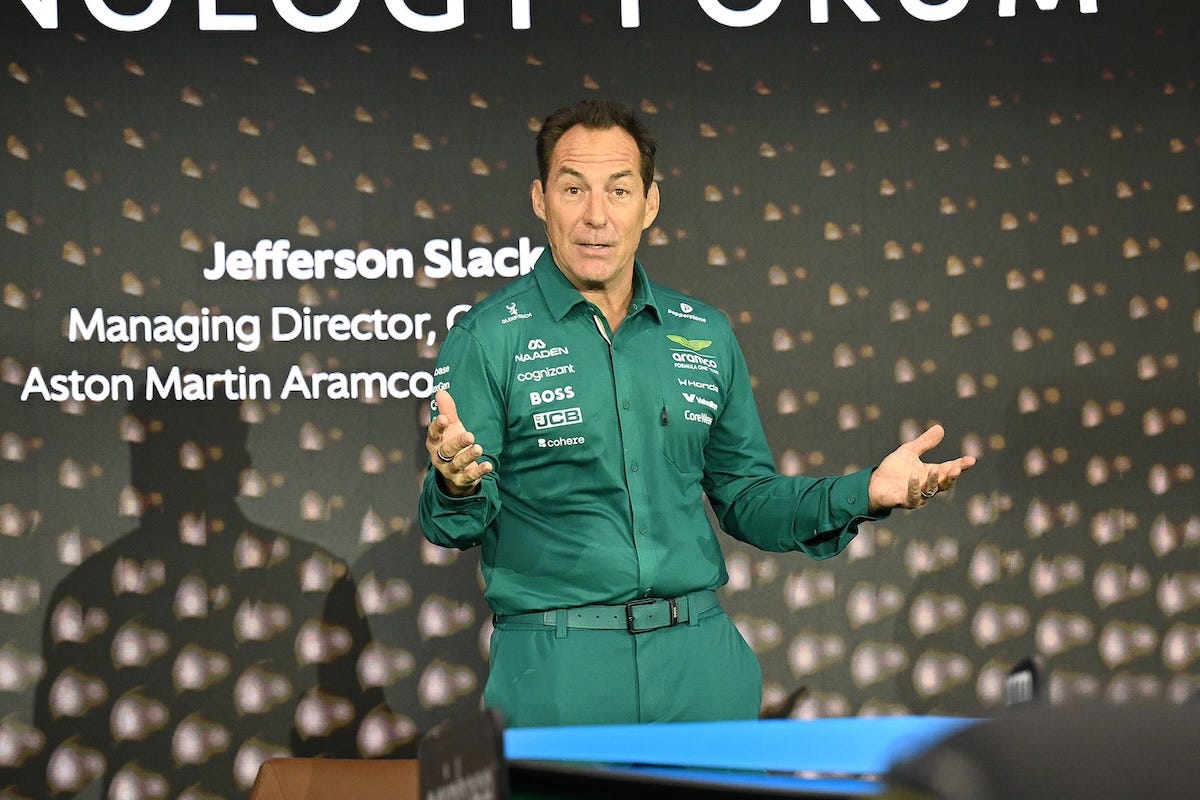
“We live and breathe technology, and the partners that we have here today are going to give us a chance to win,” said Jefferson Slack, managing director of commercial at the team. “They can make us go faster, and that is an authentic integration that you do not normally get in sports.”
“This is not primarily a story about technology and the ecosystem of technology,” said Eric Ernst, technology ambassador of the team. “It is about unleashing intelligence and using every partner not to adapt to the future but to actually architect it.”
Intelligence can be outsourced with AI but experience cannot, Ernst said. The experience stays with the team and its people, while AI provides the cognitive scalability to handle work that would otherwise require two or three more staff members.
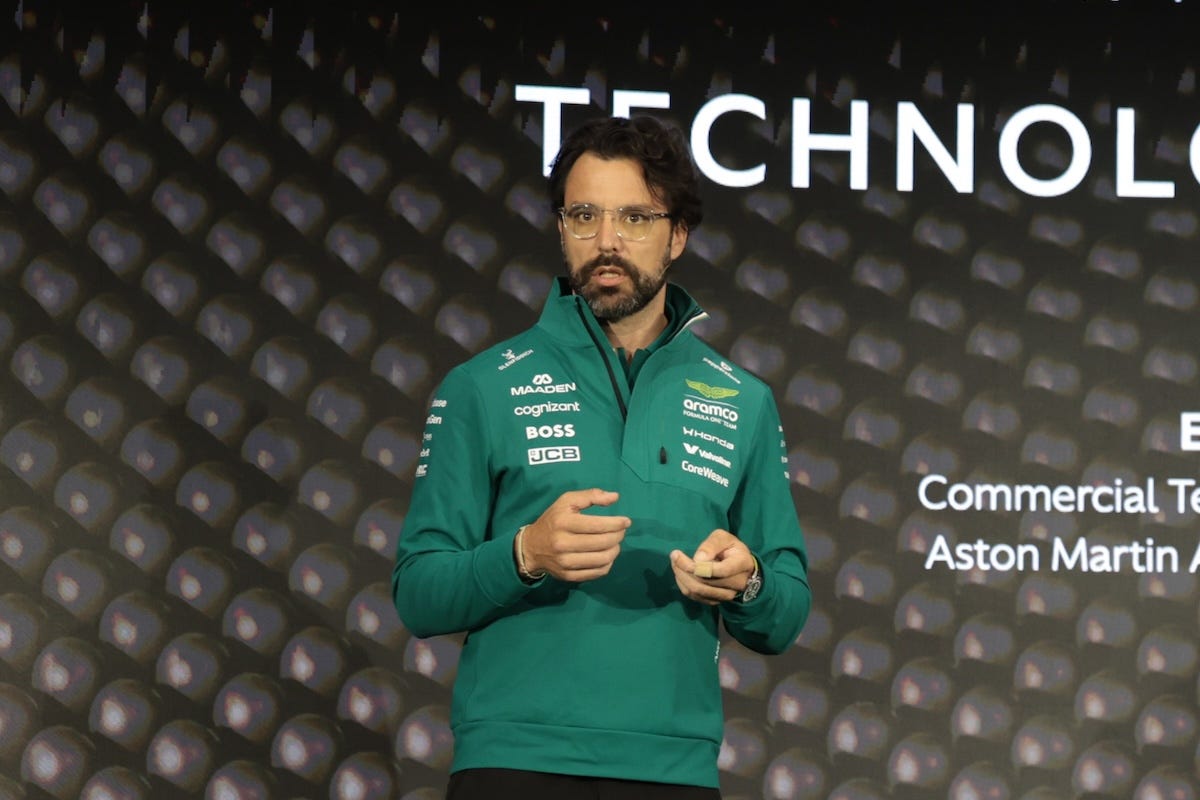
Having joined the team five months ago, he compared the ecosystem’s almost accidental assembly to the founding of Aston Martin itself. Lionel Martin and Robert Bamford created the brand in 1913 after Martin’s successful day at the Aston Hill Climb.
In his stack, Arm provides the silicon, CoreWeave the compute, NetApp the data infrastructure, Cohere the sovereign AI brain, Cognition the agentic coding, Zscaler the security shield, ServiceNow the unseen operational processes and Cognizant the understanding of how the layers operate together.
The team does not believe in outsourcing the way its models are weighted, he said.
“We want to control how a model is reasoning, what our values are weighted by when we ask a question to a large language model,” Ernst said.
Slack, who has worked in sports for about 30 years, said the team has never had such a critical mass of technology partners, with some on board since the rebrand in 2021 and a new group this year.
He said the partners are discovering they can do business with one another, and one partner’s valuation has jumped from $1 billion to $25 billion in 18 months. At June’s Cannes Lions festival, no other sport was represented the way Formula One was, he added.
“The sport really has become the epitome of what is happening with engineering, technology and culture,” he said.
From silicon to strategy
The comments came at the inaugural AMR Network Technology Forum on July 3 at the AMR Technology Campus in Silverstone, UK, ahead of the British Grand Prix. Aston Martin Aramco organized the forum to launch the AMR Network, a platform uniting its partners around the future of AI in Formula One and beyond.
Dozens of invited reporters took part in a pitstop challenge and watched sprint qualifying from the Mission Control viewing gallery.
In the first panel on building an AI ecosystem, Ben Richardson, head of CoreWeave International at CoreWeave, said that nine out of the 10 largest AI model builders run on the company’s cloud infrastructure.
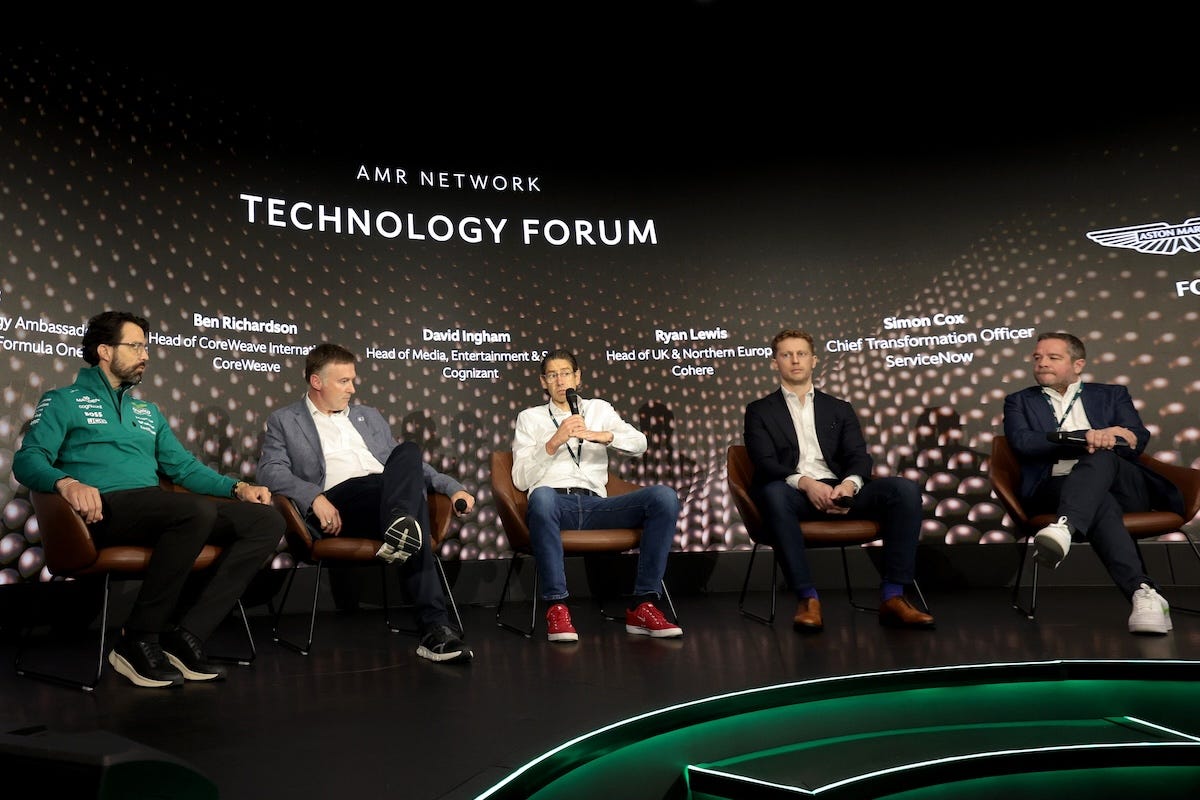
“I often get asked where we are in a cycle. Is this a hype cycle?” he said. “I always use the US example that we are probably at the top of the second innings in a baseball analogy. This is just starting.”
He said companies must be brave, avoid waiting for perfect conditions and put guardrails in place where needed. His first question to job applicants is now about their personal and professional AI stack.
Richardson said CoreWeave’s business is all about speed and execution, a direct parallel with a team that pulls data from hundreds of sensors on a car and runs it through models.
David Ingham, digital partner in media and entertainment at Cognizant, said organizations are most often stuck with legacy systems when assembling an AI stack.
“To unpick data, to understand where the data is sitting in the organization, how do I get data from A to B, that is really where Cognizant can add value,” he said.
Ryan Lewis, head of UK and Northern Europe at Cohere, said the enterprise AI firm builds foundation models from scratch, one of about 10 companies in the world still doing so, and deploys agent platforms inside customer environments.
“Instead of having a single agent do these things sequentially, now you have each agent being an expert in this workflow, so the diagnostic agent is going to meet with the simulation agent,” he said. “They are going to synthesize those insights and create reports that give these teams faster insights and time to value.”
Simon Cox, chief transformation officer at ServiceNow, said many enterprises are paralyzed by the fear that their data is inaccurate, when the most successful ones fix it as they go.
“The real difference this time with AI is that the AI can find those gaps, the signal and the noise in that data, and help you fix as you go,” Cox said. “If you do not start, others are going to go flying past you.”
He said ServiceNow, an Aston Martin partner since 2023, calls itself the team behind the team, handling staff processes and moving into sea and freight logistics and travel.
Businesses learned from the cloud era, when they left the tap running and were hit with charges. Firms should build an AI control tower from the start or risk exhausting their budgets.
“Control and governance of it sounds dull, but it is really important,” he said.
Ernst told the panel that machine learning spots patterns while generative AI can now draft race strategies, leaving an engineer with several options and the experience to pick one. He said the data shows the situation, the AI shows the trajectory and the human decides whether to go faster or slower.
Zscaler is the newest layer of the shield. The cybersecurity firm joined in June as the team’s global cybersecurity partner in a multi-year deal, with branding debuting on the nose, seatbelts and wing mirrors of the AMR26 race car.
A single race weekend can generate more than a terabyte of telemetry from hundreds of sensors on each car.
Armies of agents
In the second panel, on building an AI-powered enterprise, Emily Cohen, senior vice president of operations and people at Cognition, said the firm’s AI software engineer Devin was adopted fastest by engineering managers because they were already used to delegating chunks of work.
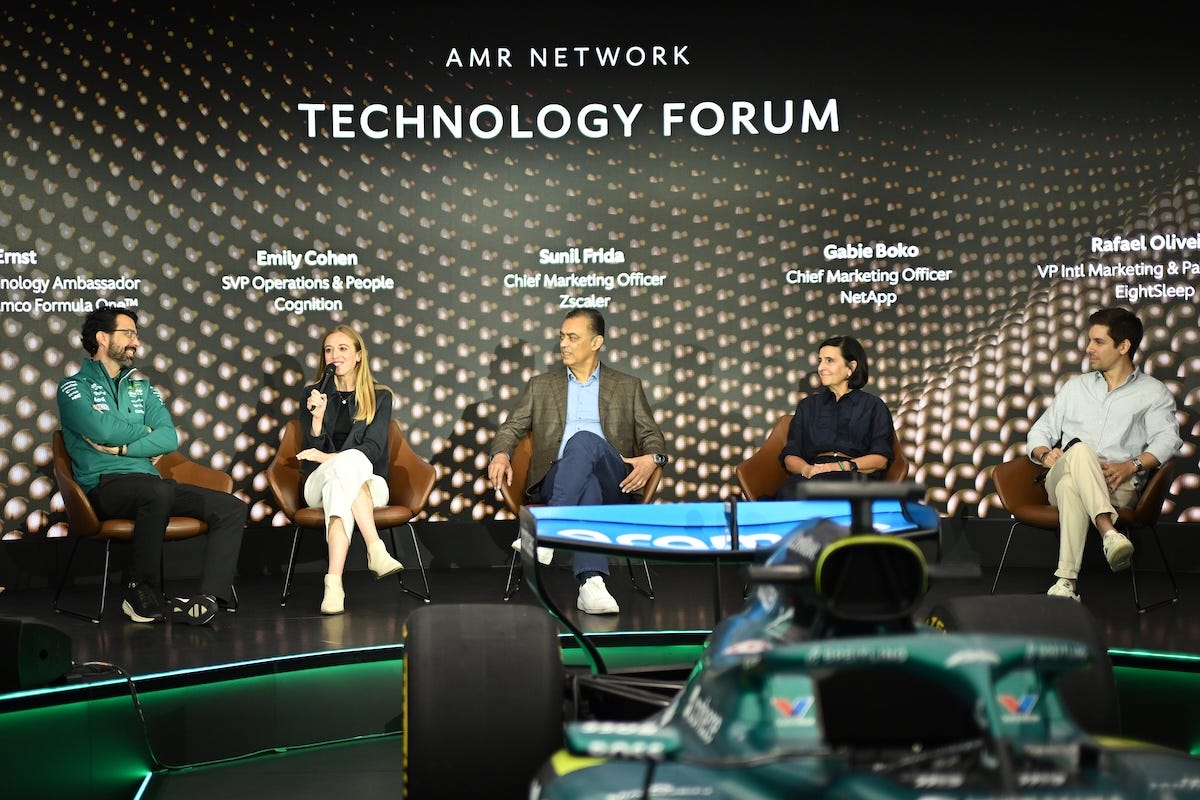
“Everyone is becoming a manager of their army of agents,” she said. “I actually think a lot of people undervalue the change management that has to go into getting people there.”
Sunil Frida, chief marketing officer of Zscaler, said the firm secures more than 45% of the global Fortune 500 and handles about 750 billion transactions a day, roughly 10 million a second.
“What zero trust does is it makes your house disappear,” he said. “When your house is no longer reachable, your enterprise is not going to be breachable.”
Gabie Boko, chief marketing officer of NetApp, said the data infrastructure firm moves about 50 petabytes for the team on a race day, a volume that a healthcare client might spread across a month.
Rafael Oliveira, vice president of international marketing and partnerships at Eight Sleep, said the driver is the only element of a car not covered by sensors. The firm’s smart mattress makes hundreds of temperature adjustments a night, with clinical studies showing up to 25% more deep sleep and 45% less snoring.
He said a tired brain makes measurably worse decisions, turning sleep into a competitive advantage for the whole team.
Ernst added that humanity is undergoing a shift toward a superpower comparable to Gutenberg's printing press in the 15th century, with people becoming more valued for triage than for creating work.
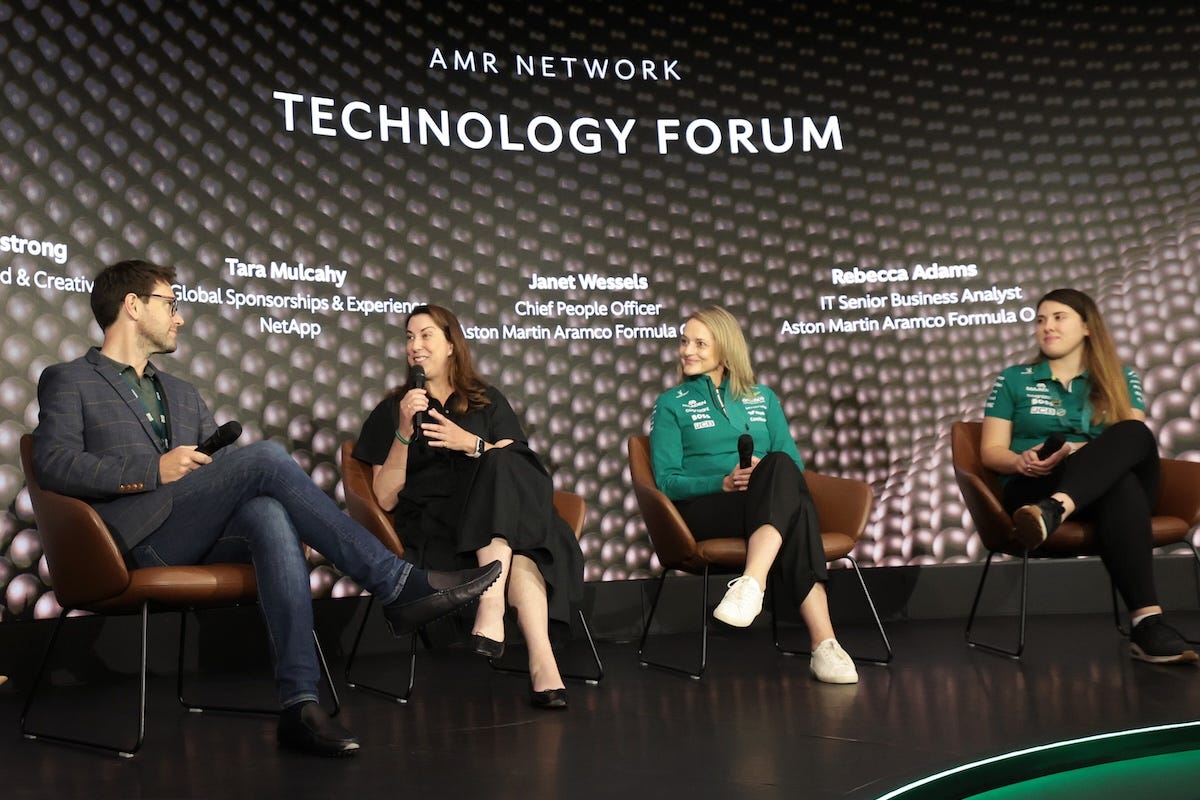
The final panel turned to the issue of expanding access to careers in motorsport technology.
Janet Wessels, Chief People Officer, Aston Martin Aramco F1 team, said programs such as Make A Mark and the STEM Racing initiative with Aramco, targeting 100,000 students by 2028, have made attracting women the easy part.
“The challenge is retention,” she said. “As with most high-performing sports, we still have a lot to do around creating the right culture and the right environment for women to thrive.”
“I often compare diversity to aerodynamics. Do not tell my colleagues this, but it is something we cannot see, and yet it definitely makes the car go faster,” she added.
She urged companies to give women a fair chance to project manage AI initiatives rather than only analyze results.
Jonathan Armstrong, senior director of brand and creative at Arm, said recruitment gets people in the door but belonging keeps them, and inclusion must feel intentional. Arm is 18 months into a partnership with team ambassador driver Jessica Hawkins, who he said has taken three consecutive podium finishes this season.
Tara Mulcahy, vice president of sponsorships and experiences at NetApp, said that AI- and data-backed storytelling helps brands authentically reach female audiences.
Rebecca Adams, IT senior business analyst at the Aston Martin Aramco F1 team, said AI now handles much of her presentation work, freeing up time to dig into problems with colleagues.
Whether the ecosystem translates into lap time remains the harder question. Aston Martin Aramco races as a full works operation for the first time in 2026, with Honda power units and Adrian Newey as team principal, and its partners will be judged on how much faster they make the car.