


Business travelers are willing to let artificial intelligence (AI) simplify their journeys, but draw a clear line at allowing it to make decisions on their behalf. The question of how much to trust AI with consequential decisions has emerged as the defining challenge for the corporate travel industry.
Survey data underscores the scale of the problem. Despite 90% of IT leaders reporting satisfaction with their travel technology stacks, the experience for travelers themselves breaks down the moment complexity arises. Disruptions, policy interpretation and approval processes all force manual intervention at precisely the moments when travelers most need support.
“This feels like an important inflection point right now. So many of us are getting used to using AI to answer quick questions or analyze data, but moving to action is a completely different element of trust, and that trust will come from having the right context around it. What policies do you have in place? What guardrails and dependencies?” said Erica Antony, senior vice president, Product and Engineering at American Express Global Business Travel (Amex GBT).
Antony said travelers today are manually stitching together expenses, policy requirements, supplier receipts and approval processes.
“It is really not about a sprinkling of AI, here is a feature or let us dabble in the corners. Instead, we are looking at it as a systematic approach, a system with four key pillars,” she said.
Antony outlined Amex GBT’s four-pillar framework for deploying AI across its platform:
Agent-to-agent architecture to connect workflows end to end
End-to-end integration to move beyond point solutions
A high-tech and high-touch model that deliberately embeds human support at complex moments
Trusted intelligence grounded in data and governance
Tarun Avasthy, principal consultant at Forrester, said the central question facing the industry is not one of capability.
“It is not about what AI can do. It is about what people trust AI to do,” he said.
Forrester surveyed more than 2,000 business travelers across eight markets and 500 IT leaders for its study.
Avasthy said both groups identified three prerequisites for trusting AI: transparency in how decisions are made, clarity on why certain recommendations were surfaced, and the ability to control and override outputs.
“It is not whether it is AI versus a human. It is the coordination between the two that would work and be more harmonious,” he said.
He said AI performs well at predictable, repeatable tasks, while human oversight remains essential for decisions that require empathy and judgment.
Amex GBT moved to address those expectations on April 14, announcing a major evolution of Egencia, including agentic AI capabilities and a native integration with Concur Expense. The company said the upgraded platform delivers an average booking time of under three minutes and automated expense reconciliation, targeting the fragmented workflows that have long burdened corporate travelers.
The new Egencia AI assistant allows travelers to search, book and manage trips through natural-language conversation within tools they already use, including Microsoft Teams. Amex GBT described the Concur integration as the first of its kind for a non-SAP solution, with travel bookings and receipts flowing into expense reports in near real-time.
A joint study by Amex GBT and Ipsos found that 78% of business travelers expect AI to improve the shopping experience within five years, and 76% expect it to improve access to on-trip support.
Agentic travel at scale
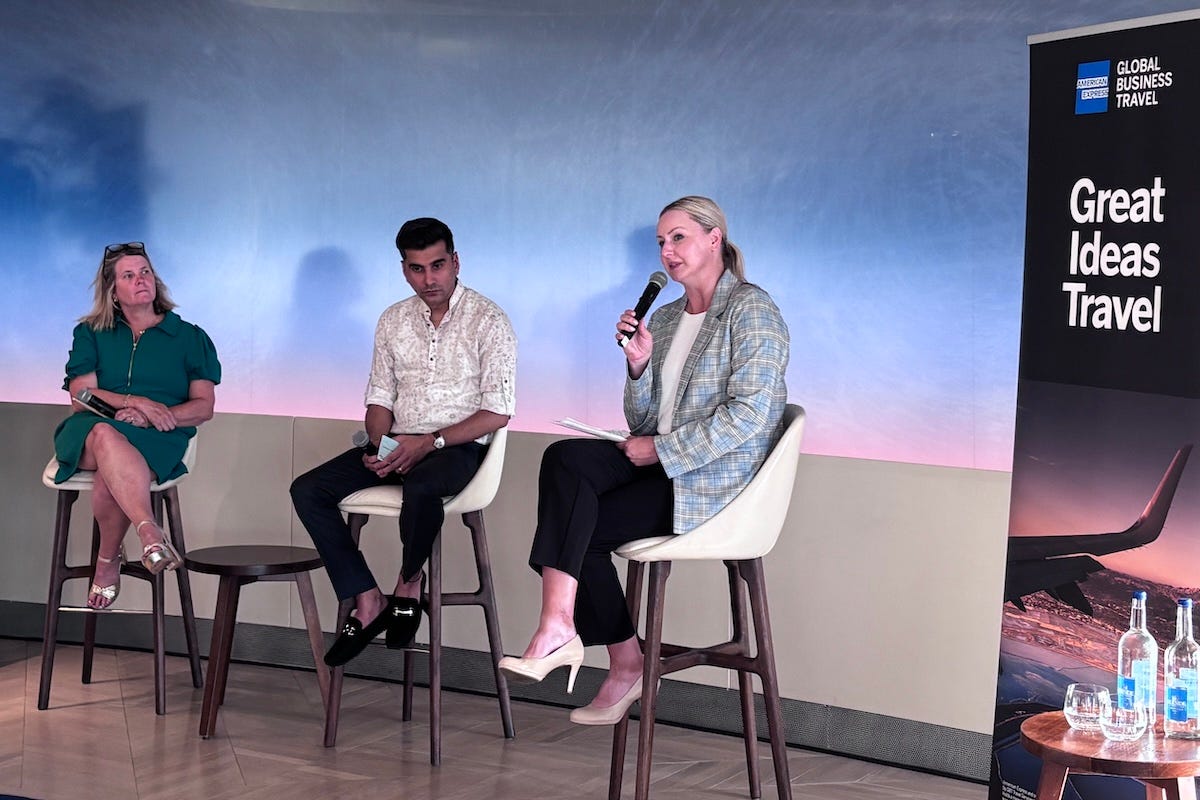
The discussion took place at a panel session in London during an event organised by Amex GBT on June 23.
The session was moderated by technology journalist Jane Wakefield, who spent more than two decades at the BBC covering technology and has written about AI since 2015. Wakefield now hosts the podcast Human in the Loop, which examines how humans and AI can work together effectively.
“We launched with Egencia a conversational experience, an agentic trip management capability,” Antony said. “Through natural language, you can go ahead and search and book, have policy-compliant recommendations, and at the same time, it also knows when it has gone far enough and needs to connect to a travel counselor.”
She said the handoff to a human counselor is not a fallback but an intentional design feature that has proven effective in building traveler confidence. Antony said the integration between Egencia and Concur, the expense management platform, goes further than automation.
“With Egencia and Concur, we now have data syncing with booking and expense data to not just make that easier, but it is actually eliminating steps,” she said.
She added that Amex GBT's AI recommendations are grounded in more than a petabyte of travel data, over one million enterprise policies and transactions from hundreds of suppliers.
Avasthy said the concept of graduated autonomy offers a more sustainable path than full AI implementation. He outlined three stages:
AI reduces complexity by offering recommendations that the traveler selects from, building trust gradually
The traveler retains control by choosing between AI-generated options
In well-defined scenarios only, AI operates fully autonomously
“A lot of companies fail when they fully implement AI and cut jobs. And you have seen those companies get back the workers they let go over the last couple of years,” he said. “Graduated autonomy would help, having AI that assists first, reduces complexity, provides options and gives recommendations that you still control and oversee.”
He added that trust built with IT leaders naturally extends to business travelers.
Fragmented stacks fractured journeys
The structural obstacles to AI-powered travel are significant.
Avasthy said only 3% of companies have travel technology stacks that are fully integrated and cross-functional across enterprise workflows. The remaining 97% operate with partial or low integration, meaning that complexity is amplified rather than absorbed by the system, shifting the burden onto the traveler.
Antony said the solution lies in recognizing where AI adds most value. She said routine tasks are where full automation is simply expected, while complex, high-stakes moments demand a different response.
“The human piece is not a fallback, not something we have to do because we cannot figure it out. It is exactly the opposite, a very intentional embedded design of where humans need to be part of that, because we know where it is more sensitive, critical and urgent,” she said.
Wakefield said the corporate world has been slow to reckon with both the limits of AI and the risks of deploying it without governance. She said that scaling AI and embedding it into the fabric of an organization is a far harder proposition than most businesses anticipate, and that infrastructure in most companies is not yet ready to support AI tools of any kind.
When a platform explains why a travel option has been ranked at the top, citing policy compliance, past behaviors and corporate benefits, traveler satisfaction follows quickly, she said.
Both Avasthy and Antony said the industry is moving from a phase of AI experimentation toward one of execution, with the goal of removing friction points rather than simply navigating them.
Amex GBT was spun off from American Express in 2014 as a joint venture and later became a publicly traded company.
On May 4, tech-focused investment firm Long Lake, backed by General Catalyst, agreed to acquire Amex GBT in a deal that would result in American Express Company exiting its minority equity stake. The transaction does not affect the brand licensing and commercial agreements between the two companies.