No single type of computer chip can carry the weight of modern artificial intelligence (AI) anymore. Agentic AI, systems that plan and execute multistep tasks with limited human input, is forcing a rethink of how AI infrastructure gets built.
Graphics processing units (GPUs) still handle the heaviest computational lifting, but the orchestration and data pipelining that agentic AI requires increasingly falls to central processing units (CPUs). That inversion is reshaping data center architecture faster than many planners anticipated just a year ago.
“Compute actually equates to intelligence. There is no one type of compute that will satisfy every AI application. You need a whole host of compute, whether that is the latest accelerators and GPUs, the CPUs or the general AI infrastructure in terms of networking,” said Dr. Lisa Su, chair and chief executive officer of AMD.
“We’re early in the research and development phase as we think about new models, we’re early in AI for science, and we’re still very early in AI for enterprises,” she sai.
She said AMD believes the entire ecosystem needs to come together and collaborate across those foundational elements. Enterprises are shifting AI, month by month, from something they experiment with into something that changes how they operate.
She added that AMD’s goal is to build the highest-performing chips, using AI throughout its own research and development.
In June, AMD said it would commit up to £2 billion to AI research and innovation in the UK over the next five years, extending its more than 50-year presence in the country with new computing and research partnerships at the University of Cambridge and Imperial College London.
Su said in the press release that the UK “has the talent, research excellence and ambition to help lead the next era” of AI, adding that AMD is “proud to deepen our commitment to the UK” and to expand access to the compute infrastructure needed to advance sovereign AI.
Part of that commitment includes a partnership with Oriole Networks on the UK’s ARIA Scaling Inference Lab, pairing AMD’s Instinct GPUs and EPYC processors with a photonic networking system designed to cut latency and energy use in large-scale inference workloads.
In August, AMD and the University of Oxford signed a memorandum of understanding to launch the British Open-ended Learning and Discovery Lab, involving University College London and Imperial College London, committing £5 million in compute resources over 18 months to research AI training methods beyond backpropagation, multiagent systems and adaptive physical AI for robotics.
London Tech Week
Su spoke in a fireside chat with Carolyn Dawson OBE, chief executive officer of Founders Forum Group, at London Tech Week in June.
Founders Forum Group and Informa jointly run the event, co-founded with London & Partners and Tech London Advocates. The event brought together governments, universities, startups and large enterprises to debate how AI infrastructure gets built and who gets to use it.
Su said success for the UK’s AI ecosystem depends on solving problems that matter, not on deploying the technology for its own sake. She said she is particularly passionate about healthcare, since faster progress in medicine could change lives.
“We’re here to use technology to solve some of the world’s most important problems, and to do things that you never thought were possible,” she said.
She extended that argument to sovereign AI, framing it as a shared opportunity rather than a competitive race.
“There’s a lot of conversation today about sovereign AI capability, and we are very much of the belief that we want to be partners in that opportunity to build compute around the world,” she said.
Su pointed to the breadth of collaboration on display at London Tech Week as evidence of that philosophy in practice, spanning financial services, manufacturing and research and development across large enterprises, startups and universities working side by side, a pattern she said is now emerging across the country.
“It’s bringing together experts in hardware, software and applications, making one plus one much greater than three. We want it to be five plus,” she said.
Dr. Thomas Zacharia, senior vice president of public sector at AMD, extended that argument at the same event.
“Sovereign AI is fundamentally about this broader concept of national capability, the ability for a nation to control its digital future and to do all the layers of the stack. It’s not really a technology discussion. It’s an economic strategy, an industrial strategy, an innovation strategy, and also a national security strategy,” Zacharia said.
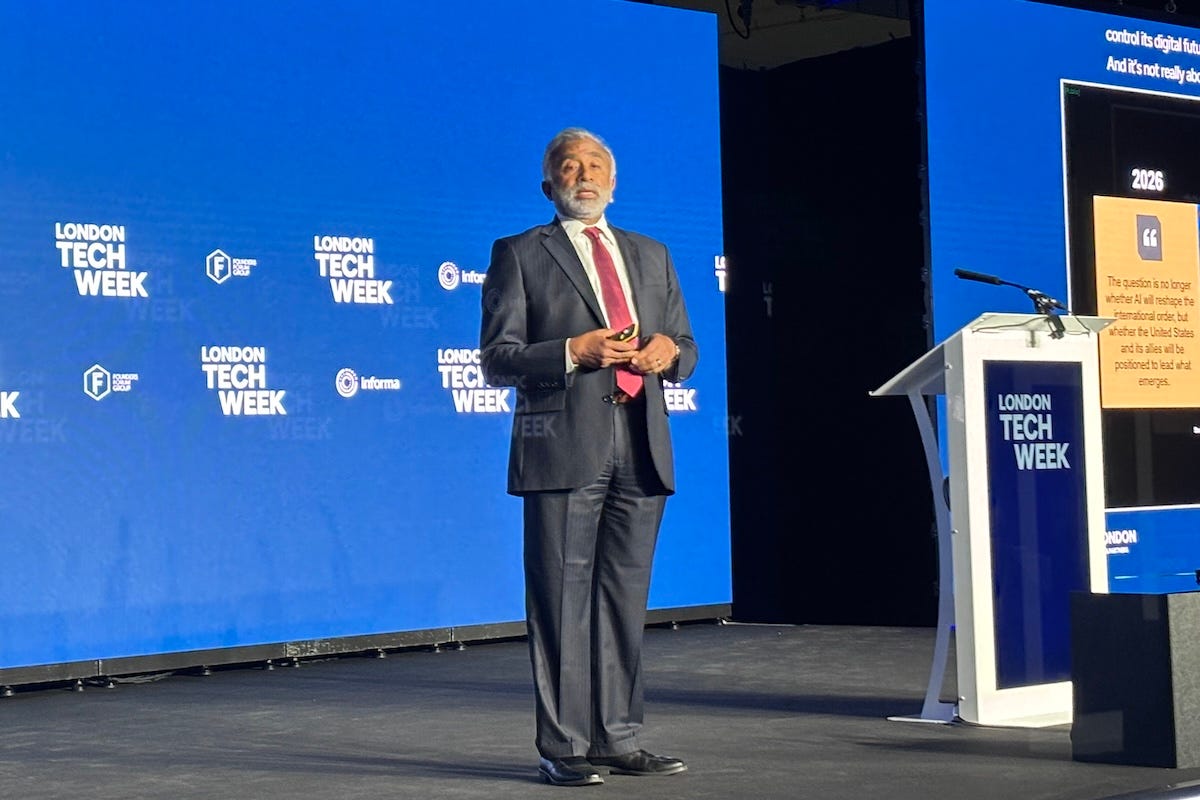
His definition of sovereignty: how a nation shapes the progression of the technology so that it scales and shapes the future.
A report published the week before the event argued the real question is no longer whether AI will reshape the international order, but whether the United States and its allies will be positioned to lead as that new order takes shape in the years ahead.
Zacharia traced that argument to the period between 1847 and 1914, when the steam engine, electricity and the scaling of chemistry for agriculture and steelmaking transformed the modern world. Imperial College emerged from that same academic push around 1900.
“Nations that build the infrastructure to scale and shape technology are going to shape the future. That has been the outcome of the industrial revolution, and I’m here to say the same outcome is likely to happen with AI infrastructure,” Zacharia said.
He connected that history to the energy demands of today’s AI systems: the US exascale program he was part of set out to deliver exascale compute at 20 megawatts, when others believed a gigawatt would be needed.
“We have already begun to see the interdependency between energy and AI infrastructure,” he said.
AI factories
That interdependency is already reshaping how AMD’s government partners design and provision their computing systems. The balance between CPUs and GPUs has shifted dramatically over the past year, driven by the industry’s move from generative AI to agentic AI workloads.
“Six months ago, the goal was that CPUs were viewed as a head node, just to manage the GPUs, where GPUs did most of the work. But with agentic AI, that work is shifting to CPUs,” Zacharia said.
“Before, we would design systems with one CPU for every four or eight GPUs. Now we’re talking about systems where it’s one to one, or maybe even two CPUs to one GPU, because most of the time is spent in the orchestration layer and the data pipelining layer, which sits on the CPU side.”
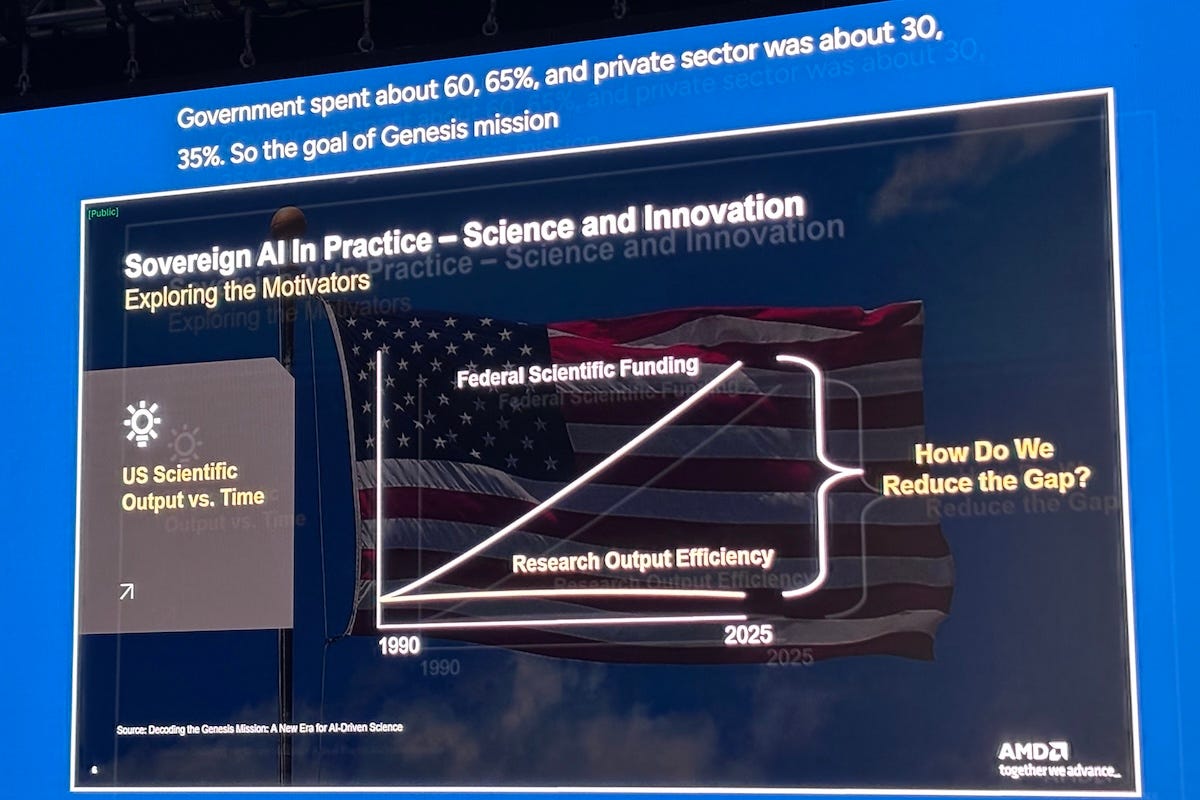
Last year’s Genesis Mission, launched by a White House executive order, set out to double the scientific productivity of the United States within a decade. The US spends about $1 trillion on research and development, with 75% now from the private sector versus 25% from the public sector, a reversal from the Vannevar Bush “endless frontier” era, when government funded roughly 60% to 65% of the total.
“Japan joined the Genesis Mission as the first country to join, and they’re going to invest $1 billion in a joint effort with the Genesis Mission in the US, because innovation knows no boundaries,” Zacharia said.
He said health and clean energy are universal challenges, making the case that accelerating research by working together was a natural fit.
The Department of Energy’s own $300 million funding round drew about 8,000 applicants from industry, academia and government labs, of which it could likely fund only about 100.
A chart AMD presented showed federal funding surging since 1990 while research efficiency stayed flat.
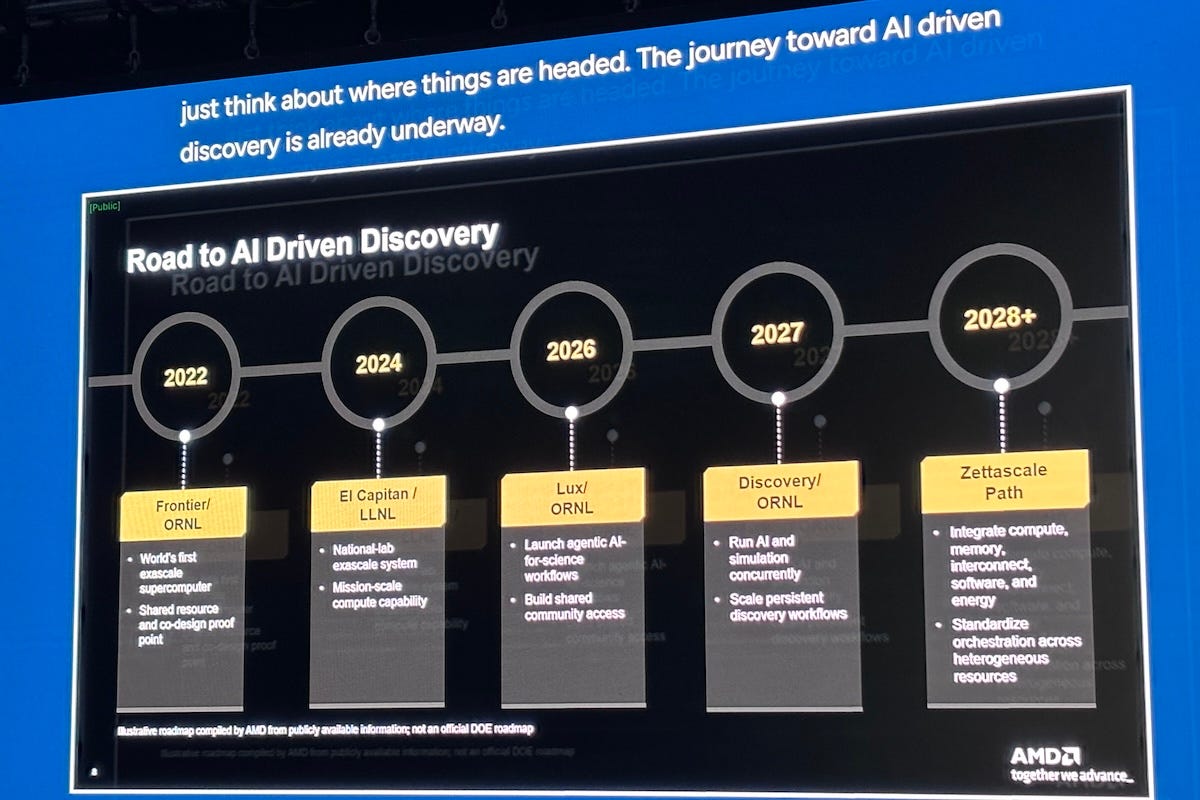
That scale of interest extends to the hardware itself. Frontier, deployed in 2022, was the first exascale system, and El Capitan is now the fastest system in the world.
“At Livermore they’re using El Capitan to come up with a new crystal structure for their inertial confinement fusion energy device. That could not have been done any other way, other than using AI to invent new material to drive fusion,” Zacharia said.
According to a roadmap AMD compiled from public information, Lux, an MI355X cluster at Oak Ridge, is set to launch agentic AI-for-science work in 2026, followed by Discovery in 2027. Discovery is expected to be the fastest AI and high-performance computing system available to the US scientific community.
“We’re really proud of this Zenith system that is going into Cambridge. It offers an opportunity for the UK scientific community to partner with peers in the US in driving this innovation ecosystem forward,” he said.
Zenith runs on AMD’s Instinct MI355X chips, a similar platform to the systems deployed under the Genesis Mission in the US. Zacharia pointed to ARCHER2, the UK’s national supercomputer run by the Edinburgh Parallel Computing Centre (EPCC), as evidence of the returns that investment can generate.
“At ARCHER2 in Edinburgh, they’ve already shown a return of about eight pounds for every one pound spent on supercomputing,” he said.
Zacharia said SUNRISE, a system being built with the UK Atomic Energy Authority, AMD, Dell, the University of Cambridge and WEKA, is set to become the world’s most powerful supercomputer dedicated to fusion energy. He said AI acceleration has brought that goal, a working fusion prototype by 2040, within reach for the first time.
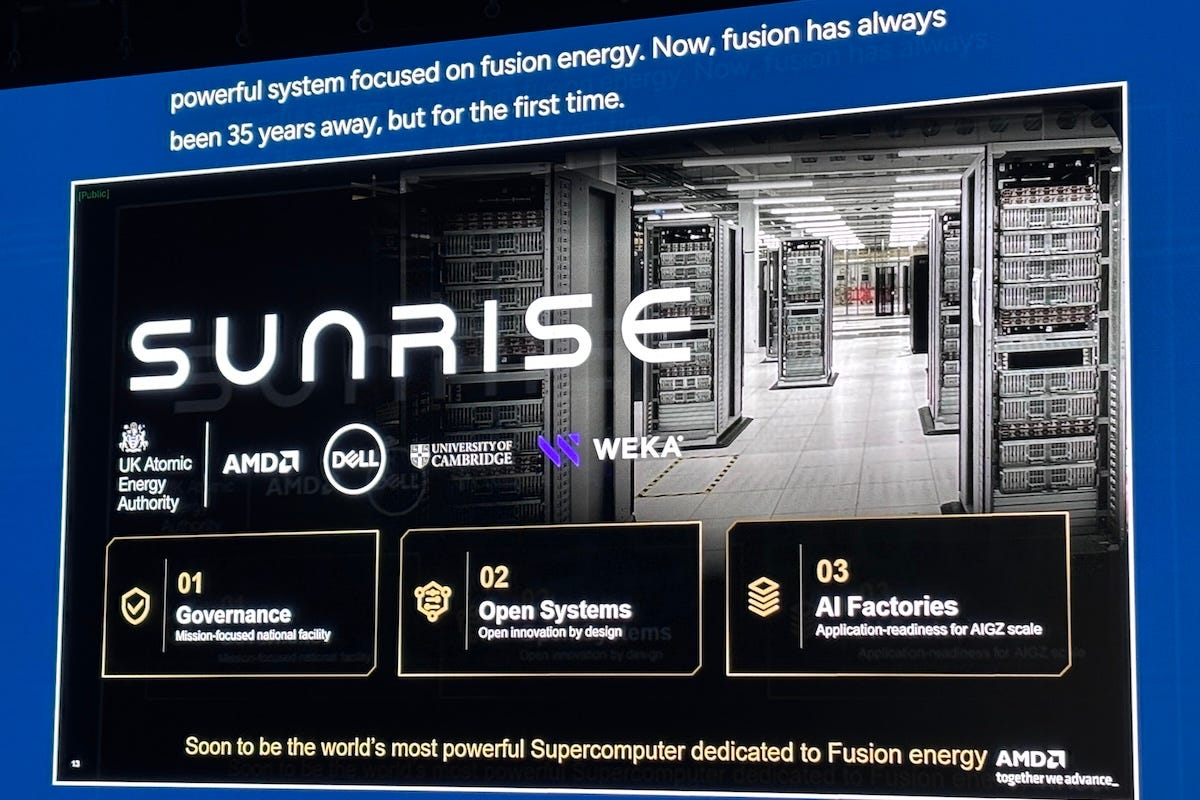
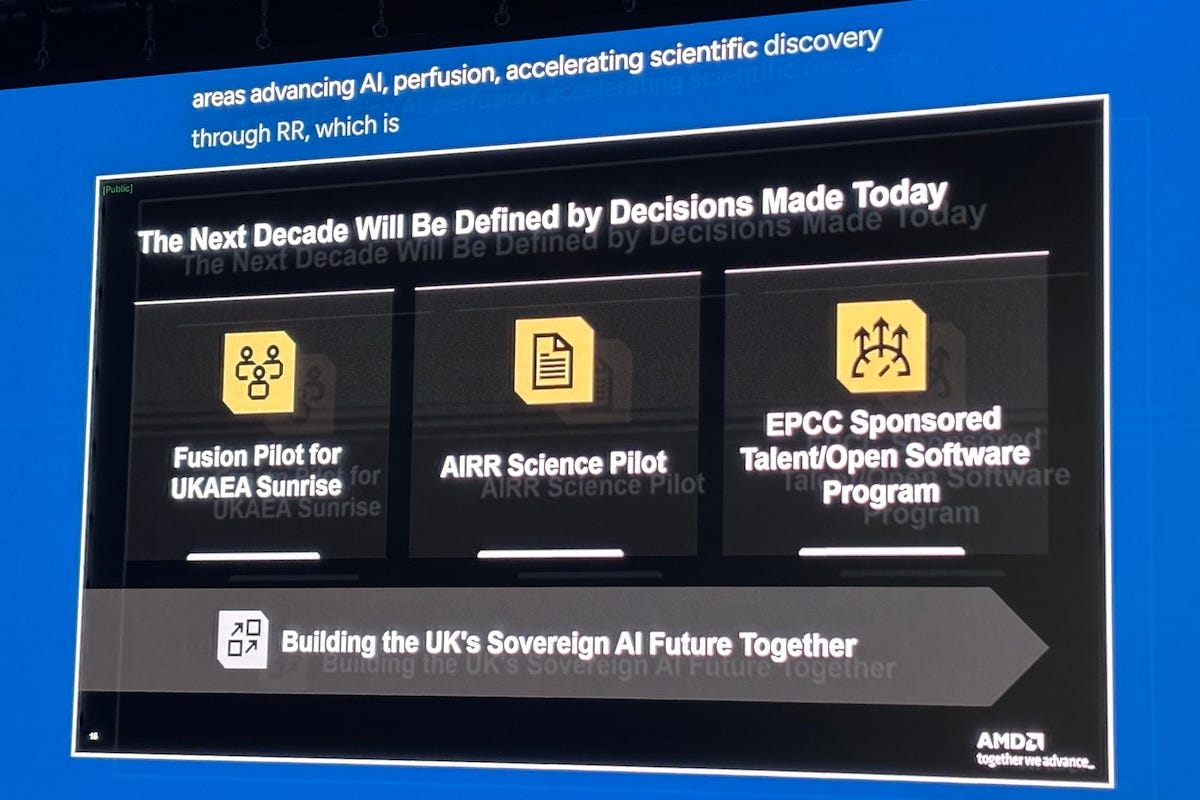
Zacharia closed by pointing to three commitments, part of what he called building the UK’s sovereign AI future together:
A fusion pilot built around SUNRISE
The AIRR Science Pilot to accelerate scientific discovery
An AMD-backed talent and open-software program with EPCC
History remembers the nations that built the foundational technologies of past eras, Zacharia said. The question now is not whether AI will shape the future, but who will shape it.