


Startups juggling multiple currencies, entities and revenue streams are getting a new way to see where their money stands in real time, as artificial intelligence (AI) pushes deeper into corporate finance.
Airwallex, a global payments and financial infrastructure company, has launched an AI-native accounting platform called T:0 that automates bookkeeping and revenue recognition for growing businesses.
The platform automatically categorizes transactions and builds financial reports around how a business actually earns and spends, giving founders instant visibility into cash, burn rate, and runway. It went live on September 1 for U.S. startups after a period in private beta, targeting companies from early stage through scaling.
The launch follows Airwallex’s $320 million Series H funding round, which closed on June 25 this year, and valued the company at $11 billion, up from $8 billion the previous December.
Speaking in June, before the round closed, Airwallex co-founder and president Lucy Liu said the strategy was already years in the making.
“We are thinking about today’s business as being very global native,” she said. “Beyond just collecting and paying out money, you need your expense management systems and financial operations systems. It is all interconnected because a lot of the data comes from your payments.”
“That is why we expanded way beyond just payments. We have treasury management software, and with AI, we have an AI Copilot and agentic finance, everything that helps a business operate more efficiently. I think it is where the market is heading, and where we made the right bet,” she said.
Airwallex was founded in 2015 by Jack Zhang and fellow entrepreneurs in Melbourne, after a coffee shop venture of theirs ran into the cost and friction of moving money across borders.
Liu invested $1 million in the idea before later joining as co-founder and president. The company, now dual-headquartered in Singapore and San Francisco, has grown to more than 2,300 employees across 27 offices worldwide.
She said the company moved its financial operations onto its proprietary system about three years ago, adding that she personally approves every bank account and calling the resulting team the most efficient she has seen.
To make that shift visible, Airwallex has sponsored Formula One team McLaren and Premier League club Arsenal, courting the chief financial officers, finance managers and chief technology officers who ultimately choose its platform.
Betting on infrastructure
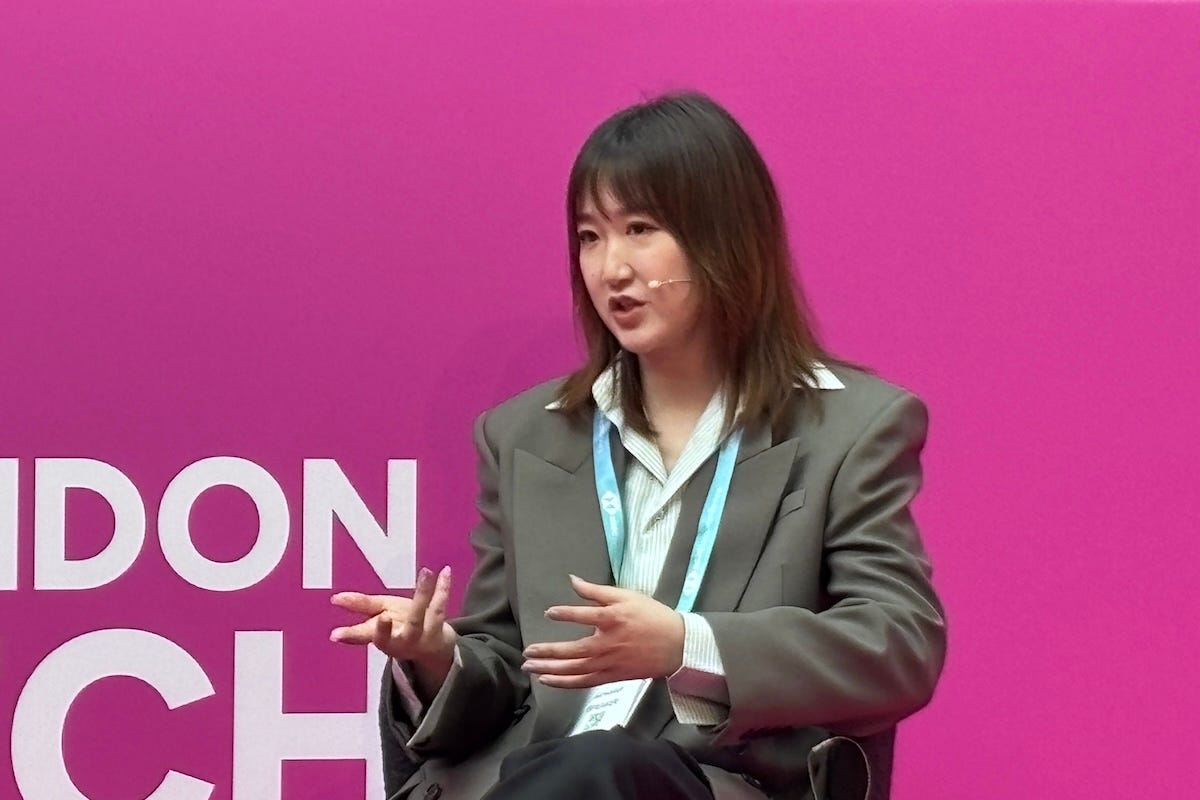
Liu made the comments in a fireside chat with Jess Jones, senior reporter at The Times, at London Tech Week in June 2026. Organized by Founders Forum Group and Informa, the London event explored how founders navigate the shift from hypergrowth to profitable, sustainable scale.
She credited Airwallex’s early decision to build as an API (application programming interface) first company, wiring its systems so customers could plug directly into them.
“Our choice to be API-first became very valuable,” she said. “It means we can become almost irreplaceable once we are integrated and once we provide the necessary data and services.”
She said pricing across the industry, from foreign exchange margins to payment collection and transaction fees, has become commoditized.
“We are not really competing on price anymore. We started to compete on service, then on scalability. We always emphasize that Airwallex is a platform that can be used from anywhere from a small business all the way up to multinational, billion-dollar enterprises,” she said.
“In the early days it was difficult to sell because people got confused,” she said. “Are you an SME (small and medium-sized enterprise) platform or an enterprise solution? Actually, you are both. You are the whole spectrum.”
Getting there took years of licensing work with regulators, she said. Airwallex now holds more than 85 licenses and registrations globally, serving more than 200,000 businesses.
That infrastructure took years to build. Liu said Airwallex was pre-revenue for about three years after it was founded in 2015, a stretch that tested investor confidence and internal morale alike.
She said the company pivoted its product roughly 18 months in, after the specific offering it was pushing found less traction than the broader infrastructure it was building underneath, including its own banking licenses and payment rails.
“We spent so much time and resources building the foundations of the business, the infrastructure, the APIs and what was going on underneath the applications, so we were able to switch our product offering to something that was welcomed by our customers,” she said.
She said growth then became a matter of speed: sticking to strict unit economics as the company expanded from Australia into the Asia-Pacific region (APAC) and, eventually, worldwide.
When the demo failed
Liu said Airwallex nearly collapsed three times in its first decade, and the closest call came during a funding round when a technical glitch, likely a firewall issue, disrupted a live demo in front of investors.
“It was not the internal team that was championing us. It was the investors who were looking to invest in us,” she said.
Tencent, which sat in on the pitch ahead of its own investment board meeting, told the team there were “greater things to look at” than the single glitch.
Liu said not everyone who joined the company in its early years stayed, but those who did shared a single vision with the founders, and the same drive.
Airwallex has been licensed in the UK since around 2020. In December 2025, it said it would invest $590 million in UK and regional growth between 2026 and 2030.
The plan includes a new Fitzrovia office of more than 16,000 square feet in London and a 60% increase in UK headcount, from about 100 to more than 160 people, by the end of 2026. Christos Chamberlain, a former Flexport general manager, took over as general manager for the UK and EU in January 2026.
“UK and EMEA (Europe, Middle East and Africa) are one of our fastest-growing regions at the moment,” Liu said. “London was a very natural expansion point for us because of the talent and its role as a financial hub, as well as the natural connection it has with where we first started, which was Australia and APAC.”
“You can tell by the sports teams that we pick. They are both London-based and UK-based, and we are receiving a lot of love from our UK customers,” she said, a reference to the McLaren and Arsenal sponsorships.
Big global players approached Airwallex with acquisition offers around eight years ago, when the company was only two years into generating revenue but already growing at hundreds of percent annually.
“We never started the business with the intention of selling it. There was so much more opportunity and potential then. It was a very generous offer, but being independent and building it ourselves was the vision that we had,” she said.
Jones, the moderator, asked Liu whether the funding environment has grown tighter for founders today, with far more scrutiny on profitability. Liu’s answer centered on a single, overused word in the startup world.
“It is a great time to be a builder, but it is also massively easy to build these days because of all the tools you have. You can code something over the weekend if you want to,” she said. “Validation comes a lot quicker these days. You might see results within the first two weeks of launch.”
She said that ease makes people matter more, not less: what a team stands for, and whether it can build trust with customers and its audience.
With the accounting platform now live and its valuation freshly reset at $11 billion, Airwallex’s next test is whether it can maintain that pace as competition in AI-driven finance intensifies.