


Space has become an invisible front line in modern warfare, with satellites shaping recent US strikes on Iran even as threats against them multiply.
In Operation Epic Fury, the US campaign against Iran launched in February, space and cyber forces were the first movers, blinding Iranian sensors and cutting military communications before aircraft struck. Space also supported Operation Midnight Hammer, the June 2025 US strikes on Iran’s nuclear facilities.
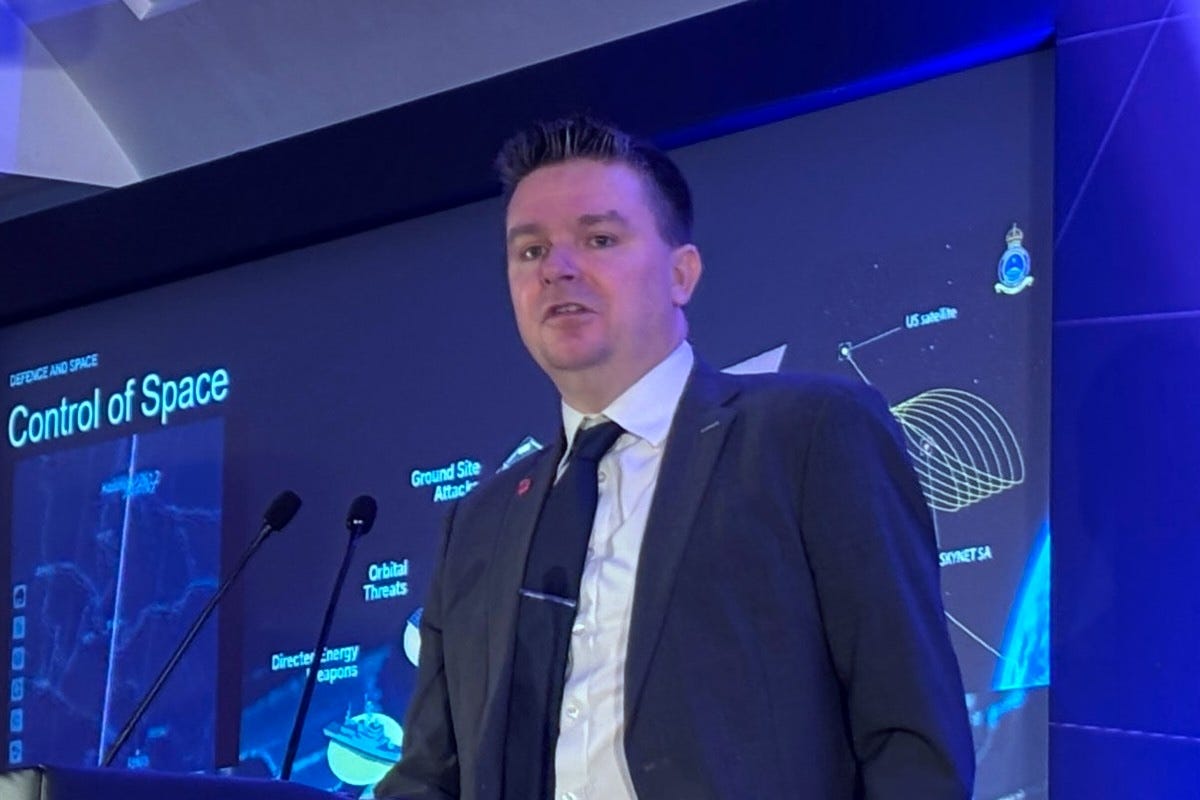
“The threats in, from and to space that we face every single day are continuing to grow,” said Dr Michael O’Callaghan, head of Geospatial UK and Future Programmes at Airbus Defence and Space. “This is not just about thinking about the satellite itself. We get drawn very quickly into technology.”
He cited Air Chief Marshal Sir Harv Smyth, chief of the air staff, as saying space is about gaining operational advantage for the integrated force. He said official accounts of recent operations say little about the role space played.
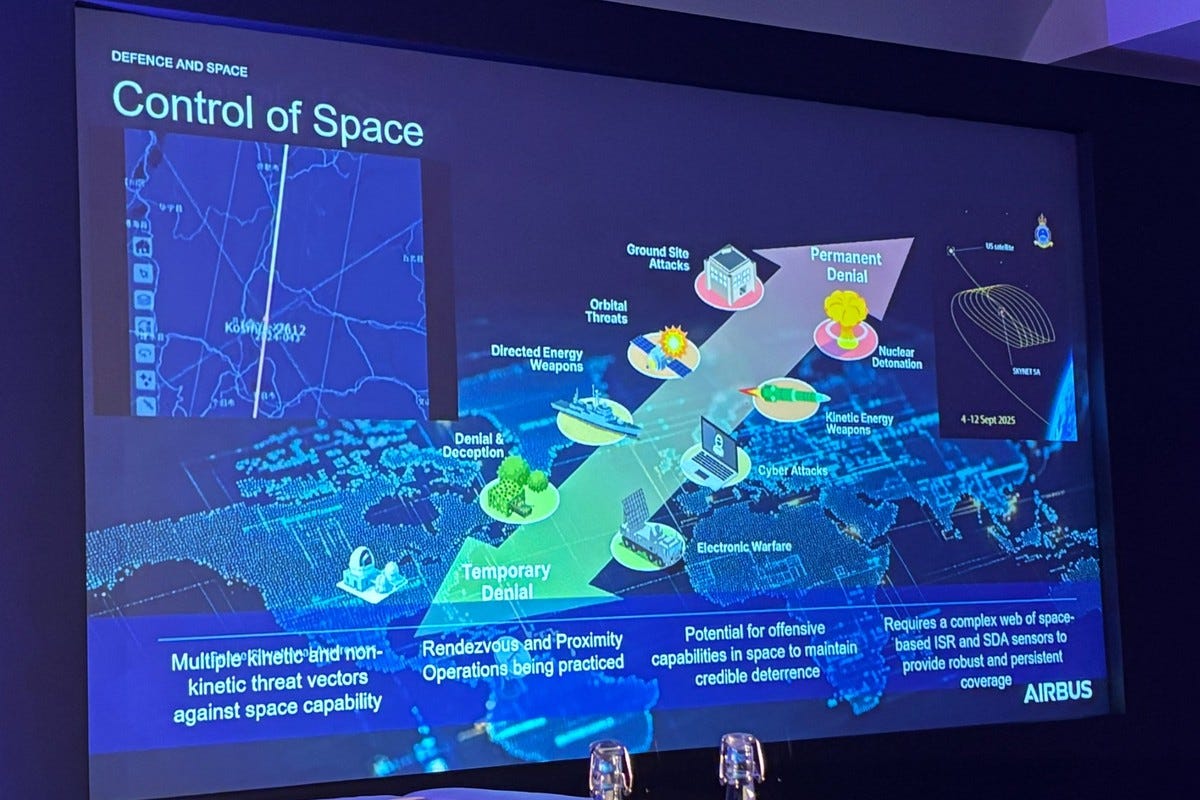
Threats now range from temporary denial, such as electronic warfare, cyberattacks and deception, to permanent denial through directed energy weapons, kinetic weapons, attacks on ground sites and nuclear detonation. Rendezvous and proximity operations (RPO) are already being practiced in orbit, and credible deterrence may require offensive space capabilities.
The UK Space Strategy calls for the capability to gain and maintain freedom of action and maneuver in, from and through space, and to deny adversaries the same freedoms.
Recent moves he cited include:
The US confirming in September that it had deployed a space weapon
The Royal Air Force forming No. 3 Space Effects Squadron in September to disrupt, degrade and deny hostile activity in space
The BBC reporting the same month that the UK military has been jamming hostile satellites
A US satellite inspecting the UK’s Skynet 5A military communications satellite in a joint operation in September 2025
“I believe we’re still very much in the foothills of this conversation, including with allied nations, and this is where we need those partnerships across government, industry and academia to make progress,” O’Callaghan said.
Airbus Defence and Space operates the UK’s Skynet 5 military communications satellites on behalf of the Ministry of Defence.
Resilience by design
O’Callaghan delivered the keynote “Space: The Contested Frontline” on October 27 at the Defence in Space Conference (DiSC) 2026 in London, a two-day event organized by and for the space and defense industry.
“The question for us is how we can maintain control of the air, the land and the sea if we don’t also have some element of control of space,” he said. “To have any prospect of this, we need resilient and layered capability.”
He said military, allied and commercial assets must be layered together, along with the ability to deter action in space so terrestrial operations are not disrupted.
Resilience must be built in from the outset. Major programs in other domains, such as the Global Combat Air Programme (GCAP) and the UK’s aircraft carriers, will intersect with space, artificial intelligence (AI) and drones in 2030 and 2035, while UK space plans are relatively fixed for the next five years.
“Commercial systems have their vulnerabilities, as in any sector. So they need to be intelligently leveraged, but not constrained,” he said.
“Approaches that allow us to roam across sovereign, commercial and allied satcom (satellite communications), taking a hybrid approach across multiple orbits for RF (radio frequency) and optical comms, will be needed to provide network resilience,” O’Callaghan said. “We say those words quite quickly, but it’s easy to say and much harder to do.”
He said the task is to orchestrate traffic across multiple satellite links and security domains while keeping the separation each domain requires, moving toward “predictive resilience” that stays ahead of the threat.
The same applies to intelligence, surveillance and reconnaissance (ISR). He said unclassified commercial data must work alongside classified sovereign and allied data, drawing on multiple vendors for true resilience. The UK’s own space-based ISR system is in its first phase and will need edge processing in orbit, while UK systems remain somewhat fragmented.
After attending the Royal Aeronautical Society’s Future Air and Space Defence Summit earlier this year, he said today’s debate mirrors the development of air superiority doctrine before World War II.
“It seemed clear to me that we find ourselves in the same place on control of space as we were on control of air during the 1930s. We might look back on this era in the same light as we reflect on the 1930s,” he said.
As with air power, control of space exists to help terrestrial forces win, must be integrated across domains and is never achieved once and for all.
“If we look at traditional space capabilities such as ISR, satcom and PNT (positioning, navigation and timing), at least we know the parameters of the argument one way or another. But it’s a lot murkier as we get into this domain of control of space,” he said.
He said the harder question is which mix of terrestrial and space-based counterspace systems a mission needs.
Western counterspace gap
O’Callaghan cited the Secure World Foundation’s annual counterspace report, an open-source snapshot of declared capabilities among allies and adversaries. It shows that Western nations outside the US still have relatively little capability despite recent announcements.
“I can’t think of any other domain where we would be content with this as the status quo,” he said.
China had at least 100 active counterspace capabilities in orbit as of April 2025, according to open-source reporting. Russia focuses on asymmetric space warfare, persistent electronic warfare from space and close monitoring of commercial and allied intelligence satellites.
He said China’s Qianfan (G60 Starlink) and Guowang (Satellite Internet Series Satellites) constellations will reach about 25,000 satellites within five years, with about 1,000 next year.
“We know from open-source reporting that those won’t just be for comms, but for ISR, missile warning and tracking, and PNT,” he said.
“The reality is that UK programs aren’t of the scale needed to sustain the industrial capacity we need,” O’Callaghan said.
He said supporting exports will be key, with Airbus seeing about £10 billion of space export opportunities over the next five to 10 years. He also wants government and industry to break down barriers and share intelligence in the right fora with trusted partners, as the US does through its Commercial Augmentation Space Reserve.
“Resilience isn’t just about technical capability or satellites, but it’s also about building those skills for the future,” he said.
Airbus’s education programs for pupils aged six to 18 have reached more than 2,500 young people, with more than 40% achieving higher GCSE predictions. He said 95% of students in some programs take at least one science A level, against an average below 50%.
“We’re in real need of those skills from across society to build that resilience,” he said. “We need to make sure that space isn’t just rocket science.”
Airbus also mentors underserved and underrepresented students in school years 10 to 13 with Motivez, a community interest company.
With China’s two constellations alone set to add about 25,000 satellites within five years, he said the UK must invest to build resilience into ISR and satcom and develop its own approach to controlling space.