


Artificial intelligence (AI) is poised to compress the automotive industry’s most time-consuming work, from the first sketch of a product concept to its appearance in a finished vehicle. The pressure to move faster is intensifying across every segment of the market.
Leading carmakers say the gains are most visible inside the organization rather than on the showroom floor. AI is accelerating the validation of ideas, the engineering of components and the deployment of automation on shop floors, a transformation that will ripple from product design all the way to the customer. The shift is already underway at some of the world’s largest vehicle manufacturers.
“AI will speed up the process from the very first idea to seeing it implemented in the car, all the way from deriving a business case, validating a product with the customer, engineering, simulating, crash simulation, to physical AI on the shop floor. We will definitely see speeds in this one,” said Manuel Schneider, head of open innovation at BMW.
Schneider said BMW has been working on AI for 15 years. His open innovation role involves identifying and validating ideas from academia, startups and entrepreneurs worldwide, as well as from more than 120,000 employees inside the company. He described AI adoption as a cultural shift rather than a departmental initiative, one that requires the entire organization to become receptive to external ideas.
“The organization needs to open up. We need to open up to large language models (LLMs), we need to open up to Chinese LLMs and bring world knowledge into the company,” he said.
Karin Svensson, chief sustainability officer of Volvo Group, one of the world’s largest manufacturers of commercial vehicles, trucks, buses and construction equipment, said AI is central to creating business value across its entire value chain, from design and production to customer interfaces, operation and services. She said deployment is uneven: some areas are quite advanced, while others are still at a sorting stage.
“AI could absolutely be something that can increase sustainability. But we cannot only talk about AI for sustainability. We also need to talk about sustainable AI,” she said.
China sets the pace
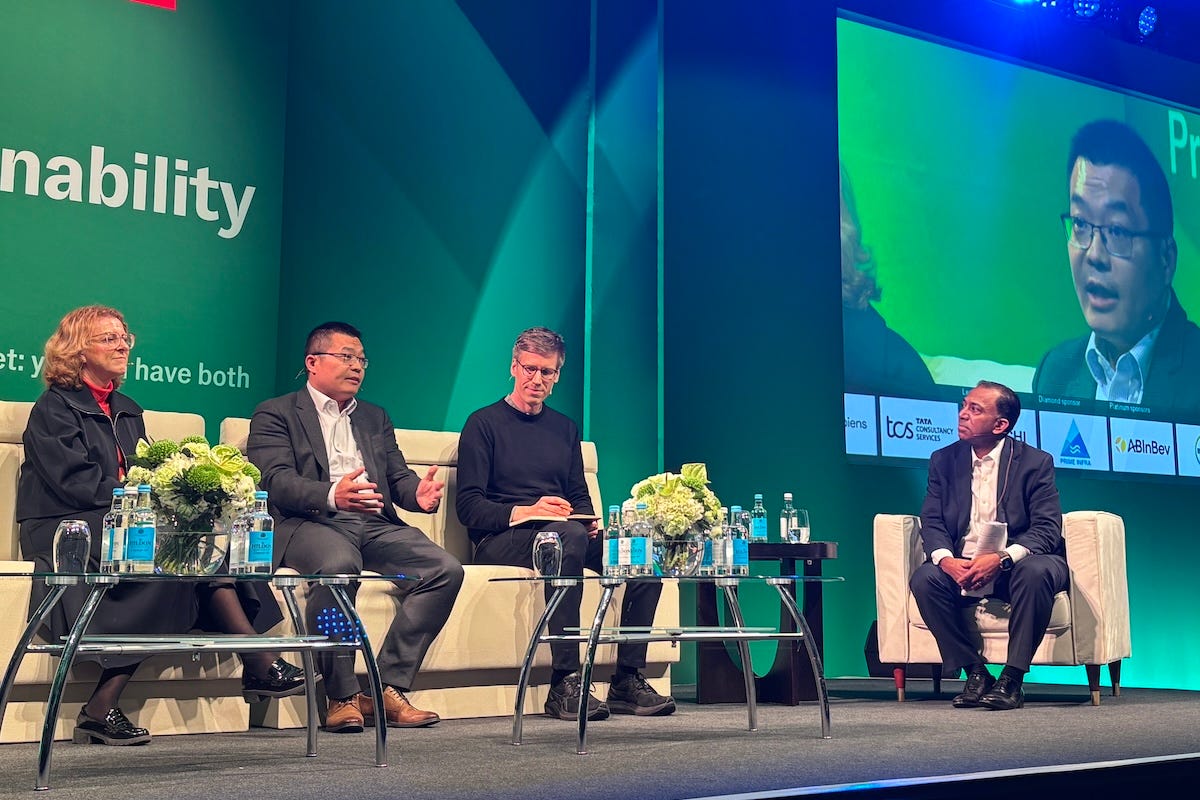
The panel “Shifting Gears with AI: The Future of Mobility” was moderated by Vijay Vaitheeswaran, global energy and climate innovation editor of The Economist, at the 12th annual Sustainability Week organized by Economist Enterprise in London.
Schneider said BMW takes a technology-agnostic approach, working with multiple LLM providers, including Gemini, Anthropic, OpenAI and DeepSeek, depending on the use case. He has team members based in China, Germany and the US who exchange frequently on AI developments across all three ecosystems, giving the company a ground-level view of how different AI cultures are evolving.
Bono Ge, country manager for the UK and Ireland at BYD, said the difference in customer behavior between China and Europe is stark.
“The customer is quite different in China. Chinese customers enjoy electric cars because the infrastructure is already there, and as a further extension, there is a lot of smart stuff they are more willing to explore,” Ge said.
He said European customers surveyed at random had often never used the voice control on their BYD vehicles. Chinese customers, by contrast, actively seek out and test every digital feature available to them. He said he expects European consumers to follow a similar path once they become more comfortable with electrification.
“We see massive speed in China, in the market in general, across various companies. To us, it’s super motivating. When I see my colleagues and competitors using local AI and local technology and advancing, this is something we have to do. There is no way around it,” Schneider said.
BMW is launching the iX3 in China in partnership with a local company to push autonomous driving capabilities, with the vehicle expected to reach the market in autumn 2025. Avoiding vendor lock-in is a guiding principle for the company, applying equally to vehicle drivetrains and to AI service providers.
“We have to use the ecosystems that are provided in the markets where we operate. We see many advancements in China that are highly beneficial to the world. It would be wrong not to look into them and use them,” he said.
The shift in innovation culture extends beyond software. Schneider said BMW is piloting in-car medical services in partnership with a hospital in Berlin, exploring whether the vehicle’s sensors can monitor passengers’ heart rate variability and blood pressure. The pilot represents a broader opening of what has historically been a tightly closed innovation ecosystem.
“We have a lot of sensors in the car and we have the people in the car. Can we measure heart rate variability, blood pressure? Can we provide medical services? This is at a pilot stage, but it just shows that this very closed ecosystem is opening up to new transactions and new business models,” he said.
Autonomous driving at levels 3 and potentially level 4 will create unoccupied time inside vehicles, he said, and in-car medical monitoring is one potential use of that time.
Autonomous driving is classified on a scale from level 0 to level 5:
0: the driver controls everything
1 and 2: basic driver assistance such as lane keeping and adaptive cruise control; the human remains in charge
3: the car handles most driving tasks, though the driver must be ready to take over
4: full self-driving in defined conditions with no human intervention needed
5: complete autonomy in all conditions and on any road
Beyond borders and batteries
Ge described the automotive industry’s evolution using a football analogy. The first half is electrification, which is nearing completion in several markets: Norway has exceeded 95% electric-vehicle (EV) penetration in new-car registrations, and China has reached 50%. He said the second half belongs to AI-driven digitalization, and the race to lead it is already underway.
“The car must be smart enough to know which things you want the car to do, and which things you are saying to the passengers. The charging route can also be fine-tuned by AI,” he said.
AI applications in development at BYD include autonomous driving for taxis and buses, natural language interfaces, battery health monitoring and vehicle-to-vehicle messaging. He said battery state-of-health monitoring, which tracks degradation over time to predict remaining useful life, is already among the most mature applications in the fleet. Regulatory approval will be the key gating factor for many others.
Svensson raised the resource cost of AI itself. The semiconductor chips required for advanced AI applications consume significant amounts of fresh water during production, a cost that is rarely factored into assessments of AI’s environmental impact.
She said companies face a transparency challenge in marketing AI systems as “smart” while being honest about their limitations and failure rates. The transportation sector must make mobility cleaner, safer and more efficient as global demand continues to rise. AI can contribute to that goal, but only if its own environmental footprint is managed alongside the benefits it delivers.
Trade tensions cast a long shadow over the panel. Ge said China, South Korea and Japan together dominate global power battery production, with China alone supplying 70% of EV batteries worldwide.
“If we keep talking tariffs but cannot develop electric cars because there is not much battery production in Europe, the whole industry suffers. The automotive industry is global. We have to ensure global sustainability for the supply chain,” he said.
Schneider agreed that the codependencies run too deep to unwind through trade barriers alone.
“There is no car that doesn’t have ingredients and parts from China, Germany and the US. The value chain is established and there are codependencies. We have to account for these tariffs, and at the same time believe in the dependency between China, Europe and the US,” he said.
The codependency he described has already shaped policy.
In January 2026, the European Union withdrew the punitive anti-subsidy import tariffs it had levied on Chinese electric vehicles, replacing them with a minimum selling price agreement.
As AI capabilities mature and the EV transition accelerates, both the opportunity and the pressure on the global automotive supply chain will only intensify.