


Artificial intelligence (AI) is delivering visible efficiency gains across enterprises, but proving its real business value remains far more difficult. For many executives, the challenge is no longer adoption, but demonstrating measurable returns rather than incremental productivity gains.
That tension is becoming more acute as investment rises. AI tools are easier to deploy than ever, yet the risk of misallocated capital is also growing. Companies are being pushed to adopt stricter financial discipline and clearer metrics.
“It’s super easy to spend money on AI that won’t deliver anything,” said Pierre-Yves Calloc’h, former chief digital officer at Pernod Ricard, a French producer of wines and spirits. “We actually measure the return on investment (ROI) because finance is on our back every three months, given the scale of investment.”
“On this use case, the best way to measure is A/B testing — you take a population using the tool and another not using it, and you see the difference in performance,” he said. “What we have already said publicly is that implementing this tool has generated in two to three years of growth. That’s tangible and audited.”
The company’s approach reflects a shift toward evidence-based deployment, where success is defined by measurable business outcomes rather than experimentation. Its sales optimization engine was first piloted in two markets before being rolled out more broadly.
Calloc’h said such discipline is increasingly necessary because generative AI has created a surge of potential use cases. Without filtering mechanisms, companies risk funding projects that deliver little impact.
Tewfik Bedreddine, global vice-president of data and analytics at Reckitt, a British manufacturer of consumer goods, said AI investments are treated like capital projects with defined timelines and return thresholds.
“From the beginning, the requirement was that it had to return within a year or a year and a half,” Bedreddine said. “The investment is significant, and most of it is not the model itself — the large language model is actually about 1% of the total cost.”
This cost structure highlights a broader misconception. While attention often focuses on models, the bulk of investment lies in integration, product development, data pipelines and organizational change. Companies are under pressure to ensure that returns justify the full cost of deployment.
ROI in action
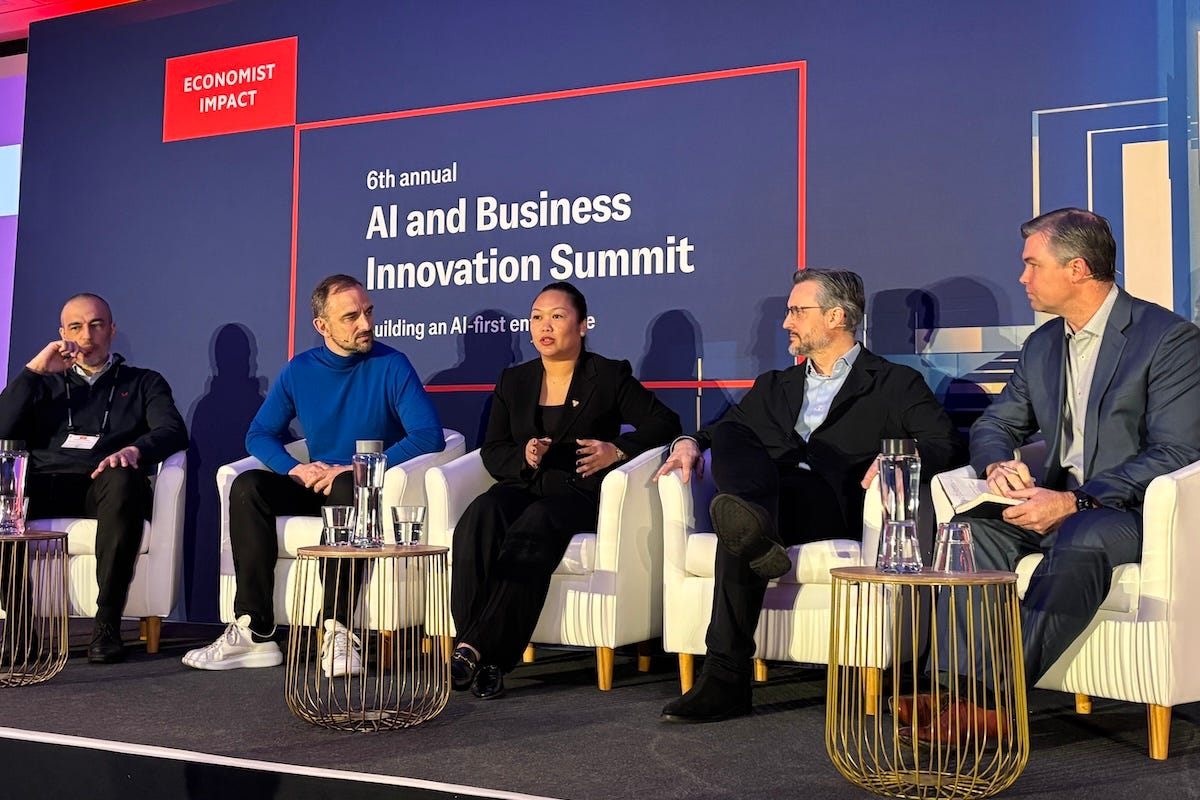
The discussion took place at the AI and Business Innovation Summit in London, organized by Economist Impact. Moderated by John Ferguson, global lead for new globalization at Economist Impact, the panel brought together senior executives from Reckitt, Pernod Ricard, Carlsberg Group, and Ferrovial to examine whether AI returns can outweigh costs.
Across industries, executives pointed to high-impact use cases in which AI has delivered measurable results, particularly when embedded in core operations rather than used as standalone tools.
Stella Alamil, vice-president and CIO for Central and Eastern Europe and India at Carlsberg Group, a Danish brewery company, said early gains often come from foundational adoption that reshapes how employees work.
“The question is not what agents can do for us, but what we want them to do for our business and how that fits into our strategy,” she said. “That starts with enabling teams to understand how AI can support daily work and free up time to rethink processes.”
Dimitris Bountolos, chief information and innovation officer at Ferrovial, a Spanish infrastructure and concessions group, described how the AI technology is improving decision-making in the infrastructure sectors.
“We are closing lines for maintenance, accidents or weather thousands of times per year across massive highways,” Bountolos said. “The ability to accelerate the understanding of when to close a lane, coordinate stakeholders and synchronize the supply chain has improved dramatically.”
Such decisions involve multiple variables, including traffic flow, safety risks and environmental conditions. Previously handled manually, they are now optimized with AI-driven analysis.
Pernod Ricard developed an AI engine that recommends weekly priorities for field teams.
“We implemented an engine to recommend every Monday which outlets our sales reps should visit and what actions they should take,” Calloc’h said. “This is based on about 40 flows of data, from sales and outlet characteristics to the demographics around each location.”
The system supports more than 5,000 employees in the field and is embedded into daily workflows, enabling measurable performance improvements.
At Reckitt, AI is transforming marketing analytics.
“Brand managers used to spend weeks in spreadsheets and PowerPoint to understand performance and market share,” Bedreddine said. “We’ve compressed that into just a few minutes so they can focus on what to do strategically.”
Despite these successes, many AI initiatives fail due to organizational resistance.
“When you tell a marketing director how to allocate budget, they say, ‘I’ve done it differently for the past 10 years — was I wrong?’” Calloc’h said. “That’s where you face major pushback, and in one case, we had to pull back and roll it out again.”
AI systems often disrupt established ways of working, and adoption can stall even when the technology performs well.
“At the beginning, we were experimenting without the right tools and many assumptions were not aligned with the capabilities of the technology,” Bountolos said. “You need to be prepared to fail fast and turn those experiments into lessons learned.”
Change management is critical and requires leadership engagement.
“On many decision-making projects, you need to start from the top,” Calloc’h said. “It’s difficult to ask people to trust AI if leadership has not been equipped with the same tools and confidence.”
Why AI falls short
Beyond adoption challenges, executives highlighted the operational effort required to make AI work effectively.
“You need to be good at the boring stuff — understanding your business processes and doing time studies to see where people spend their time,” Bedreddine said. “Most organizations don’t have that capability.”
This includes mapping workflows, cleaning data and identifying inefficiencies before AI is introduced. Without this foundation, AI risks being applied to flawed processes.
“A lot of the context you need for generative AI is not documented,” Bedreddine said. “It sits in the heads of people with 10, 15 or 20 years of experience and gets transferred informally.”
Capturing this tacit knowledge is essential but requires sustained effort.
“We realized that unstructured data — pictures, videos — was much more valuable than before, but we were not ready to manage it at scale,” Bountolos said.
This shift is forcing companies to rethink data architectures as traditional systems are often inadequate for AI-driven applications.
To manage complexity and risk, companies are adopting targeted strategies.
“We didn’t go for a broad approach where you give licenses to thousands of employees and hope for the best,” Bedreddine said. “We went deep and narrow, starting with marketing and then expanding function by function.”
Looking ahead, AI agents remain largely experimental.
“There is a limit to how much context you can give these systems,” Bedreddine said. “Beyond a certain point, they start to hallucinate, and that makes them unreliable for complex decision-making.”
“Fully autonomous, end-to-end business process automation by agents is still science fiction,” he added. “Today, it works in narrow areas like chatbots or structured data analysis.”
Alamil said companies should align AI with business strategy.
“The question is not what agents can do for us, but what we want them to do for our business and how that fits into our strategy,” she said.
As AI evolves, companies are shifting toward disciplined execution, focusing on measurable outcomes, targeted deployment and organizational readiness.