


The energy industry is quietly running one of the biggest tests of artificial intelligence (AI) orchestration ever attempted, and the results are not what anyone expected. Across millions of homes, AI systems are now scheduling when cars charge, when boilers fire and when batteries discharge, coordinating devices in real time across a grid that no human workforce could manage at that scale.
The surprise is not that it works. It is because customers prefer it. A growing share of energy consumers now choose to interact with an AI agent over a human, because the agent has read every message, complaint and conversation they have ever had, and responds accordingly.
“We found that through using AI-generated messages, customer satisfaction has increased by over 10 to 15%,” said Charlotte Johnson, General Manager Generation Flex at Kraken. “The reason for it is often that the messages can be more empathetic. They can read the tone of all of the previous conversations that the customer might have had with someone else, months or years ago, and respond in a tone that resonates and builds a relationship.”
On the trading floor, the same dynamic is playing out. Energy markets are being pushed toward full automation as more renewables come online and trading windows shrink.
“We’re moving to an algo trading world where you can’t have humans just sit there trying to buy and sell electricity at any given time in the day, because you’re missing the opportunity,” Johnson said. “By the time you’re ready to click the button, and you’ve worked out what you needed, you’ve missed it; it’s already gone.”
“A lot of companies are still running pilots, but they’re not able to scale those pilots. When we’re talking about the scale that we need for the energy transition, it’s also about having the right infrastructure, platform and data foundations in place,” said Charlotte Blommestijn, Head of Sustainability at Kaluza.
Blommestijn said most utilities are still far from this point. Many do not even know which of their customers own an electric vehicle (EV), let alone have the systems to bill them accurately, offer the right tariffs in real time or nudge them toward behavior that benefits the grid.
She said the gap is not a shortage of AI tools but a failure to move from experimentation to production at the scale the energy transition demands.
Kraken Flex is considered one of the world’s largest residential virtual power plants (VPPs). Kaluza, the intelligent energy platform spun out of OVO Energy, provides the software layer that allows utilities to manage millions of distributed devices, including EVs, heat pumps and home batteries, in real time. Kraken has over 2,000 developers working on its platform.
Grid on the brink
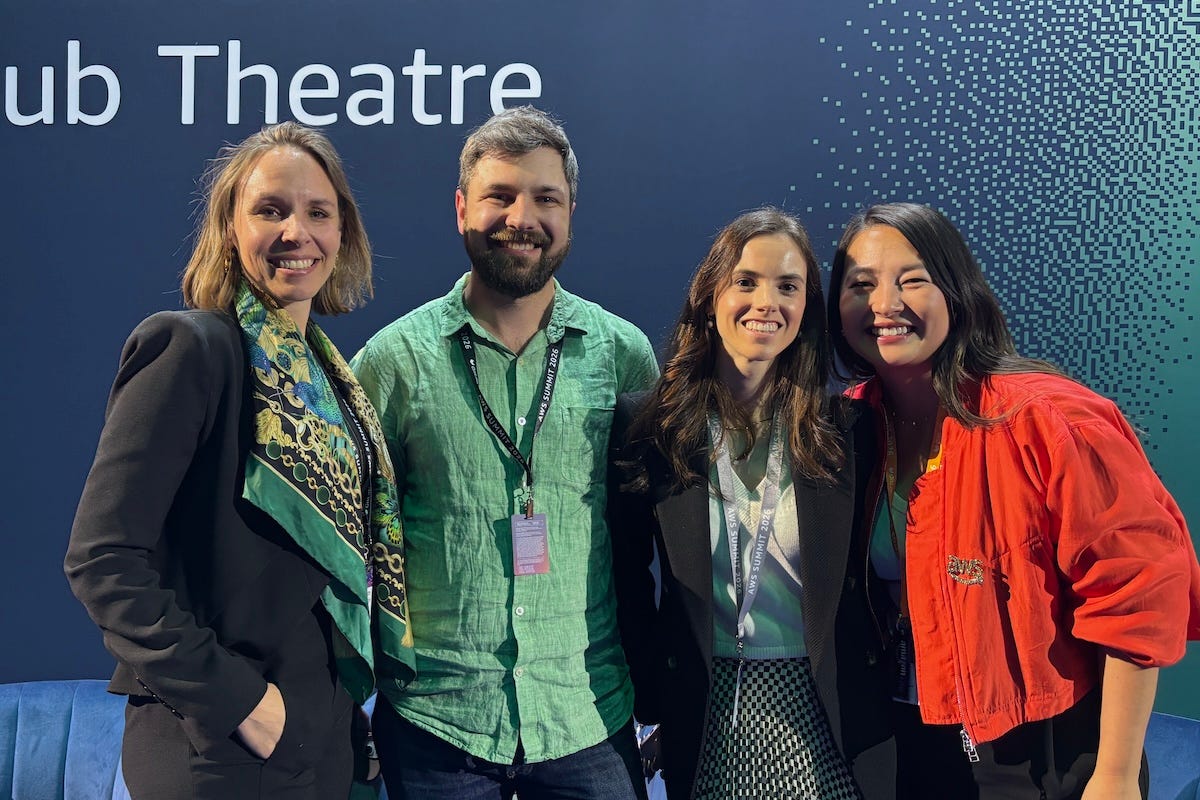
The panel was held at AWS Summit London on April 22, 2026, where Carol Yan, Energy and Utilities Leader UK&I at AWS, moderated a session titled “The Future is Renewable: AI Orchestrating the Energy System.”
Yan was joined by Johnson and Blommestijn, as well as Bartek Szostek, CTO and co-founder of Tem Energy. The discussion explored how AI is reshaping the way energy is bought, sold and balanced across a grid that was never designed for the world it now serves.
Blommestijn identified three areas where AI is having the most transformative impact on the power sector:
forecasting and grid orchestration in real time;
demand flexibility at scale, where aggregated EVs can be managed as a single coordinated resource; and
software velocity, meaning the ability to deploy new capabilities far faster than before.
The velocity gains are already tangible. For OVO Energy, Kaluza has reduced time-to-serve by 62%. New product bundles that previously took months to develop can now be built in weeks or days, a pace of change that Blommestijn said remains underappreciated outside the technology sector.
On whether falling software costs will open the market to new entrants, Szostek drew a parallel with the open banking revolution in financial services, which allowed challengers such as Revolut to force incumbents to improve. He said the energy market is at a similar inflection point.
“It is easier to build. But the context is missing. You still need to have a bit of experience and understanding, to have been on the inside for a while to understand how to optimize it,” he said.
That context matters because the system those entrants are trying to fix is deeply, structurally broken.
Last year, 800 gigawatts of renewable energy capacity were added globally, the equivalent of the entire EU power system, with more than a quarter coming from solar. Yet in the UK alone, £1.46 billion worth of wind energy was curtailed, switched off because it could not get onto the grid.
In the Netherlands, grid constraints have become so acute that new homes and businesses in most provinces will soon be unable to obtain a connection.
“These are not capacity issues. This is not a problem of more renewables coming online. This is a coordination problem,” Blommestijn said.
Johnson illustrated the consequences vividly. Traditional thermal power plants provide system inertia, a rotating mass that acts as a shock absorber when something trips on the grid. As those plants are retired and replaced with wind and solar, that buffer disappears.
She said Spain’s blackout in April 2025 affected 60 million people, while the UK’s 2019 outage, triggered by a lightning strike that hit a wind farm and a gas plant simultaneously, left large cities dark within seconds. Both countries have since deployed large-scale batteries capable of injecting stability into the grid within milliseconds. Interconnectors in the UK now trip every week, but consumers no longer notice, because batteries absorb the shock before it cascades.
Stripping out the middlemen
While the grid’s physical problems attract the most attention, the commercial infrastructure sitting above it is no less dysfunctional.
Szostek said there are typically six or seven intermediaries between a business buying energy and the generator producing it, including brokers, utilities, exchanges and hedging partners, each adding fees, risk margins and profit that the end customer never sees.
“We truly believe 30% of the bill, or at least on the power price, could be saved by simply optimizing the entire system,” he said. “That’s basically the fat of all the additional charges and fees that intermediaries are putting on the bill.”
Tem Energy’s platform collapses that chain into a single infrastructure layer, allowing businesses to buy more directly and see where their energy comes from. The company can issue a price quote in 10 minutes, against an industry standard of 48 hours.
“They’ve probably changed their mind or gone somewhere else,” Szostek said, adding that by then the market would have shifted and the quote rendered stale.
He said large language models (LLMs) are used to streamline back-office processes, fixing meter data problems before customers are aware of them and handling the complex workflows involved in switching suppliers.
Szostek’s longer-term vision is for energy bills to become as readable as bank statements. He said this mirrors what open banking did for personal finance, where customers can now see exactly where their money goes.
“My hope is that we can do the same thing for energy,” he said.
He added that greater transparency would also reduce public skepticism toward renewables, because if people understand the system, they are less likely to blame clean energy when things go wrong.
Underpinning all of this is the flexibility market and the consumer relationship it requires. The shift from supply-side to demand-side balancing has created a significant opportunity for households, but it will only work if energy companies earn genuine trust.
Kraken Flex has over half a million EVs on its platform across 90% of UK car brands. Customers are asked just two questions: when they want their car charged by, and to what level. The platform handles the rest.
“You can’t have the transition without flexibility, and you can’t have flexibility without engaging the end customer,” Johnson said.
Kaluza worked with AGL Energy in Australia on a scheme called “Three for Free,” giving customers three free hours of electricity during solar peak hours between 11 am and 2 pm. Australian regulators have since mandated the program across three provinces, a sign that what starts as a product innovation can quickly become grid policy.
With the first wave of AI orchestration now delivering measurable results, the challenge ahead is scaling what works: from pilots to production, from individual assets to coordinated systems, and from a market built around coal plants to one designed for a renewable-first world.