


When a customer walks into a hardware store clutching a broken part they cannot name, AI may now be their best hope of finding a replacement. Across retail, banking and financial services, companies are moving well beyond experimentation, deploying artificial intelligence (AI) that solves tangible problems and generating results they can take to the boardroom.
The most successful deployments share a common trait: they were built around a specific business problem, not around the technology itself.
“Most of the time our customers go to our stores not to look for a product but to solve a specific problem. They go and describe their problem to our colleagues: ‘I want to remove all the wallpaper, I don’t know how to do that,’ and then we have to actually come up with the product and how you do it,” said Mohsen Ghasempour, Chief AI Officer at Kingfisher.
“We launched our first public-facing DIY system in December 2023, where you could actually go and ask, ‘I want to tile my bathroom, how do I do that?’” he said.
Kingfisher operates B&Q and Screwfix across more than 2,000 stores in Europe, employing 76,000 people. Beyond the DIY chatbot, it developed Lens, a mobile visual scanner that searches 2.1 million products on diy.com to identify broken or unrecognizable parts. The platform handled over one billion product interactions last year.
Paul O’Sullivan, SVP of Solution Engineering and CTO for Salesforce UK and Ireland, described a similar logic at work in the contact center. After deploying its own AgentForce AI agent on help.salesforce.com, Salesforce achieved 83% first-time resolution across all inbound queries.
“That has relieved a tremendous amount of frontline pressure, enabling us to redeploy people into areas that can drive higher value tasks and ultimately more employee satisfaction,” he said.
The results extend to Salesforce’s customers. Heathrow Airport shifted 70% of phone-based contact center volume to web-based agent interactions. Simply Health, with over 2 million members, reduced claims processing time from 12 minutes to one minute after automating 87% of its claims workflow.
At Citi, Ryan Courtier, SVP and Senior Product Manager for generative AI (Gen AI) platforms, takes a design-thinking approach to finding where AI fits.
“I try to understand from these business leaders: what are the problems you’re trying to solve today? What kind of challenges do you have?” he said. “I try to help them understand this is where AI will enable you to free up very manual, repetitive processes, when you could spend a lot more time on the purpose of what your business is trying to achieve.”
Governance as a launchpad
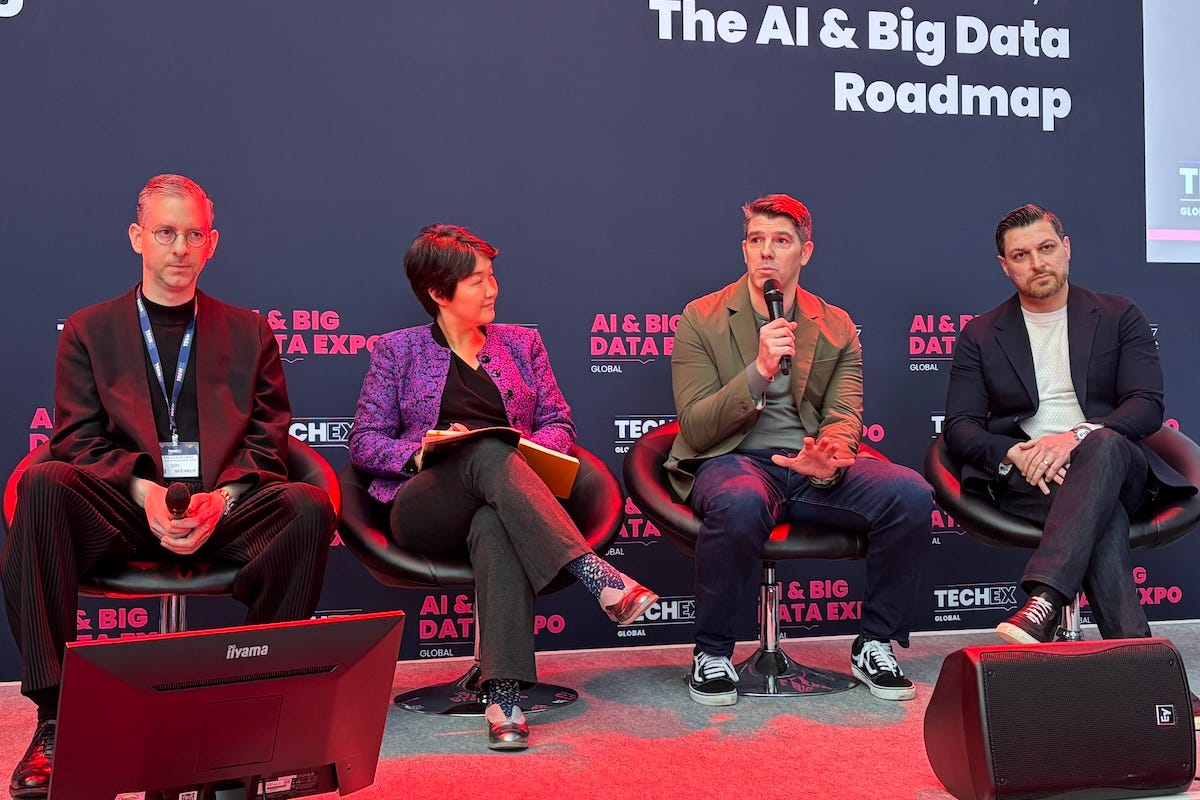
The panel, titled “Transforming Industries with AI and Big Data: Success Stories from the Frontlines,” took place at the AI and Big Data Expo in London, part of the TechEx Global 2026 conference.
It was moderated by Mark Sage, Executive Director of the Augmented Reality for Enterprise Alliance (AREA) and the Enterprise Data Management Alliance (EDMA), and featured O’Sullivan, Courtier, Ghasempour and Yao Li, Global Chief Product Officer for Data Quality at Experian.
For Courtier, operating inside one of the world’s most heavily regulated banks means governance is not an obstacle. It is a prerequisite. Rather than pitching AI as a technology initiative, he frames every proposal around operational outcomes.
“I treat governance as an enabler. Hallucinations are down to almost zero, and to do that, you need a really close relationship with those teams. Don’t see them as blockers, but as avenues to help you get that value out even faster,” he said.
“If I’m joining a call trying to convince people to use this AI, I feel I’m already setting myself up for failure. I go in and say, ‘I’m going to remove X manual touch points, I’m going to reduce risk by X,’ and that’s often the easiest way to get them on board,” he added.
O’Sullivan argues the governance challenge begins with the large language model (LLM) itself.
“The LLM alone is not enough. When ChatGPT launched in 2022, we all went ‘Wow.’ We very quickly fast-forwarded and saw hallucinations, toxicity and misinformation,” he said. “We consciously focused on trust; trust is our number one value at Salesforce, and we built a trust layer within our core platform to connect to LLMs through a secure gateway, to check for toxicity, bias, and hallucinations, and to provide a predictive score while keeping a human in the loop.”
Ghasempour faced a structural version of the same challenge. Scaling to hundreds of Gen AI agents at a FTSE 100 company would have meant hundreds of separate governance approvals. Kingfisher resolved this by building Athena, a centralized framework that bundles security, legal and compliance checks into a single layer.
“The way we tackled that was to join technology and governance, a central location to apply security measures that gives legal and compliance a bit of assurance,” he said.
Li, whose team at Experian processes 1.2 billion records a month from 700 sources, frames the stakes plainly.
“Where I work really determines ultimately whether AI is truly intelligent or just confidently wrong,” she said. The EU AI Act sharpens the point: violations carry fines of up to 7% of global gross revenue, equivalent to £70 million for a billion-pound business.
Trusted data first
When an audience member asked how AI could support real-time decision-making, Li offered a three-layer answer: trusted data at the foundation, transparency and explainability in the decision process, and scalable governance that embeds institutional knowledge.
“Number one is to start with trusted data at the foundation. If you start with good data, the decision can be faster, near real-time or getting to real time,” she said. “It’s not just about the decision itself, but how do you roll back and explain it to people? You need transparency, explainability, observability and remediation when things go wrong.”
Experian helped a client cut manual data interventions by 50%, resulting in 120,000 data fixes, and helped IKEA reduce duplicate customer records by 15%. It also implemented 150 automated Gen AI workflows to enforce consistent data-quality guardrails at scale.
O'Sullivan described a complementary approach built around confidence thresholds. For fully automated decisions, a confidence score can gate whether an action proceeds. For more complex or sensitive ones, the role of AI is to surface the right information to the right person at the right time.
Salesforce’s Next Best Action feature presents a contact center agent with a relevant offer when a customer with multiple open complaints calls in, rather than automating the response entirely.
The panel cited striking results. Citi is saving 100,000 developer-hours per week by accelerating engineers’ productivity. Kingfisher attributed £18 million in revenue to AI-driven personalization and reported a 15% margin improvement from a pricing optimization project.
“When we talk about a 15% margin improvement, that’s not AI making 15%, that’s people using AI technology to make that impact,” Ghasempour said.
“We’ve seen lots of proof of concepts, pilots, lots of pounds and dollars being chucked at AI that hasn’t really unlocked any business value,” O’Sullivan warned. “I think we’ve got a once-in-a-lifetime opportunity to reimagine how we run our businesses, and the whole business process model will have to be rethought through with agentic AI and workflow automation.”
Closing the skills gap will be central to that ambition. Ghasempour warned that without education, organizations risk both uncritical hype and paralyzing fear of job displacement. O’Sullivan called AI literacy a shared industry obligation, pointing to Salesforce’s £50 million UK investment in hands-on training.
Courtier suggested the most effective reframe comes from Nvidia CEO Jensen Huang: rather than asking which tasks AI can automate, ask what purpose a role is ultimately meant to serve, and let that guide where the technology goes next.