


Artificial intelligence (AI) is making it cheap enough to look inside microwave components that factories have treated as identical, exposing differences that standard tests miss.
Radio frequency (RF) filters that pass inspection still carry microscopic differences left by etching, baking and depositing materials. Until recently, finding those differences took so much custom scripting and bespoke work that manufacturers simply treated every unit that came off the line as the same.
“If I did this in 2017, this would take me about a week to do. But this time around, I did this in a day,” said Charles Phiri, executive director for SME AI/ML innovation at JPMorganChase.
“Can I still do this work? And now that I’ve got a lot of AI tools available to me, what else can I do? This is the art of the possible,” he said.
Phiri was referring to four two-port RF bandpass filters that came off a production line in April 2017 and were built to be functionally identical. He had analyzed them while working with a defense and space company.
All four passed standard tests. Nine years later, he ran the same data through five layers of analysis:
Classical frequency-domain diagnostics
Time-domain analysis
Vector fitting
Topological data analysis
Machine learning (ML) trained on synthetic data
He said the earlier blindness to microscopic variation was not a failure of mathematical understanding. Treating components as identical was an economically mandated compromise, because digging deeper cost more than it was worth.
He warned that these invisible substrate errors can cause critical failures in phased-array radars and precision timing circuits.
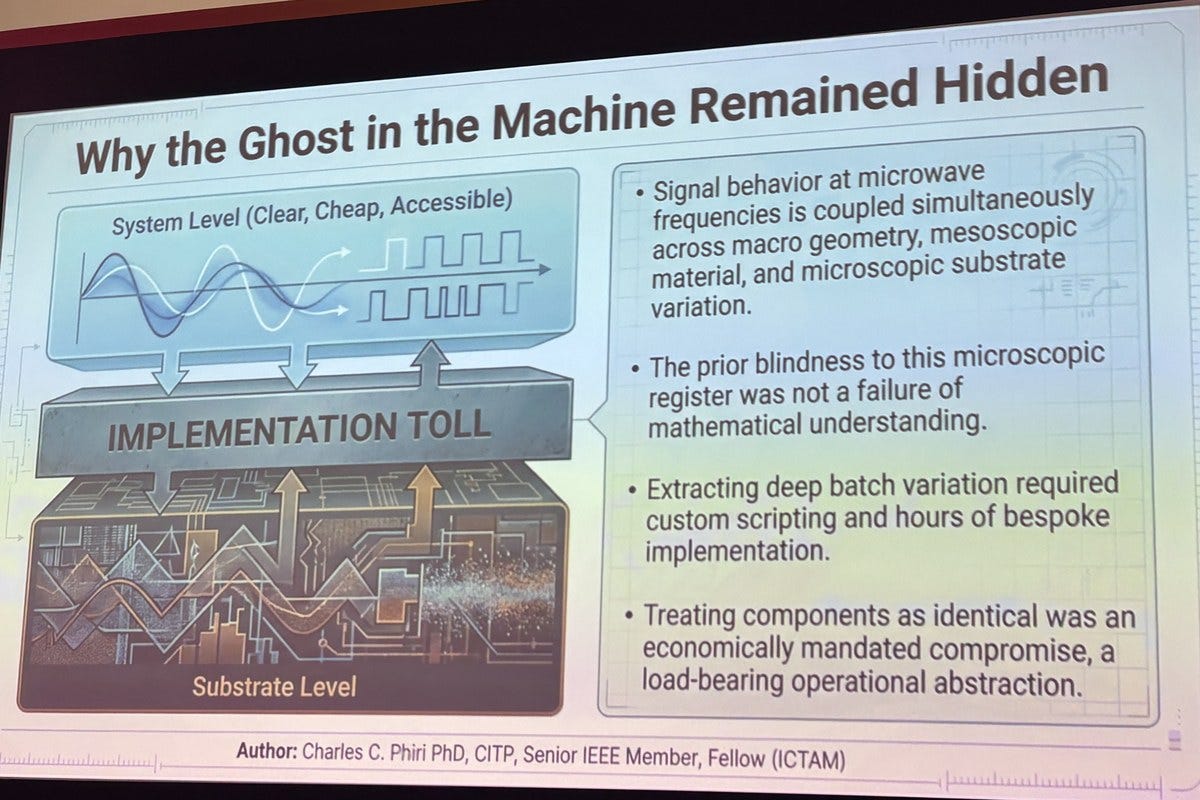
Once the baseline audit took a day instead of a week, Phiri used the time saved to probe what the classical tests had missed.
“Now that I bought more time, what else can I do? If it is done today, I can build this and multiple versions of it in a very short period of time. All this discovery was done in a day,” he said.
He found a set of physical fingerprints that the 2017 tests missed.
Identical only on paper
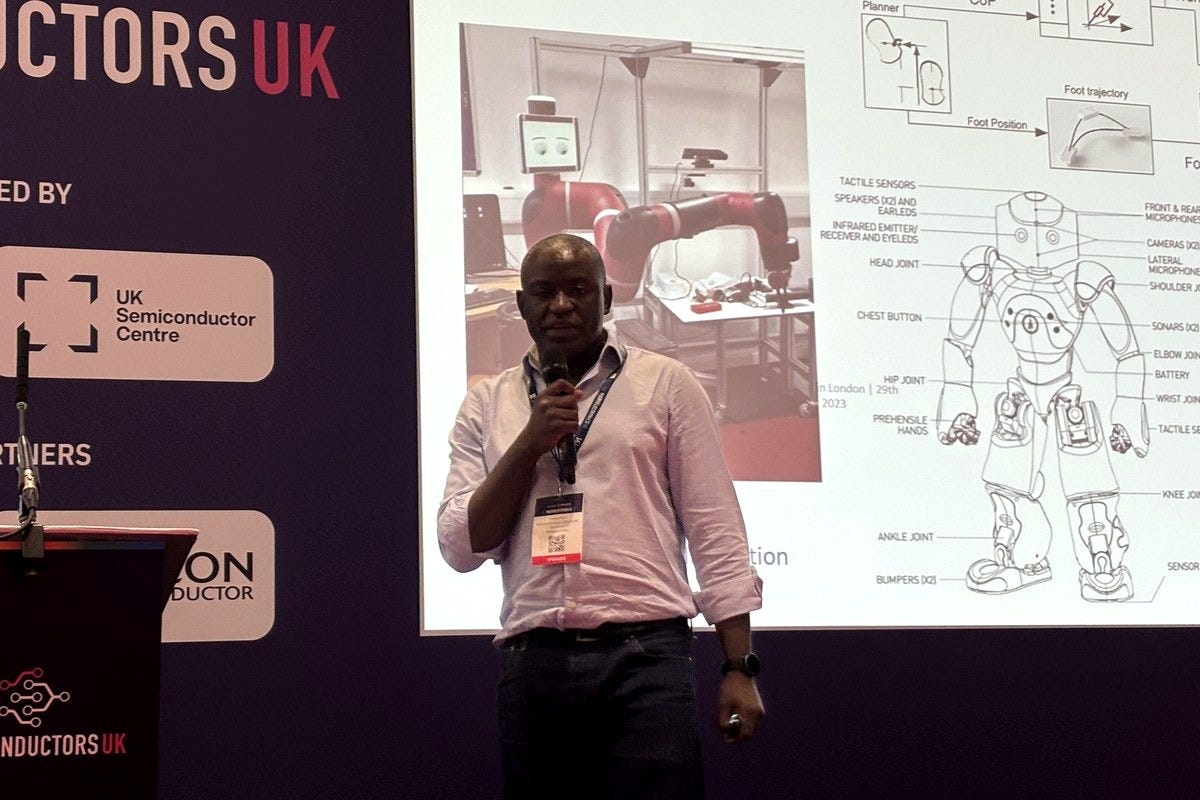
Phiri spoke at Semiconductors UK, part of the Microelectronics UK 2026 conference organized by IQPC Exhibitions in London on September 29. Conference chair Martin McHugh, board chair of Novomorphic, hosted his keynote, “The Economics of Curiosity: Breaking the Barriers of Microwave Engineering.”
Phiri holds a PhD in humanoid robotics from the University of Portsmouth and has built robots and their motion-planning algorithms. He has worked at 21 companies across the sectors represented at the event.
Outside work, he uses satellite images to study farming and designs a personal safety device for at-risk people.
Manufacturing optimizes for interchangeability, meaning functional identity within strict specifications. Yet the process of making parts the same inevitably leaves device-specific traces, such as lithographic line-edge roughness, deposition scars and material impurities.
“If you’re manufacturing filters or any RF system, the idea is that those systems will look the same at the macro level. All these systems pass the test,” Phiri said. “However, if you start looking at the mesoscopic level, things start to change. When you start going to the microscopic level, this is where things are very different.”
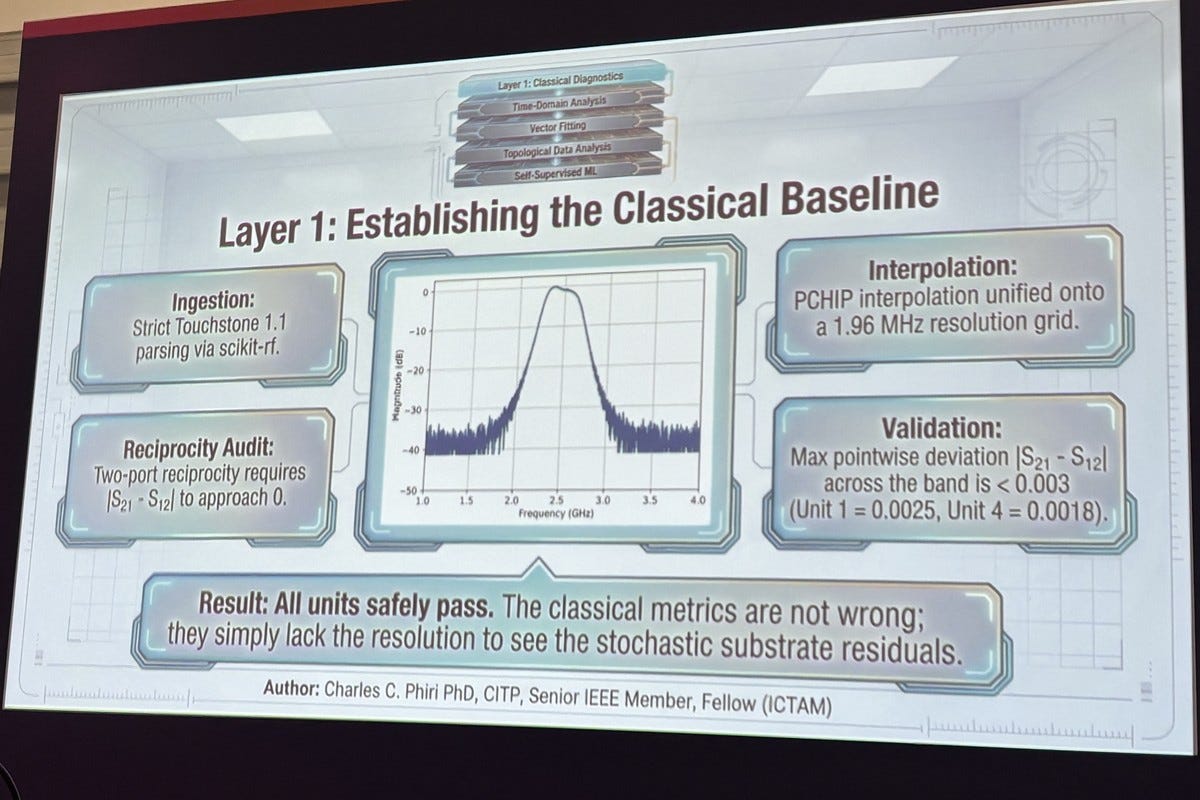
Standard measurements of the 2017 batch, taken from 1 GHz to 4 GHz, showed the four passbands stacking almost exactly on top of one another. The classical metrics were not wrong. They simply lacked the resolution to see the residual differences in the substrate.
Phiri said the standard data-science approach can mislead engineers.
“If you take any data scientist and give them an RF problem, one of the go-to methods is PCA (principal component analysis),” he said. “But if you apply PCA to this type of problem, it conflates the bandwidth variation with the primary shift modes. You get very good isolation, very good information, but that information does not represent what the physical system looks like.”
PCA captured 93.4% of the variance in the filter data in a single component, producing a statistically tidy summary that hid the physics. Phiri replaced it with physics-informed shift-fit registration, which aligns each filter’s passband to lock its center frequency. That cut the mean passband error by 58.8%, from 13.1 dB to 5.4 dB.
It also showed that Unit 1 was detuned by 184 MHz in one direction and Unit 4 by 188 MHz in the other.
The odd one out
Phiri then moved to the time domain to check that what appeared in frequency plots also showed up over time.
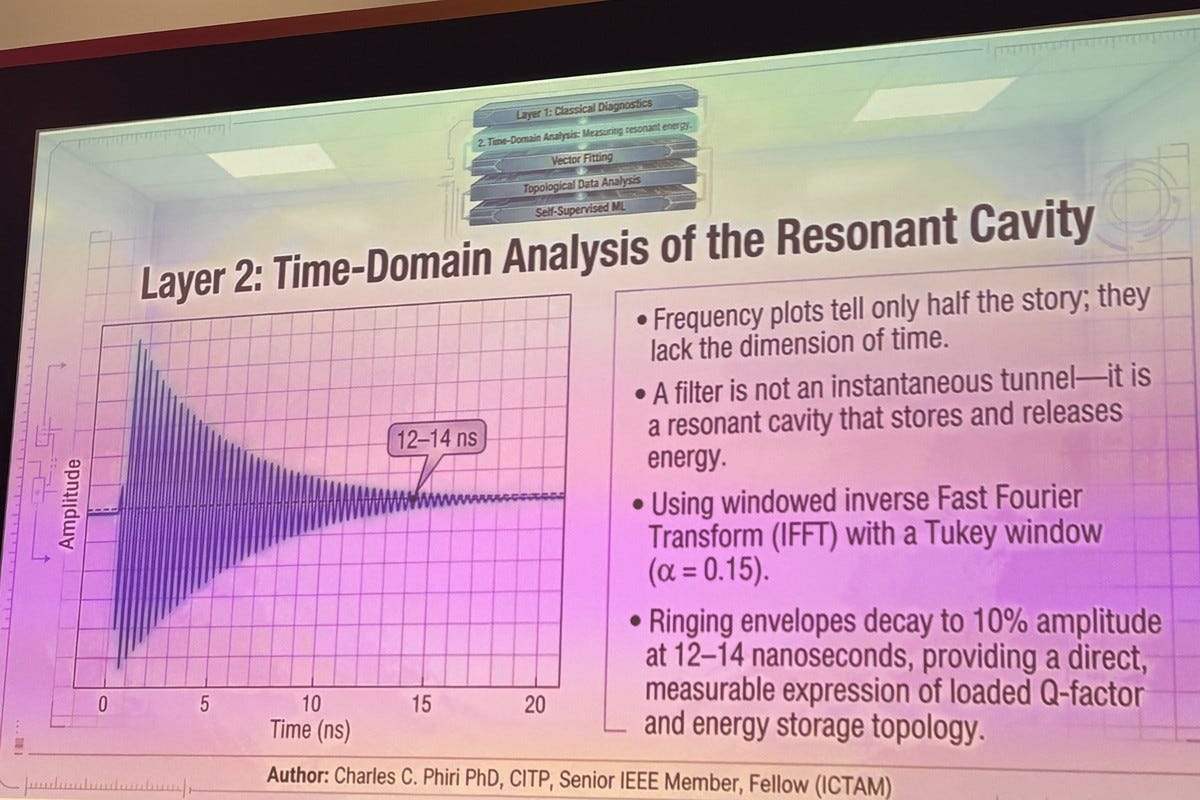
A filter is not an instantaneous tunnel but a resonant cavity that stores and releases energy. Using an inverse fast Fourier transform, he measured ringing envelopes that decayed to 10% of their amplitude within 12 to 14 nanoseconds, directly measuring each unit’s loaded quality factor.
A third layer, vector fitting, turned each filter’s response into a 20th-order mathematical model that can be simulated. He said the fixed model order was an arbitrary choice that did not satisfy him.
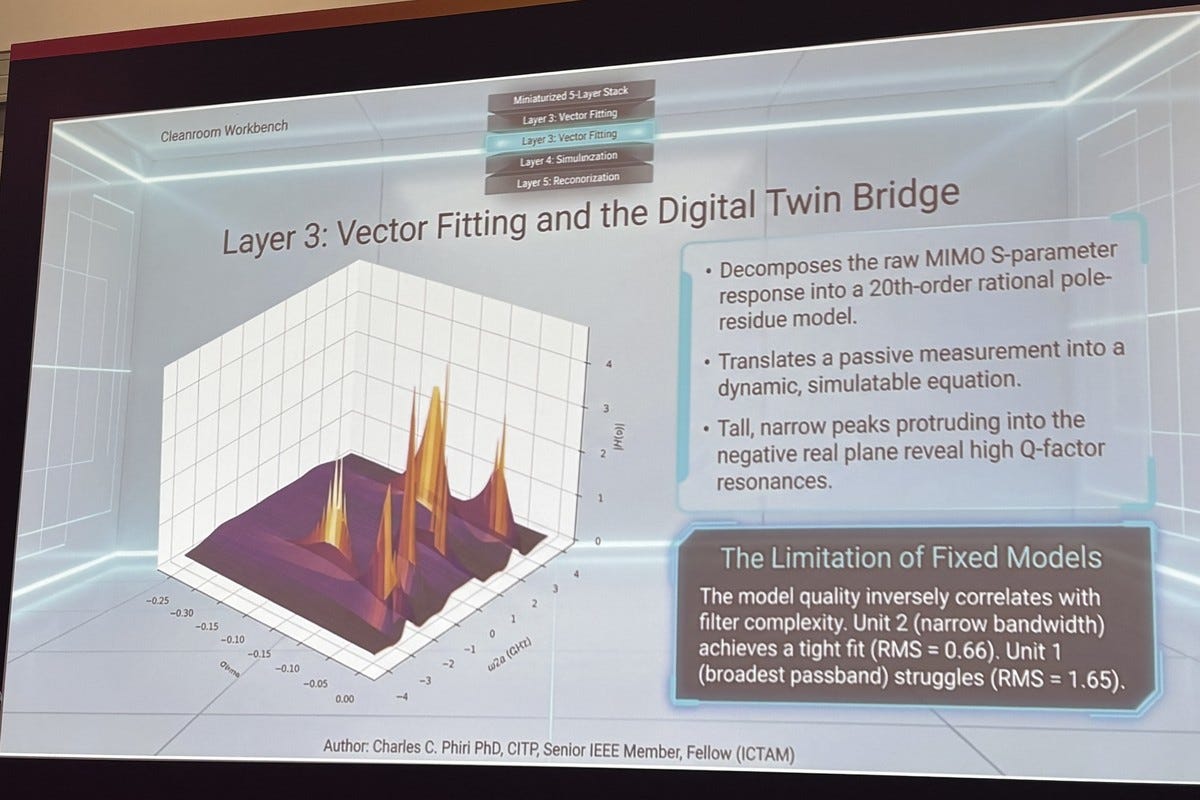
“Instead of me doing this manually, what I want to do is to use AI to get the topological structure from the data that I have,” he said.
He compared the approach to mapping a cathedral’s acoustics, where reverberations reveal the space's shape. A growing neural gas network, which learns the structure of data without human bias, flagged Unit 4 as anomalous, with six distinct cycles against two or three for the others.
He then turned to persistent homology, which tracks when topological features form and vanish.
“You can think of this as if you’ve got mountains and you’re filling those mountains with water. How long does it take for each mountain to disappear?” he said.
It gave Unit 4 a bottleneck distance of 0.322, while Units 1, 2 and 3 clustered at 0.13 or below.
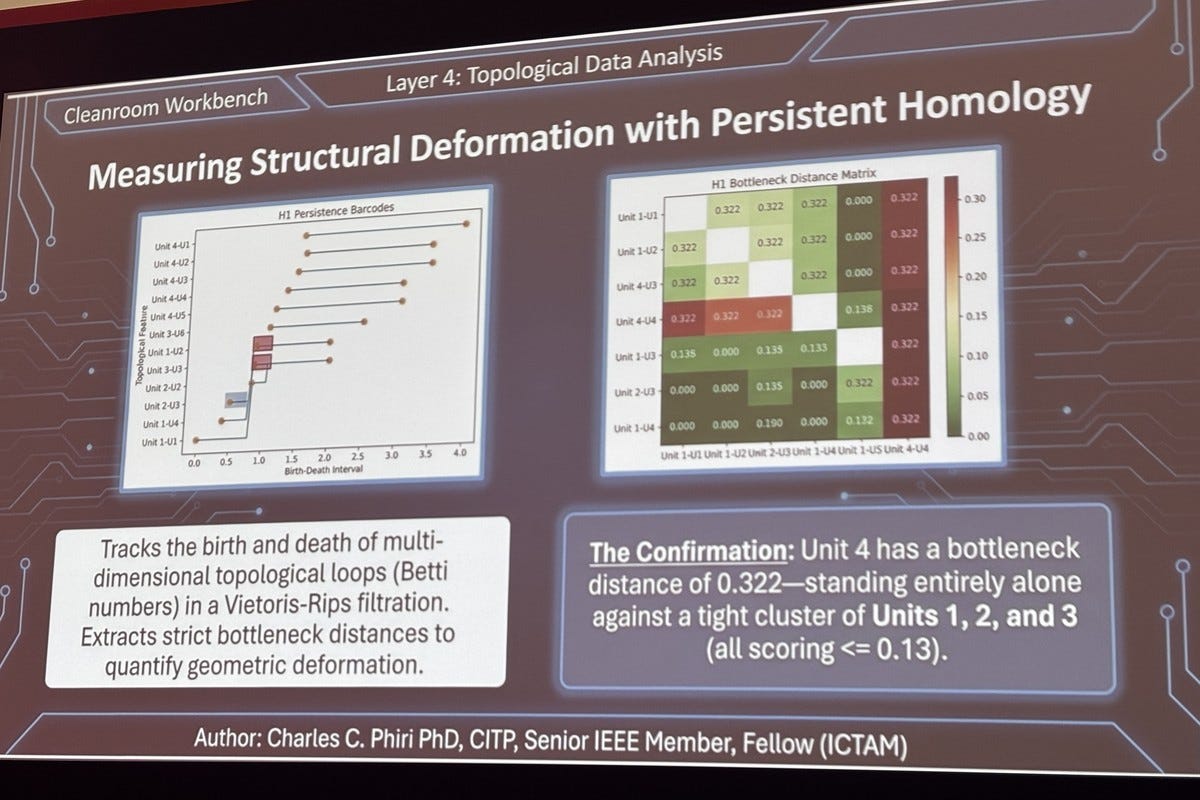
The gap matters in practice. In a simulated 600 MHz-bandwidth RF pulse, Units 1 to 3 lost 2.6 to 3.9 dB, but Unit 4 lost 6.53 dB because its offset center frequency clipped the pulse.
Four filters, however, are not enough to build a reliable model.
“I’ve only got four units. With four units, I cannot build a machine learning model that is useful for anybody,” Phiri said.
He used a mathematical technique called Dirichlet blending to create 2,000 synthetic filters from the structures extracted from the real units, adding small physical perturbations such as a 0.5 dB gain shift, a 5-picosecond phase delay and a 200-parts-per-million frequency stretch. The results separated the units by the structures inside them.
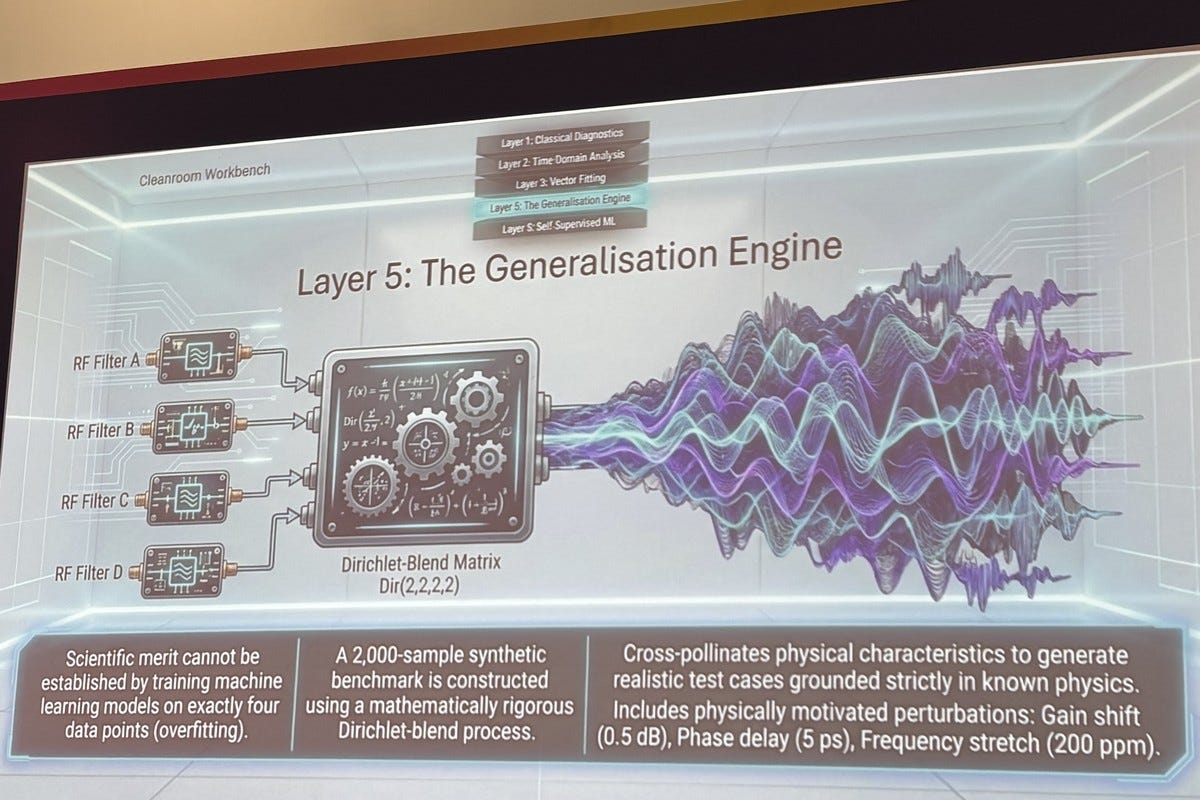
He said a conventional digital twin represents a system’s physical structure but not its physics. His physics-informed model maps the inside of each unit from its measurements.
“Instead of talking about RF systems as information theory constructs, we need to look at the morphological structures that represent your RF systems. Where is your signal going, and how is it going through the system?” he said.
Phiri said the method is generic and has been published on GitHub for engineers to review, extend and use in their own research.