


Artificial intelligence (AI) is rapidly moving from back-office experimentation to the center of supply chain decision-making. For companies managing thousands of variables across global networks, AI is becoming essential to maintain speed, accuracy and financial efficiency.
That shift is being driven by the limits of traditional planning and the growing complexity of global supply chains. As networks expand across regions and product lines, companies are struggling to maintain accuracy and speed using manual processes alone.
At the same time, rising disruption across global trade routes is exposing the limits of traditional supply chain models, forcing companies to rethink how they keep operations running.
“In our supply planning area, we deal with about 70,000 combinations of style, color and destination. The question is how a team of humans can act well and do it in a timely way, and the answer is it’s really hard,” said Todd Soller, chief supply chain officer at Patagonia, a US-based outdoor apparel company.
“We are running parallel processes of the manual process with an automated process. The difference in time is stark, and the benefit is huge,” he said.
“We see a 25-plus percent decrease in working capital possible just from changing our supply planning. That number is to be proven, but it is of that scale,” he said.
Supply planning at this scale involves balancing lead times, minimum orders and cost constraints across thousands of variables. Manual processes struggle to handle this level of complexity efficiently.
AI systems can process large datasets and generate optimized decisions far more quickly. Patagonia is running AI alongside its human planning process to compare outputs and validate results before implementation.
This parallel approach allows learning without introducing excessive risk. Over time, these capabilities are expected to be integrated into core workflows once reliability is proven.
Patagonia’s supply chain model is focused on controlled production and long-term partnerships. Its approach prioritizes resilience and accountability over scale-driven sourcing.
Hormuz disruption response
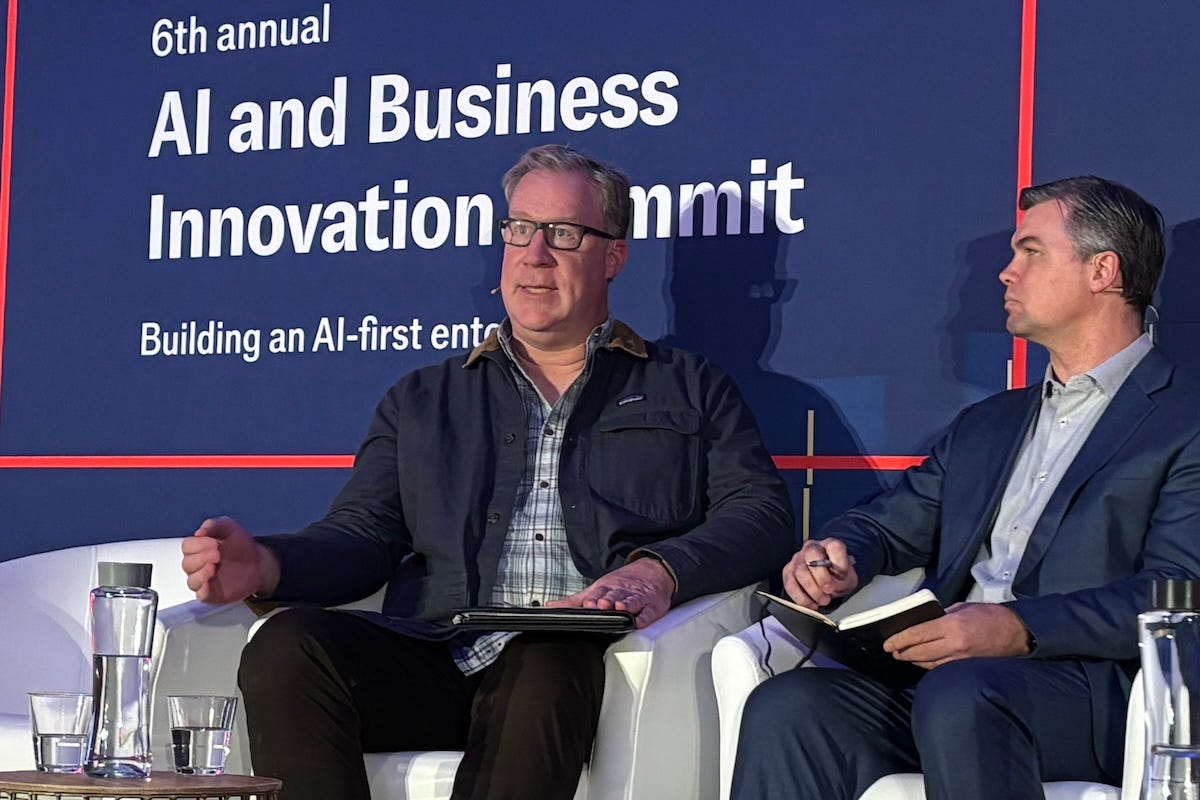
The discussion took place at the AI and Business Innovation Summit, organized by Economist Impact, in London. It was moderated by John Ferguson, global lead for new globalization at Economist Impact. The discussion focused on how companies are building supply chains that operate in real time.
Since February 28, the United States and Israel have launched airstrikes on Iran, triggering a regional conflict that has disrupted global trade. Iran retaliated with missile and drone attacks and shut down the Strait of Hormuz, a key maritime route, while the US imposed a counter-blockade on Iranian ports.
The disruption has sharply reduced traffic through a key global shipping channel. It is delaying the movement of raw materials and components and disrupting manufacturing supply chains worldwide.
“We had raw materials for a very technical product on the way from Central Europe and Japan, and that supply chain immediately became in jeopardy. Within hours of diversions, we were able to redirect supply away from Jordan into Vietnam,” Soller said. “We were able to use automation in our tracing programs to have a pretty real-time response. That was critical for this very new and very technical product.”
Ahead of the disruption, Patagonia had expanded production into Jordan with a trusted partner.
The company relied on pre-built redundancy and upstream visibility to stabilize operations. Backup capacity had been established in Vietnam, while shared tracking systems provided insight into raw material shipments from Japan and Central Europe. This allowed materials to be rerouted within hours, maintaining production flow despite the disruption. This level of responsiveness depended on long-term relationships across multiple tiers of suppliers.
However, the use of AI introduces new tensions between optimization and responsibility.
“Sometimes it could be an incredibly optimal solution, but it doesn’t respect the agreements we’ve made with our factories. We value those agreements more than the optimization AI could deliver,” he said. “We try to minimize the black box and test different models against human experience to understand whether the result is right.”
The company compares outputs from different models to identify inconsistencies and improve accuracy. When results diverge, teams examine assumptions and data inputs before making decisions.
Human oversight ensures decisions reflect broader priorities, including stable production flows and workforce considerations. This means accepting less efficient outcomes to preserve long-term relationships.
AI is therefore used as a decision-support tool rather than an autonomous system, balancing performance with responsibility.
AI-driven organizational redesign
The introduction of AI is reshaping roles across the supply chain organization. Tasks that were previously manual are increasingly automated, allowing employees to focus on higher-value work.
“This is not a skunkworks project. It’s an open project where team members provide input and understand the results,” Soller said.
“We found that when you are transparent and talk about the role of humans, people are actually energized. They see the benefit and can focus on higher-value work,” he said. “Everyone’s role is changing, not only within an organization but across teams. The roles, interactions and tools people use are changing really rapidly.”
The shift requires new skills and changes in how teams collaborate. Workflows are becoming more data-driven, affecting decision-making and organizational structure.
This transformation extends across teams, making alignment more complex as processes evolve.
The evolution of AI is also raising questions about enterprise architecture, particularly the future of enterprise resource planning (ERP) systems.
“There’s a question around how much is in the ERP system and how much is done outside. I think it will be a mix of the two. Some people say this will be an AI analytics cloud outside ERP, while others say they won’t need ERP at all. We’re still trying to figure that out,” Soller said.
The company is running parallel systems to compare traditional ERP outputs with AI-driven analytics. This approach supports testing but increases complexity and is not sustainable in the long term.
The right balance between systems is still being defined. Across the industry, there is no clear consensus on how AI will reshape enterprise platforms.
Beyond operational gains, the discussion also highlighted the broader role of AI in supply chains.
“We should be asking not just how AI makes our business better, but how it makes the world better in the places we touch. How can we use this to reduce environmental impact and create a better social infrastructure in the places we do business?” Soller said.
Patagonia’s approach reflects its broader mission, where inventory is a major contributor to environmental impact. Improving planning accuracy can reduce both waste and cost.
He said companies should consider the wider implications of AI deployment, including environmental and social outcomes.
As supply chains move toward real-time operations, companies will need to balance speed with responsibility, optimization with resilience and efficiency with long-term impact.