


Crewless boats run by artificial intelligence (AI) and deployable within months are set to join Europe’s frigates and destroyers in a “hybrid navy.”
The shift carries drone warfare’s software-driven, mass-produced model from the air to the sea.
“They are the perfect accompanying vessels for our frigates, cruisers and destroyers, because the trend goes into something that we call the hybrid navy,” said Uwe Horstmann, founder and chief executive of Stark Defence. “Those are systems that cost a thousandth of the price of a manned frigate, which takes years to produce.”
“We didn’t think we were backing a drone company. We thought we were backing a multi-domain neo-prime,” said Luciana Lixandru, a partner at Sequoia Capital, which has backed Stark since its founding.
Stark, a Berlin-based defense technology company founded in 2024, is known for its aerial drones and AI software platform. On November 3, it unveiled the Vanta 24, a 24-meter unmanned surface vessel that can carry other crewless boats. It joins the smaller Vanta 6 and Vanta 12.
The Vanta 24, due to launch in 2027, can carry up to 50 metric tons, including missiles and cannons, and travel at more than 64 kilometers per hour without a crew.
Horstmann said the number in each model’s name refers to the vessel’s length. Larger boats can operate and survive in rougher seas, beyond coastal waters in the North Sea and the Arctic. He said defense planners should not always define exactly what a system will do in five years and then work backward through engineering.
Standard containers on its back can carry different payloads, including smaller unmanned boats.
“We want to have flexibility because of the innovation speed and the innovation cycle. That modularity is at the very core,” he said. “We need to create mass right now as Europeans.”
Lixandru said Sequoia had a strong defense thesis in the US for a long time before developing one in Europe. She said the European opportunity may be even stronger because governments have underinvested in defense since the end of the Cold War, and that is now changing.
“We were looking for a team that has the gravitas to speak with governments and understands the procurement processes, because this is very different from building your typical AI software startup that sells to enterprises in the Valley,” she said.
She said Sequoia sees Stark as a platform rather than a single-product company.
Washing machine factories
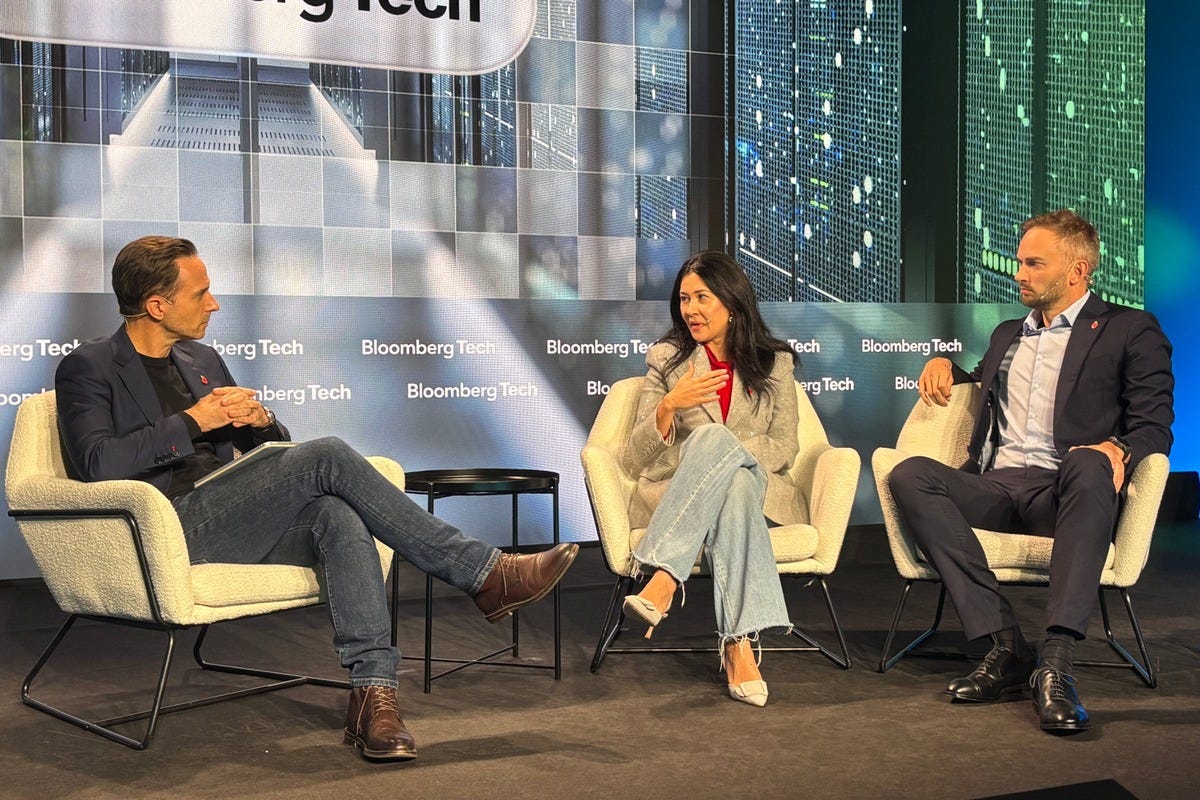
The panel, titled “Building Europe’s Defense Tech Arsenal,” took place at Bloomberg Tech London, organized by Bloomberg in London on November 3. Tom Mackenzie, an anchor at Bloomberg Television, moderated it.
Horstmann said a new defense company that wants to become a pillar of Europe’s deterrence must do four things:
stay close to the battlefield, launching new product variants almost daily;
be “venture first,” using venture capital to fund research and development (R&D) up front;
bring aerospace-quality engineering to certification and supply chain sovereignty; and
build for industrial scale.
“It is not so usual in defense, where people have been relying on R&D contracts, and where the government essentially pays for your R&D. We don’t think this is the right way,” he said.
Industrial scale matters just as much.
“When a Big Four consulting operations group came into our production facility, they said, ‘Oh, this looks like the production facility of a washing machine.’ For us, that’s exactly where you want to be,” he said.
He said people would believe a promise to build 5,000 washing machines this month and 15,000 the next.
“Not all primes that we have at the moment are doing excellently in all four dimensions. We don’t see enough response when it comes to those new modern AI-driven systems,” he said.
Still, he said Stark works well with large primes and acts as the prime contractor for smaller companies it brings along. Germany and other countries have unlocked big increases in defense spending, while procurement behavior and doctrine have also improved.
“I don’t think we’re going to need to elbow anybody out. We need to partner better,” he said.
Europe’s reliance on US technology has come under scrutiny after reports that Starlink access was restricted over Ukraine, while the German military’s use of Palantir software has faced pushback at home.
Horstmann said sovereignty means different things in different European countries. A country can buy technology from others as long as it can use and develop it freely. Stark’s products do not depend on any foreign export control, so no other country needs to approve their export to Germany or the UK.
“If I have sovereign access, it means nobody can restrict my access to technology. It does not mean that I personally need to invent everything,” he said.
He said Stark Defence can offer customers local production, local jobs and local suppliers.
“You can’t give every country its own frigate production. That just doesn’t make any sense, but I for sure can give any country its own Vanta 24 production,” he said.
Asked whether Stark’s backing from US investors undermines its sovereignty, Horstmann said strict legal controls already ensure foreign capital doesn't give outsiders control over a German defense company. He added that US funding may be European money routed through another investor.
Two or three giants
Procurement is also speeding up. Germany’s parliamentary budget committee approved initial loitering munition orders worth about €270 million each for Stark Defence and Helsing in February, capping each company’s framework at €1 billion. Rheinmetall later won its own €300 million order.
Horstmann declined to discuss Stark’s contract terms but praised Germany for buying from several suppliers and testing them in parallel.
“If you think about old-school procurement, a multi-year process where you have every phase after each other, that doesn’t make sense for products as we produce,” he said. “The idea of that contract was to do procurement, operational experimentation, certification and rollout all in a period of six months.”
He ran a venture capital firm before founding STARK and spent much of that time persuading investors that tightly regulated defense should not sit alongside the sectors their own backers had ruled out.
US university endowments and religious charitable foundations embraced the sector quickly, but change came slowly in Europe, he said.
“When it comes to the defense of Europe and building a company, two years is a very long time,” he said.
He said Stark can probably put €600 million to €700 million to work over two to three years, about what a typical prime spends on R&D in a single year. Stark has raised about €640 million since its founding, including a €500 million round co-led by Sequoia in June.
Lixandru said many European funds once barred defense deals in agreements with their own investors, but many have changed those terms in the past 18 months. She said AI and defense are now the two areas venture investors back most.
“I don’t think that there will be 20 defense companies that are going to be worth tens of billions of dollars. There will be a handful of companies that are being built now and that have a chance to become very large,” she said.
A couple of years ago, candidates approached by Sequoia’s talent team often avoided defense for ethical reasons.
“When we reach out to people, they say this is an industry I want to be part of for ethical reasons. Talent has become so mission-driven,” she said.
She said defense is one area where Europe can build very large companies, including a $100 billion-plus business.
Lixandru expects consolidation as larger platforms, with access to capital and Europe’s smartest people, absorb smaller single-product companies. That would leave two or three European defense groups holding contracts across the continent and worth tens of billions of euros.