



Artificial intelligence (AI) chips are creating demand for materials so pure that a trace of natural radioactivity in their packaging can cause them to fail.
High-purity alumina (HPA), aluminum oxide refined to at least 99.99% purity, is one such material. Chipmakers use it as a low-radiation filler in the packaging of the most advanced processors and as an abrasive to polish their growing stacks of circuit layers.
“AI chips are a great example of how a new demand market creates new material requirements with particularly demanding purities,” said Jessica Roberts, research director at Project Blue. “Radioactive alpha emissions can cause soft errors in devices. Basically, that means your device is going to fail, and so the purity of the filler within semiconductor packaging is incredibly important.”
Project Blue is a London-based market intelligence firm that covers critical materials and energy transition supply chains.
The most advanced chips now have nodes of 2 to 3 nanometers (nm). Their packaging materials, including HPA used as a filler, must meet a “super ultra-low” alpha emission limit of 0.001 counts per hour per square centimeter, a threshold that has tightened steadily since the 1970s.
Leading chips can also have up to 100 circuit layers. Each must be polished flat through chemical mechanical planarization (CMP), with HPA serving as the abrasive in the polishing slurry.
Roberts cited a Fujifilm comparison that likens the job to flattening Tokyo’s 50-meter terrain to within 1 millimeter.
"HPA demand is growing at three and a half times the pace of silicon wafer shipments over the next five years, and this is an AI chip story," she said.
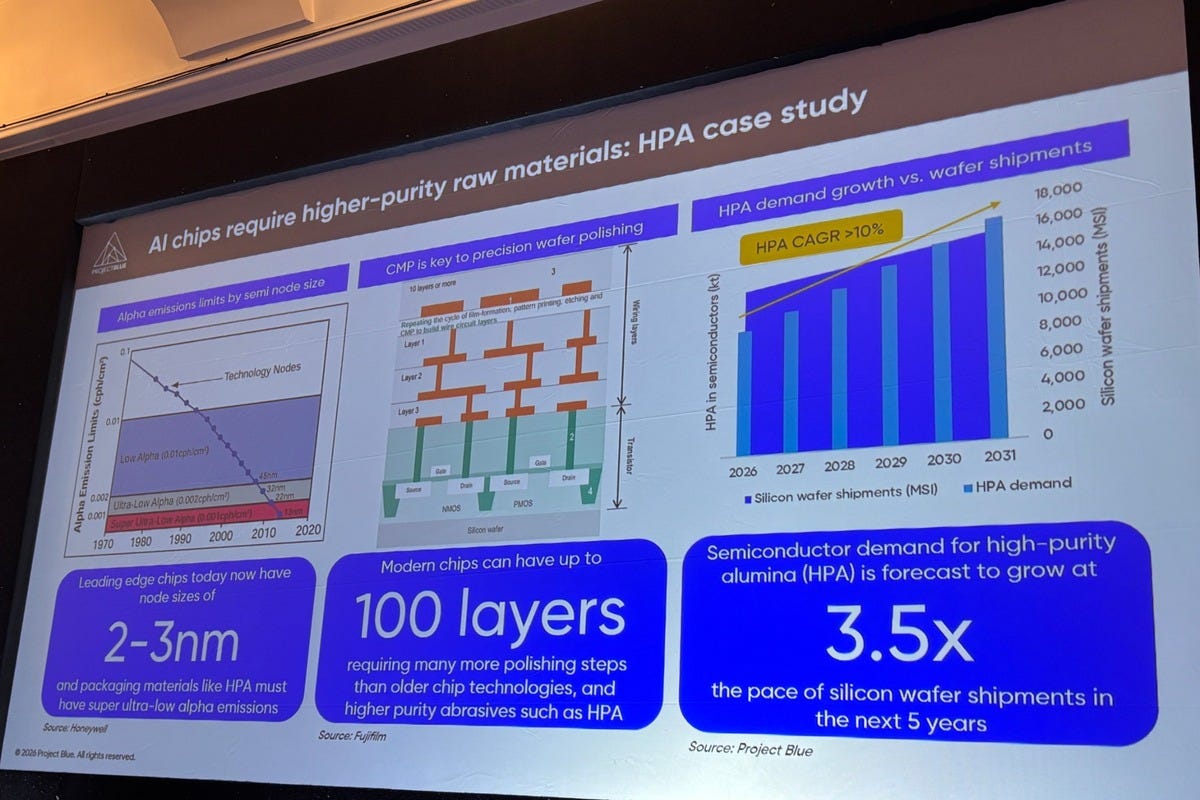
Project Blue forecasts semiconductor HPA demand to grow by more than 10% a year through 2031.
“We are at a point in time where there is interest in critical materials that I’ve never seen before in my career,” said Roberts, who has spent nearly two decades in commodities research.
China’s grip on gallium
Roberts spoke at the Critical Materials Forum: London 2026, held by Project Blue and the Minor Metals Trade Association (MMTA) during LME Week in London on October 20. Jack Bedder, founder and director of Project Blue, hosted the session, which examined how AI, defense, and semiconductors are driving commodity markets.
Chip sales passed $1 trillion for the year in August for the first time, according to industry data cited by Project Blue. August sales rose 181% year on year in the Americas, 131% in China and 99% in Europe.
Roberts said the growth is concentrated in 8- to 12-inch wafers for AI chips and advanced logic.
China is expected to supply 96% of the world’s primary gallium in 2027 and 64% of its germanium, according to Project Blue. Its forecasts show both metals short of supply by the end of the decade, with gallium sliding into deficit from 2029.
On November 24, Beijing extended its US gallium and germanium export ban until January 27.
“Can the West meet the materials requirements that it has? That’s a big question,” Roberts said. “Looking at these supply chains without the involvement of China will be a challenge.”
She said AI is now competing with aerospace for metals. At a US titanium conference a few weeks earlier, many delegates were discussing the AI sector’s growing demand for traditional aerospace materials.
The link is power. Grid connections can take years, so data center developers are installing their own gas turbines.
“When you’re potentially waiting up to six years for a grid interconnection, it can have a huge impact on whether a project fails or goes ahead,” she said. “Aeroderivative gas turbines are very similar to legacy aero engines in terms of supply chains, material requirements and the purity required.”
In October, Microsoft pulled out of a planned AI data center developed by Nscale in Loughton, Essex, after the grid operator said full power would not reach the site until the 2030s.
GE Vernova’s gas turbine backlog now stretches to 2031, with data center customers accounting for 20% of the gigawatts under contract. US alloy maker ATI is raising nickel melting capacity by 15% to 20% by early 2028, as lead times for nickel alloys have reached 12 months.
Defense is pulling on the same metals. World military spending rose for an 11th straight year to $2.89 trillion in 2025, according to data from the Stockholm International Peace Research Institute.
Military aircraft use more titanium than civil ones, but only a few suppliers make aerospace-grade titanium sponge, mainly in Japan, Kazakhstan, Saudi Arabia and increasingly China. Russian material has dropped out of Western supply chains since the war in Ukraine began.
“It takes time to bring these investments to market. It takes time to qualify them,” Roberts said. “There will be some choices to be made about who gets supplied and who pays what.”
Magnets over raw metals
Jan Giese, founder of German critical raw materials trading and advisory firm Critera, spoke earlier in the session.
He said China’s share of rare earth mining has fallen from 97% in 2010 to 69%, but it still handles 84% of magnet rare earth refining, so the dependence has moved downstream.
China’s magnet exports this year are running 8% above 2024 levels, while exports of dysprosium and terbium are down 54% and 78%, according to Critera’s analysis of Chinese customs data. Beijing put export controls on heavy rare earths in April 2025.
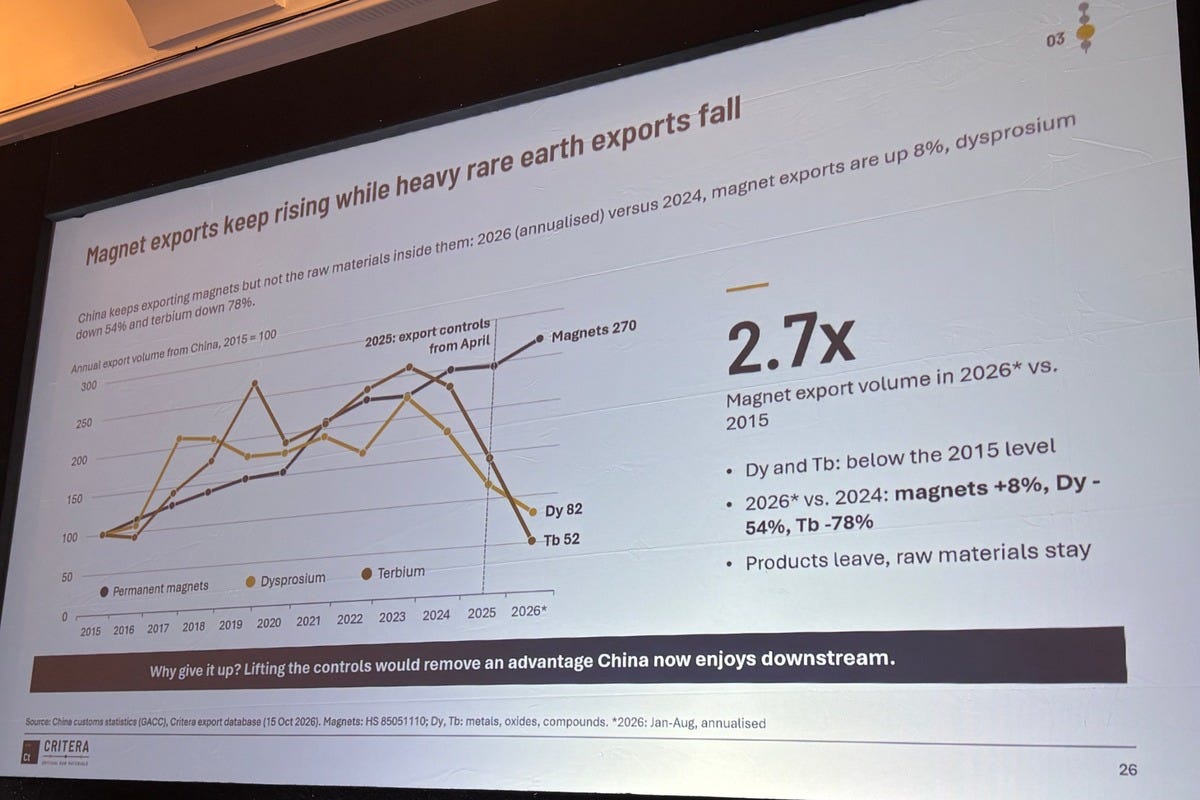
“They are exporting. They’re just not exporting the raw materials anymore. And why should they give that up?” Giese said. “The Chinese industry can use those raw materials at very cheap prices, while the rest of the world has to compete over what’s left in the market and pay extremely high prices for it.”
Dysprosium outside China traded about 1,700% above China’s export price in mid-October, according to Critera.
The pattern echoes 2010, when China cut export quotas by about 72% and halted shipments to Japan. Dysprosium oxide prices rose about 2,500% between 2009 and 2011, then fell about 90% as quotas leaked. Many companies had banked on those high prices, and US producer Molycorp went bankrupt in 2015.
Giese said China itself has changed. Its share of global manufacturing rose from 18% in 2010 to 28% in 2024, while its car exports grew about 50-fold to $110 billion after Beijing named electric vehicles a strategic industry in 2010.
He said Beijing is also far better prepared. It cut mining licenses from 113 to 67 in 2012, left only two state-owned groups holding mining and smelting quotas by February 2024 and brought in rules on state ownership, volume control and tracing in October 2024.
“You don’t do that just to react to a new president imposing tariffs. You do that through strategic foresight, with a target behind it,” Giese said.
He sees a low probability of a full return to the 2010 market, though partial and selective easing is possible.
Japan financed Australian producer Lynas with about $250 million in loans and equity in 2011. By contrast, the US Department of Defense took a $400 million equity stake in MP Materials last year and set a 10-year price floor.
“Maybe at least the US has learned its lessons, while Europe is still halfway asleep,” he said.
Roberts said financing remains a key hurdle, and the US currently shows the greatest appetite to fund these supply chains.
In August, the US moved to restrict tungsten scrap exports so the material stays with US buyers. From January 1, new Defense Federal Acquisition Regulation Supplement (DFARS) rules will bar contractors from sourcing covered magnets, tantalum and tungsten from China, Russia, Iran or North Korea.
Giese expects the world to remain dependent on China for many of these elements for at least two or three more years and urged buyers to plan for supply security.