


The artificial intelligence (AI) boom is driving new demand for minor metals such as hafnium, which are already scarce and have no easy substitutes.
Hafnium, rhenium and tantalum rarely make headlines, but new gas turbines and AI chips cannot be made without minor metals.
“They are truly critical metals. If you haven’t got hafnium going into that gas turbine, it’s not an option,” said Chris Brzozowski, commercial director of ICD Europe and chairman of the Minor Metals Trade Association (MMTA). “When you add in this new wave of demand, it’s incredibly difficult for companies to keep up with all of it, and there will be supply chain failures along the way.”
Brzozowski said aerospace and existing gas turbine demand had already constrained supply before the AI boom. He said minor metals do their work in some of the harshest environments on the planet and beyond it, in space.
Research and development teams usually hunt for a substitute when one element is squeezed.
“It’s pretty difficult to replace some of these obscure minor metals, and the likelihood is that if you do find a substitute element, it’s probably going through its own supply chain squeeze as well,” he said.
Evanna Hu, co-founder and senior advisor of the Critical Minerals Forum, said everyone in government knows what is coming.
She said governments are only gradually growing comfortable acting as buyer, lender or guarantor for projects, so the private sector needs to be patient. Several officials told her they had not seen these element names since high school chemistry.
“They’re not geologists, miners or engineers, and so they’re learning all these things,” she said. “If you look at stock exchanges and how overweight they are in AI companies, there’s a really big fear that without these minor metals, these semiconductor chips and all these other things are not going to be made, and then half of your economy is just tanking. That’s not just some theoretical thing.”
Brzozowski said copper, which is outside his specialty, seems a little overhyped, while minor metals as a whole remain underhyped.
“There are so many unique critical metals within that fundamental category that really power everything that we do today,” he said.
Security before price
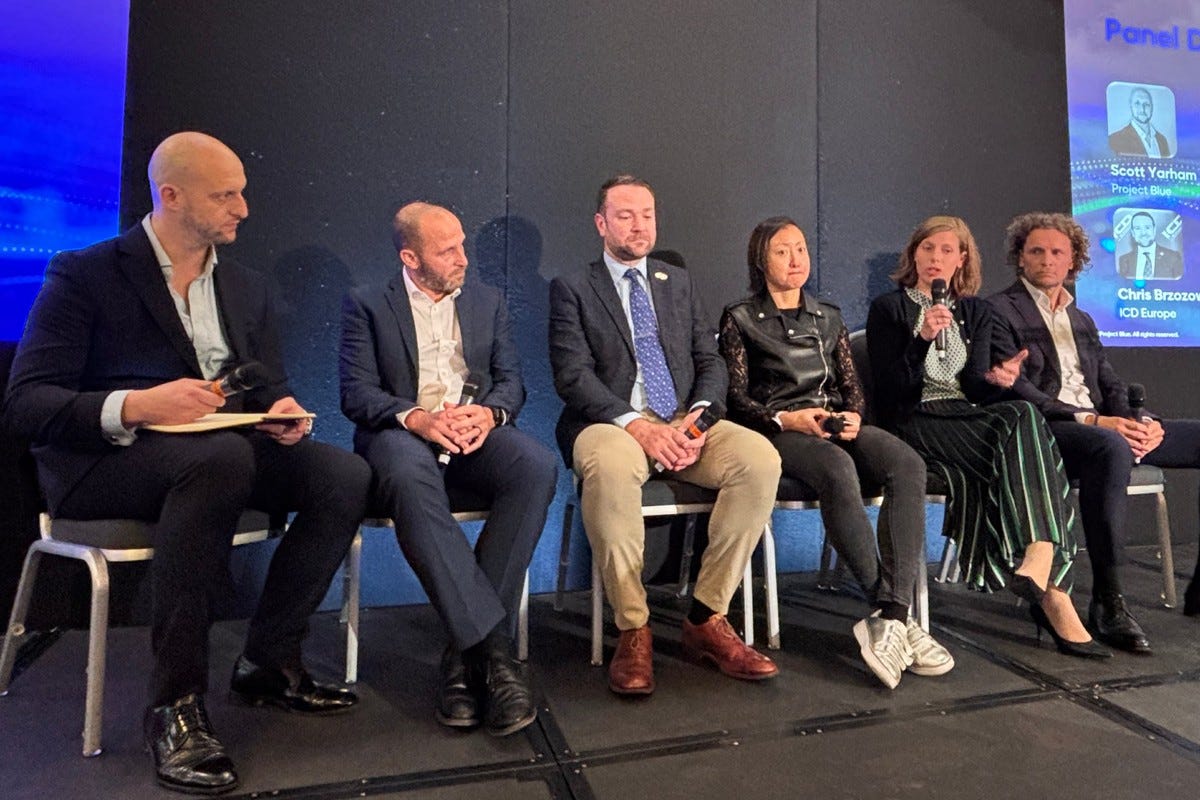
The comments were made at the Critical Materials Forum: London 2026 on October 20. Organized by Project Blue and the MMTA during London Metal Exchange (LME) Week, the panel discussion was titled “What does the Shifting Critical Material World Order mean for markets?” and moderated by Scott Yarham, head of strategy at Project Blue.
Brzozowski said that as recently as two or three years ago, buyers assumed a trader would always have material. They now cover their needs much further forward, tying up finance and taking metal out of the market that competitors could otherwise buy.
“Now it is all about security of supply. Prices will always be relevant, but buyers are coming round to the standpoint that, when they pick up the phone, they might have to make three or four phone calls until they find a party that can fulfill their entire requirement,” he said.
Sascha Ewert, head of aluminum and minor metals at tk accelis Trading, said some European customers must now buy elements they never needed before. When a customer depends on a brand from a closing smelter, his firm can buy the whole lot, finance it and deliver it monthly for six months.
“Price is always important. But before production needs to be closed, they will buy at a higher price too,” Ewert said. "I also see a job for traders to provide solutions, not only financing and logistics but also creativity. It's all about the network."
Brzozowski said customers want supply security without carrying inventory on their own books, so traders are tying up much more cash to hold it. Back-to-back trading, where a trader buys only against a matching sale, is declining.
“There’s more opportunity for the guys who have got the deepest pockets,” he said. “If you’re waiting for material to have a license approved from China, or wherever it may be, until you physically have possession of that material, you don’t have the confidence to enter into a sales contract with the consumer.”
Andreas Munz, portfolio manager for base and battery metals at Fulcrum Asset Management, said security of supply, sustainability, and carbon footprints drive some conversations, but a cheaper offer from elsewhere can still end up in the contract.
“The commercial aspects still often trump the sustainability aspects, unfortunately,” he said.
The squeeze is also reaching semiconductor and aerospace and defense parts makers, which need certified materials. Brzozowski said these end users have each developed their own specifications over decades, each with slight quirks.
“You will never get a one-size-fits-all raw material that will suit all of the customers that you’re supplying to,” he said. “Consumers have had to wake up to the real world and acknowledge that certain concessions and sacrifices need to be made to ensure they do get the supply they’re so desperate for.”
Traders now question those specifications and offer alternative grades on concession, while also pressuring upstream producers to widen what they can supply.
The missing middle
Munz said Western policy on battery materials focuses on mines and gigafactories but skips the processing in between. Nickel mined in the US may be in the wrong form, and the country lacks plants to turn it into pCAM (precursor cathode active material) and CAM (cathode active material) before it goes into a cell.
"The discussion starts at mining and misses out a lot in the middle, and then it stops at the gigafactories," he said. "That's also where the policy discussion stops, and it's very challenging to be price-competitive with those integrated assets in Indonesia or in China."
He said a project is bankable only if it can stand on its own without subsidies. China’s BYD and CATL built their integration step by step, while US plants face higher labor and regulatory costs.
Iris Speelmanns, market specialist at Anglo American, said many governments are seeking secure refined supply, but the mine remains the ultimate bottleneck. She said a mine took seven to eight years from discovery to production in the 1990s, against 18 to 20 years now.
“You cannot take a copper deposit in Chile, a nickel deposit in Indonesia or a copper deposit in the DRC (Democratic Republic of the Congo) and just relocate it,” she said. “The world hasn’t run out of copper and it also won’t run out of copper. A lot of it is a visibility gap.”
She said miners already hold undeveloped projects, and the decision is where to commit capital.
Hu said the US has the longest mine permitting time in the Organization for Economic Co-operation and Development (OECD), at about 20 years, while a two-year political cycle pushes officials toward short-term wins. She said the US government has committed $36 billion to critical minerals, and she hears the industry needs much more capital.
Asked whether the West will be more or less dependent on China in five years, Munz said more on the electric vehicle (EV) side, as Chinese EVs give buyers in Europe a good alternative at a good price.
Ewert agreed, saying that despite deposits in Germany and some tin mining in the UK, Europe and the US cannot produce those metals at home in that time. Brzozowski expects little change for minor metals in five years, though he hopes for real progress in 10 to 15 years.
“All the marginal gains that we make to diversify the supply chain at the moment seem to be outweighed by increasing demand,” he said.
Speelmanns said five years is probably not enough, but it may be when the loop starts to close, as the first fleets of EVs reach recycling and Europe can treat their copper as a local resource for its strategic supply chain.