


AI agents may eventually need a new payment layer, but the technology is still caught between ambition and usability.
The rise of autonomous software has revived interest in blockchain-based payments, as companies explore whether agents can make purchases, settle transactions and move money without relying on conventional card networks. Yet the early experience remains far from seamless.
“Agentic payments for stablecoins…there is usually hype, to be honest. I am very bullish on this because I feel this is much needed, but it is early,” said Michael Shaulov, chief executive officer of Fireblocks. “If you try to book an Uber with an agent or a ticket, it will be a very annoying experience compared with doing it yourself through the app. I think that needs to change.”
Fireblocks is a digital-asset infrastructure company that provides custody, settlement and tokenization technology to banks, fintech firms and crypto businesses.
Shaulov said the company had been investing in agentic finance and was preparing to launch agentic payments and commerce capabilities.
For him, the problem is not only whether an AI agent can complete a task. It is whether the payment instrument is suitable for software that may need to act automatically, settle quickly and work across digital platforms.
“For agents, it is pretty clear that the means of payment would not be a credit card. It will be something like a deposit or stablecoin, but it will be something that runs on a blockchain,” he said.
That view links agentic commerce with a broader debate over digital money. A payment card was designed for human-led commerce, while tokenized deposits and stablecoins can be programmed, moved and settled across blockchain-based systems.
But he added that agentic payments also face an infrastructure gap. Retail users already have access to trading apps and digital wallets such as Robinhood, Revolut and MetaMask, while younger investors are comfortable holding tokenized assets through those channels.
The institutional side is less mature. He said only a limited group of traditional custodians can hold and operate tokenized assets for professional investors, making infrastructure a bottleneck for more complex products.
“If we are talking about institutional investors, there is currently a very limited set of traditional custodians that can hold those assets and operate on those assets. It is a limiting factor,” he said.
That gap matters because the next stage of agentic finance may depend on whether regulated institutions can safely hold tokenized instruments, not simply whether AI agents can press a digital checkout button.
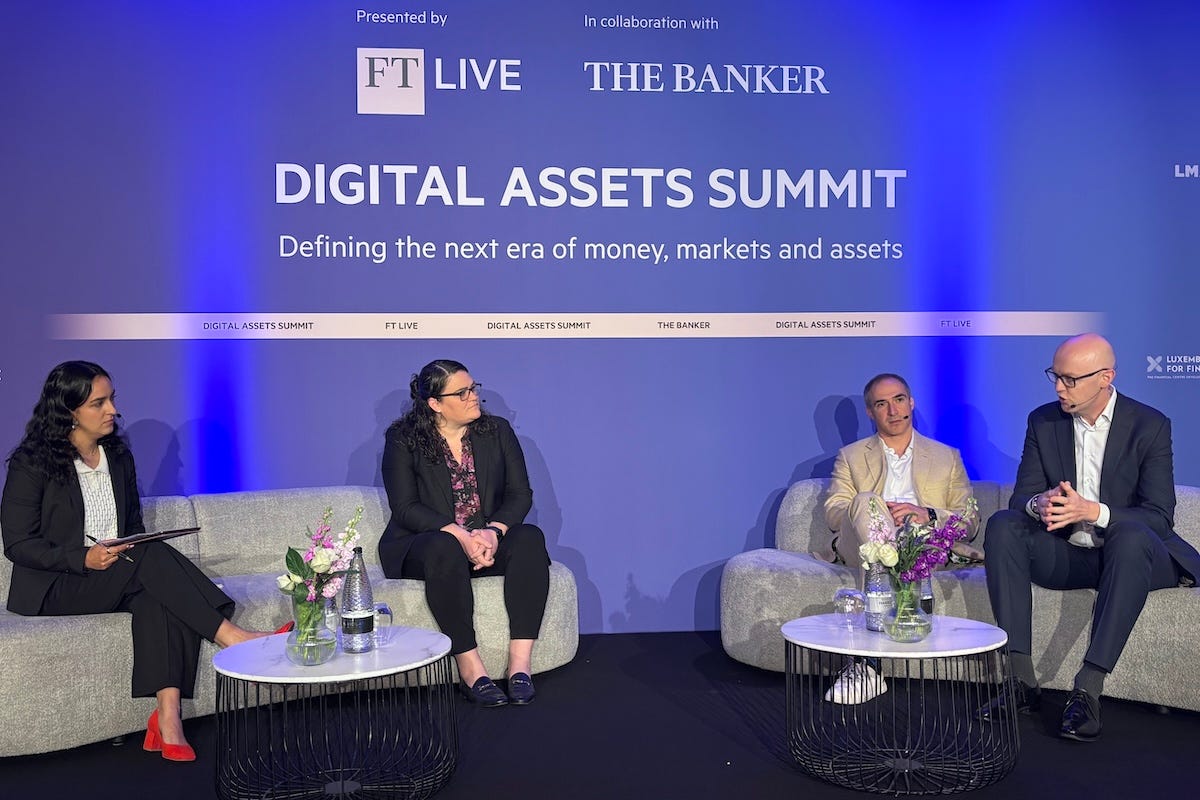
The comments were made during a panel discussion titled “Institutional digital assets: What’s real, what’s ready, what’s next?” at the Financial Times Digital Assets Summit in London on May 13. The session was moderated by Nikou Asgari, digital markets correspondent at the Financial Times.
Other speakers included John O’Neill, group head of digital assets at HSBC, and Kathleen Wrynn, global head of digital assets at Invesco.
Hong Kong app test
The Hong Kong Monetary Authority awarded its first stablecoin issuer licenses in April 2026 to HSBC and Anchorpoint Financial, a venture backed by Standard Chartered. Anchorpoint is jointly owned by Standard Chartered Bank (Hong Kong), Hong Kong Telecommunications and Animoca Brands.
O’Neill told TechJournal.uk in the question-and-answer session that HSBC’s planned Hong Kong dollar stablecoin was expected to launch in the second half of 2026. He was asked what a user could do with the stablecoin inside a payment app.
“We’ll look at the second half of this year. As I said already, it is a Hong Kong dollar stablecoin, and it is going to be embedded in our apps in Hong Kong,” O’Neill said.
The answer suggested that the stablecoin will not be positioned only as a wholesale settlement tool. HSBC plans to integrate it into its existing apps, which are widely used in Hong Kong.
“You’ll be able to use it within the existing apps for payments, and you’ll be able to invest in tokenized retail assets within the apps,” O’Neill said.
Some of HSBC’s Hong Kong apps are payment-only at present. The bank could leverage that screen presence to distribute tokenized assets, allowing users to pay for them with stablecoins.
That gives the Hong Kong dollar stablecoin a broader role than just simple person-to-person payments. It could become a bridge between bank apps, tokenized investment products and regulated digital money.
The point also supported a broader industry shift. Stablecoins are no longer just pilot projects or sandbox experiments.
“Stablecoins are definitely far outside of any pilot. Last year, stablecoin transactions exceeded the combined volume of Visa and Mastercard globally,” Shaulov said.
He said Fireblocks processed about US$6 trillion in settlement volume over the previous 12 months, with stablecoins accounting for about 65% of transactions, up from roughly 40%.
Stablecoin adoption, he said, began with people in developing countries using wallets to protect against inflation. It then moved into import-export settlement, remittances and more recently capital-market infrastructure.
“Different people have different opinions about Bitcoin and crypto. But when we look at stablecoins and digital-asset-based payment tokens in general, this is not a speculative type of activity,” he said.
He stressed that stablecoins make transactions faster, cheaper, more transparent and more accessible. The clearest institutional driver is no longer the price of Bitcoin but the arrival of clearer regulation and real payment use cases.
Collateral meets risk
Banks are also building another form of digital money: tokenized deposits. O’Neill described them as the digital version of commercial bank money, rather than a direct replacement for stablecoins.
“What we are doing is tokenizing the commercial bank money we create all the time, every day, right now. It is very accessible. It is very liquid. It is multi-currency,” O’Neill said.
In the existing financial system, central bank money provides the foundation while commercial banks create liquid money used by households, companies and financial institutions.
O’Neill said tokenized deposits fit within existing Know Your Client (KYC) and anti-money laundering (AML) systems, making them easier for regulated financial institutions to adopt. HSBC had spoken with many central banks and had not found objections to tokenized deposits as a market development.
The bank is linking tokenized deposits to its Orion platform, which is used for digital bonds and other tokenized assets. The aim is to allow digital money to settle digital assets more efficiently.
“Interoperability is the cliché for digital assets. What practically matters is access and liquidity,” O’Neill said. “It is important that different forms are interchangeable and can pay each other.”
He said bonds, gold and funds can all become more useful if their ownership can be transferred rapidly and precisely.
“Collateral is a really important theme,” he said. “Bonds and gold are widely used collateral assets. Funds have the potential to be widely used collateral assets.”
Shaulov said trading firms had begun changing how they post collateral, shifting from stablecoins to tokenized money market funds. Some of those funds now sit in exchange collateral wallets.
Wrynn said tokenization should be seen as an evolution, not an overnight replacement of existing financial systems. Tokenized repos are a promising use case, but blockchain-based systems still need to integrate with existing lending and market infrastructure.
Shaulov said security remains the largest constraint on adoption as major incidents can damage institutional confidence more than ordinary crypto-price volatility.
“The drop in the price of Bitcoin or Solana is something the market has gotten used to. But US$1.2 billion or US$1.3 billion evaporating from an exchange is something people are very scared of,” he said.
He cited decentralized finance (DeFi) attacks, AI-enabled cyber threats and North Korea-linked groups such as Lazarus as risks for the sector.
Wrynn said DeFi attacks also affect institutions' ability to engage with decentralized protocols.
The next phase of institutional adoption will therefore depend less on announcements and more on execution. Regulated money, tokenized assets, custody, liquidity and security all need to work together before digital assets can move deeper into mainstream finance.